
How Did the First Stars and Galaxies Form?


The feel-good place to buy books
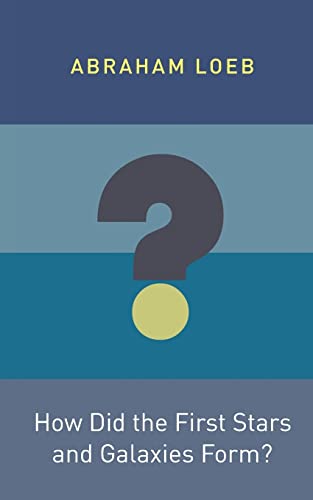
How Did the First Stars and Galaxies Form? by Abraham Loeb
Covers the basic concepts in cosmology, drawing on insights from an astronomer who has pioneered much of this research over the years. This book covers such topics as the gravitational growth of perturbations in an expanding universe, the abundance and properties of dark matter halos and galaxies, and reionization.
Winner of the 2012 Chambliss Astronomical Writing Award, American Astronomical Society "[E]ngaging, fast-paced.. Loeb's infectious excitement stirs desire to join him in these endeavors... [R]eaders will find How Did the First Stars and Galaxies Form? a lucid introduction to an exciting research field that is set to flourish in the next decades."--Science "Hands up everyone who can answer the question Loeb poses in the title of his small but sprightly book. No, not just the basics: big bang, cosmic inflation, lights, camera, action. Me neither. Harvard University astrophysicist and cosmologist Abraham Loeb can, and he does in this latest installment of the Princeton Frontiers in Physics series. While the book targets potential cosmologists and scientists, general readers will enjoy the non-technical chapters."--Australian "Anyone interested in an introduction to this dramatic story, be they academic or educated nonprofessional, would do well to start with Loeb's book. It contains only the most important equations in the field, and its general level of mathematical sophistication is compatible with introductory courses in calculus or mathematical physics. This small book is a gem belonging to an almost extinct genre: intermediate-level monographs that are both accessible to educated non-specialists in the field and tightly focused on a problem."--Milan M. Cirkovic, American Journal of Physics "Loeb, a leading theoretical cosmologist, has written a lucid account of the relevant physics, beginning with a brief review of cosmological models based on Einstein's general relativity equations."--Choice
Abraham Loeb is professor of astronomy and director of the Institute for Theory and Computation at Harvard University.
| SKU | Unavailable |
| ISBN 13 | 9780691145167 |
| ISBN 10 | 0691145164 |
| Title | How Did the First Stars and Galaxies Form? |
| Author | Abraham Loeb |
| Series | Princeton Frontiers In Physics |
| Condition | Unavailable |
| Binding Type | Paperback |
| Publisher | Princeton University Press |
| Year published | 2010-08-08 |
| Number of pages | 216 |
| Cover note | Book picture is for illustrative purposes only, actual binding, cover or edition may vary. |
| Note | Unavailable |