


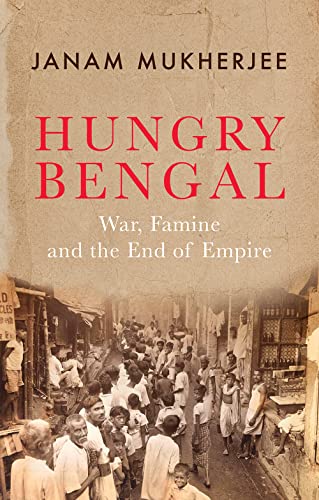
Hungry Bengal by Janam Mukherjee
The years leading up to the independence and accompanying partition of India mark a tumultuous period in the history of Bengal. Representing both a major front in the Indian struggle against colonial rule, as well as a crucial Allied outpost in the British/American war against Japan, Bengal stood at the crossroads of complex and contentious structural forces - both domestic and international - which, taken together, defined an era of political uncertainty, social turmoil and collective violence. While for the British the overarching priority was to save the empire from imminent collapse at any cost, for the majority of the Indian population the 1940s were years of acute scarcity, violent dislocation and enduring calamity. In particular there are three major crises that shaped the social, economic and political context of pre-partition Bengal: the Second World War, the Bengal famine of 1943, and the Calcutta riots of 1946. Hungry Bengal examines these intricately interconnected events, foregrounding the political economy of war and famine in order to analyse the complex nexus of hunger, war and civil violence in colonial Bengal at the twilight of British rule.
Janam Mukherjee has written an engrossing account of the most tragic event in the history of Bengal, the Great Famine of 1943. . What singles out Mukherjee's book is his thesis that the famine was at the root of the Hindu-Muslim violence that consumed Calcutta during the Great Killings of 1946, thereby contributing to the even more cataclysmic partition of the subcontinent a year later. * History Today *
Mukherjee's great achievement in 'Hungry Bengal' is to show how starvation provided an essential underpinning for the outbreak of communal violence in Calcutta in August 1946. . . . As Mukherjee insists, the Bengal Famine was no natural disaster . . . Indian elites and political leaders were both accessories and beneficiaries . . . Here, Mukherjee highlights a crucial silence in Indian historiography. * New Left Review *
The victors write history, but finally in this outstanding polemic, Mukherjee tells the victims’ side of the story. * Asian Review of Books *
By refocussing the chronological lens of famine and by consistently showing how government prioritisation of the war effort affected Bengal, this highly original book achieves a paradigm shift in thinking about the famine. Extremely comprehensive, clearly written and justifiably angry, Hungry Bengal will be indispensable for scholars of modern India. -- Yasmin Khan, author of 'The Great Partition: The Making of India and Pakistan'
This is an important contribution to our understanding of the Bengal famine of 1943 which brings out hitherto under-appreciated connections between the famine, the riots, and the resistance of famine victims. -- Maitreesh Ghatak, Professor of Economics, London School of Economics, editor of The Journal of Development Economics
Written with passion and incisive insight, this book forces us to rethink the history of Bengal by revealing how deeply late-colonial Bengal was scarred by the suffering of hunger and famine, and how that brutal and divisive experience decisively shaped political conflict and violence for many years to come. -- Nandini Gooptu, Associate Professor of South Asian Studies, University of Oxford
Janam Mukherjee's harrowing book is infused with an ethnographic sensibility and affective depth all too rare in historical studies. Hungry Bengal's central thesis is that the famines of 1943 and 1946 were not two discrete events. They were part of a process set in motion by colonial authorities engaged in total war, and with the connivance of a business and political elite more interest in profit and power than in the wretched fates reserved for the poor. With molten indignation, Mukherjee recounts how this slow-motion disaster unfurled over the course of seven years, leading to the eruption of Calcutta, and then to civil war and the partition of India. His gripping history is shot through with outrage, and with sorrow, over the treatment meted out to the living and the dead. -- Paul E. Farmer, Kolokotrones University Professor of Global Health and Social Medicine, Harvard University and co-founder of Partners in Health
This is a disturbing, vivid and outspoken account of Bengal and the city of Calcutta during the famine of 1943. In unforgiving and relentless detail Mukherjee records the negligence and failure of governance at every level that precipitated this devastation along with the social unrest and sectarian violence that engulfed Bengal on the eve of independence. A must read. -- Sudipta Sen, Professor of History, University of California, Davis
This is a ground-breaking work and is essential reading for anyone seeking to understand the calamitous and epoch-making events of the 1940s, from whose lingering clutches Bengal has never quite escaped. -- V. Ramaswamy, social activist, writer and translator
Mukherjee's great achievement in 'Hungry Bengal' is to show how starvation provided an essential underpinning for the outbreak of communal violence in Calcutta in August 1946. . . . As Mukherjee insists, the Bengal Famine was no natural disaster . . . Indian elites and political leaders were both accessories and beneficiaries . . . Here, Mukherjee highlights a crucial silence in Indian historiography. * New Left Review *
The victors write history, but finally in this outstanding polemic, Mukherjee tells the victims’ side of the story. * Asian Review of Books *
By refocussing the chronological lens of famine and by consistently showing how government prioritisation of the war effort affected Bengal, this highly original book achieves a paradigm shift in thinking about the famine. Extremely comprehensive, clearly written and justifiably angry, Hungry Bengal will be indispensable for scholars of modern India. -- Yasmin Khan, author of 'The Great Partition: The Making of India and Pakistan'
This is an important contribution to our understanding of the Bengal famine of 1943 which brings out hitherto under-appreciated connections between the famine, the riots, and the resistance of famine victims. -- Maitreesh Ghatak, Professor of Economics, London School of Economics, editor of The Journal of Development Economics
Written with passion and incisive insight, this book forces us to rethink the history of Bengal by revealing how deeply late-colonial Bengal was scarred by the suffering of hunger and famine, and how that brutal and divisive experience decisively shaped political conflict and violence for many years to come. -- Nandini Gooptu, Associate Professor of South Asian Studies, University of Oxford
Janam Mukherjee's harrowing book is infused with an ethnographic sensibility and affective depth all too rare in historical studies. Hungry Bengal's central thesis is that the famines of 1943 and 1946 were not two discrete events. They were part of a process set in motion by colonial authorities engaged in total war, and with the connivance of a business and political elite more interest in profit and power than in the wretched fates reserved for the poor. With molten indignation, Mukherjee recounts how this slow-motion disaster unfurled over the course of seven years, leading to the eruption of Calcutta, and then to civil war and the partition of India. His gripping history is shot through with outrage, and with sorrow, over the treatment meted out to the living and the dead. -- Paul E. Farmer, Kolokotrones University Professor of Global Health and Social Medicine, Harvard University and co-founder of Partners in Health
This is a disturbing, vivid and outspoken account of Bengal and the city of Calcutta during the famine of 1943. In unforgiving and relentless detail Mukherjee records the negligence and failure of governance at every level that precipitated this devastation along with the social unrest and sectarian violence that engulfed Bengal on the eve of independence. A must read. -- Sudipta Sen, Professor of History, University of California, Davis
This is a ground-breaking work and is essential reading for anyone seeking to understand the calamitous and epoch-making events of the 1940s, from whose lingering clutches Bengal has never quite escaped. -- V. Ramaswamy, social activist, writer and translator
Janam Mukherjee is Associate Professor of History at Toronto Metropolitan University. He holds a PhD in Anthropology and History from the University of Michigan, Ann Arbor.
| SKU | Unavailable |
| ISBN 13 | 9781787389670 |
| ISBN 10 | 1787389677 |
| Title | Hungry Bengal |
| Author | Janam Mukherjee |
| Condition | Unavailable |
| Binding Type | Paperback |
| Publisher | C Hurst & Co Publishers Ltd |
| Year published | 2023-04-06 |
| Number of pages | 344 |
| Cover note | Book picture is for illustrative purposes only, actual binding, cover or edition may vary. |
| Note | Unavailable |