


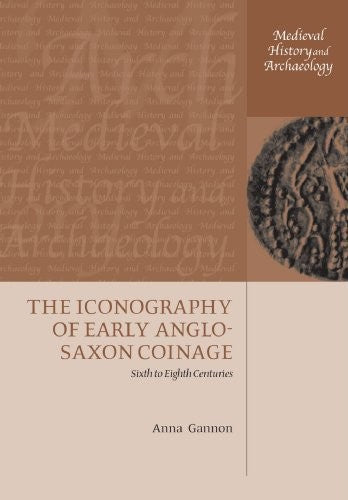
The Iconography of Early Anglo-Saxon Coinage by Anna Gannon British Museum)
This is the first scholarly art-historical appraisal of Anglo-Saxon coinage, from its inception in the late sixth century to Offa's second reform of the penny c.792. Outside numismatic circles, this material has largely been ignored because of its complexity, yet artistically this is the most vibrant period of English coinage, with die-cutters showing flair and innovation and employing hundreds of different designs in their work. By analysing the iconography of the early coinage, this book intends to introduce its rich legacy to a wide audience. Anna Gannon divides the designs of the coins into four main categories: busts (including attributes and drapery), human figures, animals and geometrical patterns, presenting prototypes, sources of the repertoire and parallels with contemporary visual arts for each motif. The comparisons demonstrate the central role of coins in the eclectic visual culture of the time, with the advantages of official sanctioning and wide circulation to support and diffuse new ideas and images. The sources of the motifs clarify the relationship between the many designs of the complex Secondary phase (c.710-50). Contemporary literature and theological writings often offer the key to the interpretation of motifs, hinting at a universal preoccupation with religious themes. The richness of designs and display of learning point to a sophisticated patronage with access to exotic prototypes, excellent craftsmanship and wealth; it is likely that minsters, as rich, learned, and well-organized institutions, were behind some of the coinage. After the economic crises of the mid-eighth century this flamboyant iconography was swept away: with the notable exeption of the coins of Offa, still displaying exciting designs of high quality and inventiveness, reformed issues bore royal names and titles, and strove towards uniformity.
Review from previous edition ".. very good bibliography ... practically every pertinent piece of information has been dug out and put in its right place." * Archaeological Journal *
"Gannon's book presents a wide variety of hitherto understudied material in a clear and thoughtful way and will make a major contribution to the study of Anglo-Saxon art as a whole and the discussion of how the art of post-Roman Europe relates to a wide variety of sources and influences." * Alan M. Stahl, Dibner Institute for the History of Science and Technology, MIT *
"...an up-to date source of information on numismatic research and relevant controversies." * Fran Colman, Folia Linguistica Historica, Vol. 27 *
"Very few recent books on early Anglo-Saxon history raise more important questions than this one does." * English Historical Review *
"Dr Gannon is to be warmly congratulated on a fine volume, containing much that her colleagues and friends will find new and stimulating" * The British Numismatic Journal *
As this book so aptly shows, a considerable amount of history can be teased out of a careful analysis...a book on coins that can be enjoyably read cover to cover. * Murray Eiland, Minerva Magazine *
"Gannon's book presents a wide variety of hitherto understudied material in a clear and thoughtful way and will make a major contribution to the study of Anglo-Saxon art as a whole and the discussion of how the art of post-Roman Europe relates to a wide variety of sources and influences." * Alan M. Stahl, Dibner Institute for the History of Science and Technology, MIT *
"...an up-to date source of information on numismatic research and relevant controversies." * Fran Colman, Folia Linguistica Historica, Vol. 27 *
"Very few recent books on early Anglo-Saxon history raise more important questions than this one does." * English Historical Review *
"Dr Gannon is to be warmly congratulated on a fine volume, containing much that her colleagues and friends will find new and stimulating" * The British Numismatic Journal *
As this book so aptly shows, a considerable amount of history can be teased out of a careful analysis...a book on coins that can be enjoyably read cover to cover. * Murray Eiland, Minerva Magazine *
Anna Gannon is Assistant Curator of Early Medieval Coinage at the British Museum.
| SKU | Unavailable |
| ISBN 13 | 9780199583843 |
| ISBN 10 | 0199583846 |
| Title | The Iconography of Early Anglo-Saxon Coinage |
| Author | Anna Gannon British Museum) |
| Series | Medieval History And Archaeology |
| Condition | Unavailable |
| Binding Type | Paperback |
| Publisher | Oxford University Press |
| Year published | 2010-06-18 |
| Number of pages | 240 |
| Cover note | Book picture is for illustrative purposes only, actual binding, cover or edition may vary. |
| Note | Unavailable |