


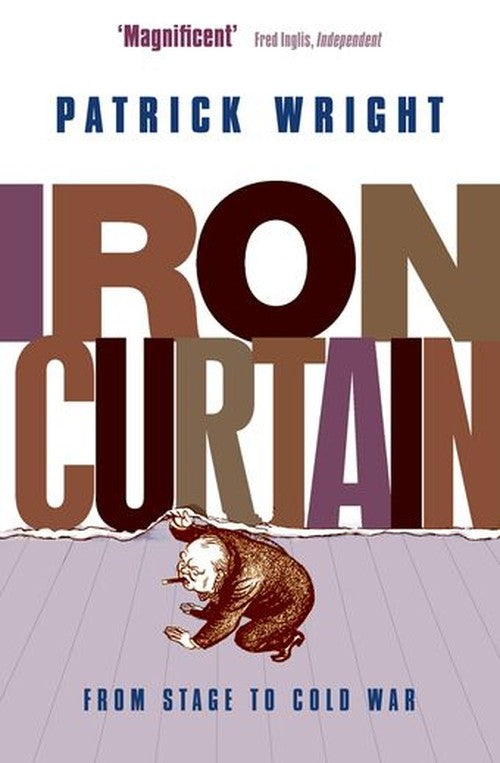
Iron Curtain by Wright
'From Stettin in the Baltic to Trieste in the Adriatic an iron curtain has descended across the Continent. . .' With these words Winston Churchill famously warned the world in a now legendary speech given in Fulton, Missouri, on March 5, 1946. Launched as an evocative metaphor, the 'Iron Curtain' quickly became a brutal reality in the Cold War between Capitalist West and Communist East. Not surprisingly, for many years, people on both sides of the division have assumed that the story of the Iron Curtain began with Churchill's 1946 speech. In this fascinating investigation, Patrick Wright shows that this was decidedly not the case. Starting with its original use to describe an anti-fire device fitted into theatres, Iron Curtain tells the story of how the term evolved into such a powerful metaphor and the myriad ways in which it shaped the world for decades before the onset of the Cold War. Along the way, it offers fascinating perspectives on a rich array of historical characters and developments, from the lofty aspirations and disappointed fate of early twentieth century internationalists, through the topsy-turvy experiences of the first travellers to Soviet Russia, to the theatricalization of modern politics and international relations. And, as Wright poignantly suggests, the term captures a particular way of thinking about the world that long pre-dates the Cold War - and did not disappear with the fall of the Berlin Wall.
Review from previous edition Some of the most vigorous, ironic and generous-hearted prose of any historian of our day.. magnificent. * Fred Inglis, The Independent *
Very well written, interesting, and full of stimulating digressions. * Fraser J. Harbutt, American Historical Review *
Wright's style carries the reader into hearfelt sympathy with one personality or episode after another. * Tom Nairn, London Review of Books, 23 *
It is insightful, anecdotal and episodic. * Alex Danchev, THES *
Superbly written... An exhilarating journey which captivates the reader's attention from beginning to end. * Marcus Papadopoulos, Tribune *
Wright is a witty and imaginative writer. * Lewis Jones, Financial Times Magazine *
A profoundly moral work...fine work of cultural history * Andrew Roberts. First Post *
I have read it from cover to cover, and have enjoyed every page * Noel Malcolm, Sunday Telegraph *
Sprightly and readable... the great strength of Wright's quietly inspiring book is that it hums with contemporary relevance * David Schneider, Sunday Times *
...stimulating, amusing... fascinating adventure ride of a book. * Frederick Taylor, Literary Review *
A work of impressive scholarship that adds much to our understanding of the roots of cold war rhetoric and attitudes * P. D. Smith, Guardian Review *
A work of wit, style and waggish erudition. I was informed and delighted by its originality. * John le Carre *
intriguing anecdotes * Eleanor Lee, New Statesman *
Very well written, interesting, and full of stimulating digressions. * Fraser J. Harbutt, American Historical Review *
Wright's style carries the reader into hearfelt sympathy with one personality or episode after another. * Tom Nairn, London Review of Books, 23 *
It is insightful, anecdotal and episodic. * Alex Danchev, THES *
Superbly written... An exhilarating journey which captivates the reader's attention from beginning to end. * Marcus Papadopoulos, Tribune *
Wright is a witty and imaginative writer. * Lewis Jones, Financial Times Magazine *
A profoundly moral work...fine work of cultural history * Andrew Roberts. First Post *
I have read it from cover to cover, and have enjoyed every page * Noel Malcolm, Sunday Telegraph *
Sprightly and readable... the great strength of Wright's quietly inspiring book is that it hums with contemporary relevance * David Schneider, Sunday Times *
...stimulating, amusing... fascinating adventure ride of a book. * Frederick Taylor, Literary Review *
A work of impressive scholarship that adds much to our understanding of the roots of cold war rhetoric and attitudes * P. D. Smith, Guardian Review *
A work of wit, style and waggish erudition. I was informed and delighted by its originality. * John le Carre *
intriguing anecdotes * Eleanor Lee, New Statesman *
Patrick Wright is a writer with an interest in the cultural dimensions of modern life. He is the author of a number of highly acclaimed best-selling history books, including The Village that Died for England (1995) and Tank: the Progress of a Monstrous War Machine (2000), described by Simon Schama as 'a tour de force.'
He has written for many magazines and newspapers, including the London Review of Books, the Guardian, the Washington Post, the Independent, and the Observer, and has made numerous documentaries on cultural themes for both BBC Radio 3 and 4. His television work includes The River, a four-part BBC2 series on the Thames. He is also a Professor at the Institute for Cultural Analysis at Nottingham Trent University, and a fellow of the London Consortium.
| SKU | Unavailable |
| ISBN 13 | 9780199239689 |
| ISBN 10 | 0199239681 |
| Title | Iron Curtain |
| Author | Wright |
| Condition | Unavailable |
| Binding Type | Paperback |
| Publisher | Oxford University Press |
| Year published | 2009-10-29 |
| Number of pages | 540 |
| Cover note | Book picture is for illustrative purposes only, actual binding, cover or edition may vary. |
| Note | Unavailable |