


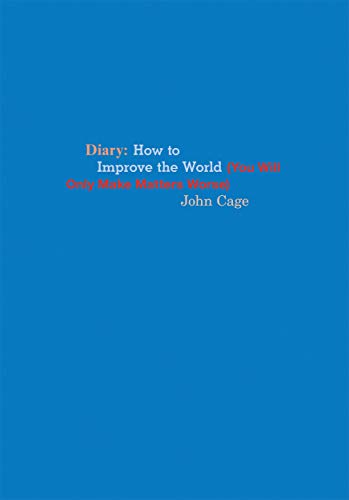
John Cage Diary by John Cage
Now available in an expanded paperback edition, Diary registers Cage's assessment of the times in which he lived as well as his often uncanny portents about the world we live in now. With a great sense of play as well as purpose, Cage traverses vast territory, from the domestic minutiae of everyday life to ideas about how to feed the world. He used chance operations to determine not only the word count and the application of various typefaces but also the number of letters per line, the patterns of indentation, and in the case of Part Three, originally published by Something Else Press color. The unusual visual variances on the page become almost musical as language takes on a physical and aural presence.While Cage used chance operations to expand the possibilities of creating and shaping his work beyond the limitations of individual taste, Diary nonetheless accumulates into a complex reflection of Cage's sensibilities as a thinker and citizen of the world, illuminating his social and political awareness, as well as his idealism and sense of humor: it becomes an oblique but indelible portrait of one the most influential figures of the 20th-century American avant-garde.
Collecting all eight parts into a single volume, co-editors Joe Biel and Richard Kraft also used chance operations to render the entire text in various combinations of the red and blue (used by Dick Higgins and Alison Knowles for Part Three) as well as to apply a single set of 18 fonts to the entire work. In the editors' note, Kraft and Biel elucidate the procedure of chance operations and demonstrate its application, giving readers a rare opportunity to see how the text is transformed.
This expanded paperback edition reproduces the 2015 hardback edition, with a new essay by mycologist and Cage aficionado David Rose and, most important, with a significant addendum that includes many facsimile pages of Cage's handwritten notebook of a ninth part in progress, bringing the reader into compelling proximity to Cage's process and the raw material from which Diary was made.
[R]ead Cage’s diary.. for his valuable insights into art, language, and humorous prose on why paper should be edible or how he describes himself as an “open cage." -- Perwana Nazif * Los Angeles Review of Books *
I realized that I gravitated towards Cage’s writings because I was tired of tidy narratives and expected endings. I wanted a text that tumbled down the page midstream, never arriving at a full stop. -- J Mae Barizo * LitHub *
[John Cage: Diary] is no ordinary account of days gone by; a plain record of events would be too simple for such a daring and meticulous artist. The product of thirty years, Diary allows us a glimpse of the late twentieth century through Cage’s eyes. His insights and observations reveal a generous, openhearted view of the world in tumult. * Paris Review *
What becomes apparent, however, in both his diary and letters, is Cage's deep sense of vulnerability, the emotional force guiding him through his craft and relationships and a world fraught with political unease. -- Dave Wheeler * Shelf Awareness *
I realized that I gravitated towards Cage’s writings because I was tired of tidy narratives and expected endings. I wanted a text that tumbled down the page midstream, never arriving at a full stop. -- J Mae Barizo * LitHub *
[John Cage: Diary] is no ordinary account of days gone by; a plain record of events would be too simple for such a daring and meticulous artist. The product of thirty years, Diary allows us a glimpse of the late twentieth century through Cage’s eyes. His insights and observations reveal a generous, openhearted view of the world in tumult. * Paris Review *
What becomes apparent, however, in both his diary and letters, is Cage's deep sense of vulnerability, the emotional force guiding him through his craft and relationships and a world fraught with political unease. -- Dave Wheeler * Shelf Awareness *
His teacher, Arnold Schoenberg, said JOHN CAGE was not a composer but an inventor of genius. Composer, author, and philosopher, John Cage was born in Los Angles in 1912 and by the age of 37 he had been recognized by the American Academy of Arts and Letters for having extended the boundaries of music. He was elected to the American Academy of Arts and Sciences in 1978, and in 1982, the French government awarded Cage its highest honor for distinguished contribution to cultural life, Commandeur de l'Ordre des Arts et des Lettres. Cage composed hundreds of musical works in his career, including the well-known 4'33 and his pieces for prepared piano; many of his compositions depend on chance procedures for their structure and performance. Cage was also an author, and his book Silence was described by John Rockwell in the New York Times as the most influential conduit of Oriental thought and religious ideas into the artistic vanguard-not just in music but in dance, art and poetry as well. John Cage's books, published by Wesleyan, are Silence (1961), A Year From Monday (1967), M (1973), Empty Words (1979), which Cage also regarded as a performance piece, and X (1983). John Cage died in 1992 at the age of 79.
| SKU | Unavailable |
| ISBN 13 | 9781938221217 |
| ISBN 10 | 1938221214 |
| Title | John Cage Diary |
| Author | John Cage |
| Condition | Unavailable |
| Binding Type | Paperback |
| Publisher | Siglio Press |
| Year published | 2019-12-05 |
| Number of pages | 200 |
| Cover note | Book picture is for illustrative purposes only, actual binding, cover or edition may vary. |
| Note | Unavailable |