


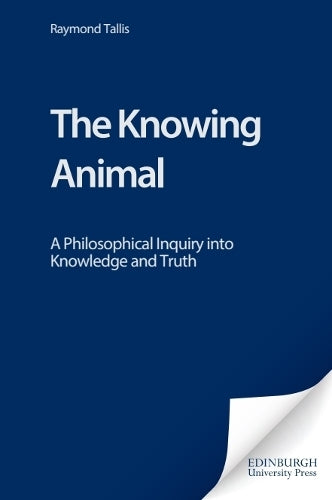
The Knowing Animal by Raymond Tallis
In The Hand, the first volume of his trilogy, Raymond Tallis looked at how humans have overcome the constraints of biology. The second volume, I Am, focused on two crucial aspects of the escape from being a mere organism: selfhood and agency. This, the final volume in the trilogy, argues that knowledge is unique to human beings and sufficiently important to call man 'the knowing animal'.Raymond Tallis examines the profound difference between knowledge 'That things are the case' and mere sentience. He criticises both accounts of knowledge that marginalise the consciousness of the knower and naturalistic accounts that assimilate knowledge to sense experience and, ultimately, neural activity. He argues that knowledge arises because humans are embodied subjects and not just organisms: knowing subjects know both about events in the material world which they can perceive as well as non-material 'facts'. It is because knowledge is relatively 'uncoupled' from the material world that active inquiry, reason-d
Tallis conjures up a challenging and endlessly fascinating way of thinking about ourselves that should act as a signpost for the future where we might learn once again to glimpse, as our forebears did, the wonder - and mystery - of ourselves-- James Le Fanu One of the most intriguing figures in the current intellectual scene. Raymond Tallis is a man unusual in modern medicine. His career has been devoted to caring for, studying, and advancing the health of older people in society. But while working as a Professor of Geriatric medicine at the University of Manchester, he has developed a parallel career - as a philosopher, critic, poet and novelist - largely unknown to his clinical brotherhood and sisterhood. Indeed, important though his medical work has been, it is likely that his philosophy, and especially his philosophical anthropology, will leave a particularly indelible mark on human affairs. -- Richard Horton
Raymond Tallis is Professor of Geriatric Medicine at the University of Manchester and Fellow of the Academy of Medical Sciences. Over the last 15 years he has published extensively outside the field of medicine. There have been three books which mount a critique of post-structuralist theory: Not Saussure: A Critique of Post-saussurean Literary Theory (Macmillan, 2nd edn, 1995), In Defence of Realism (Arnold & University of Nebraska Press, 2nd edn, 1998) and Theorrhoea and After (Macmillan, 1998). He has also published four books in the philosophy of mind: The Explicit Animal: A Defence of Human Consciousness (Macmillan, 1991), The Pursuit of Mind (co-edited with Howard Robinson, Carcanet, 1991), Psycho Electronics (Ferrington, 1994) and On the Edge of Certainty and Other Essays (Macmillan, 1999). Further books include Newton's Sleep: The Two Cultures and the Two Kingdoms (Macmillan, 1995), Enemies of Hope: A Critique of Contemporary Pessimism (Macmillan, 1997) and A Conversation with Martin Heidegger (Macmillan (Palgrave), 2002). An anthology of his theoretical writing - The Raymond Tallis Reader, edited by Michael Grant - was published by Macmillan (Palgrave) in 2000. He was awarded the degree of Doctor of Letters (hon causa) at the University of Hull in 1997 for his non-medical writings and the degree of Doctor of Letters (hon causa) at the University of Manchester in 2003 for 'contributions to literary theory and our understanding of human consciousness’. The Knowing Animal is the final volume in the trilogy of books for EUP which began with The Hand and continued with I Am.
| SKU | Unavailable |
| ISBN 13 | 9780748619535 |
| ISBN 10 | 0748619534 |
| Title | The Knowing Animal |
| Author | Raymond Tallis |
| Condition | Unavailable |
| Binding Type | Paperback |
| Publisher | Edinburgh University Press |
| Year published | 2004-11-02 |
| Number of pages | 336 |
| Cover note | Book picture is for illustrative purposes only, actual binding, cover or edition may vary. |
| Note | Unavailable |