


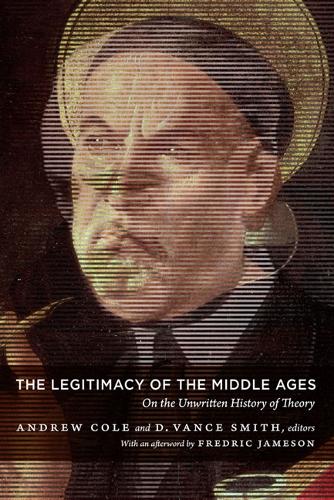
The Legitimacy of the Middle Ages by Andrew Cole
A collection of theoretical essays arguing that theorists of modernity must reckon with the medieval, which is not, as some have asserted, completely separate or different from the modern.
“[This] volume opens a productive channel to yet another way of thinking about history – in this case, the history of our discipline, its philosophical underpinnings, and the contributions of medieval thought and medievalism generally to practices of cultural and textual analysis. . . [T]his volume represents an endeavor of considerable intellectual significance, a strong opening into a set of important questions about the terms and conceptual conditions for the survival of medievalism and medieval studies. . . .” - Paul Strohm, Postmedieval
“Amidst the trash talk of theory in the past tense and the drive of the corporate university to dismantle the conditions of possibility for critique . . . the essays collected in The Legitimacy of the Middle Ages will hearten scholars and also invite them to reflect on their own complicity with current academic events. The volume marks yet another powerful contribution to ongoing investigation into the intersections of the medievalisms of modernity and the modernities of Medieval Studies.” - Kathleen Biddick, The Medieval Review
“Those already engaged in ongoing debates about the complex relation between medieval and modern will find this book to be an essential addition to an important area of inquiry. Those who have never given much thought to the subject will discover a stimulating, and perhaps even transformative, introduction to a crucial set of terms and concepts.” - George Edmondson, Speculum
“[T]he collection should be read as a collaborative work of intellectual history with serious implications for the study of modernity.... It opens up some rich dialogues between medieval and post-medieval studies, and with historians and students of modernity.” - Stephanie Trigg, Partial Answers
“An uncompromising riposte to the notion, in Medieval Studies as elsewhere, that critique is dead and that we should quietly return to tasks of description. A potent demonstration that without critical theory, modernity and the medieval are unintelligible.”—David Wallace, author of Premodern Places: Calais to Surinam, Chaucer to Aphra Behn
“These exciting and challenging essays show that medieval ideas have exerted a huge influence on Freud, Heidegger, Foucault, Derrida, Deleuze, Bourdieu, Žižek, and Negri, thus shaping our understanding of politics, aesthetics, literary criticism, and cultural critique. It is now evident that we all need a medieval basis to found modern Theory.”—Jean-Michel Rabaté, author of The Ethics of the Lie
“[This] volume opens a productive channel to yet another way of thinking about history – in this case, the history of our discipline, its philosophical underpinnings, and the contributions of medieval thought and medievalism generally to practices of cultural and textual analysis. . . . [T]his volume represents an endeavor of considerable intellectual significance, a strong opening into a set of important questions about the terms and conceptual conditions for the survival of medievalism and medieval studies. . . .” -- Paul Strohm * Postmedieval *
“Amidst the trash talk of theory in the past tense and the drive of the corporate university to dismantle the conditions of possibility for critique . . . the essays collected in The Legitimacy of the Middle Ages will hearten scholars and also invite them to reflect on their own complicity with current academic events. The volume marks yet another powerful contribution to ongoing investigation into the intersections of the medievalisms of modernity and the modernities of Medieval Studies.” -- Kathleen Biddick * Medieval Review *
“Those already engaged in ongoing debates about the complex relation between medieval and modern will find this book to be an essential addition to an important area of inquiry. Those who have never given much thought to the subject will discover a stimulating, and perhaps even transformative, introduction to a crucial set of terms and concepts.” -- George Edmondson * Speculum *
“Amidst the trash talk of theory in the past tense and the drive of the corporate university to dismantle the conditions of possibility for critique . . . the essays collected in The Legitimacy of the Middle Ages will hearten scholars and also invite them to reflect on their own complicity with current academic events. The volume marks yet another powerful contribution to ongoing investigation into the intersections of the medievalisms of modernity and the modernities of Medieval Studies.” - Kathleen Biddick, The Medieval Review
“Those already engaged in ongoing debates about the complex relation between medieval and modern will find this book to be an essential addition to an important area of inquiry. Those who have never given much thought to the subject will discover a stimulating, and perhaps even transformative, introduction to a crucial set of terms and concepts.” - George Edmondson, Speculum
“[T]he collection should be read as a collaborative work of intellectual history with serious implications for the study of modernity.... It opens up some rich dialogues between medieval and post-medieval studies, and with historians and students of modernity.” - Stephanie Trigg, Partial Answers
“An uncompromising riposte to the notion, in Medieval Studies as elsewhere, that critique is dead and that we should quietly return to tasks of description. A potent demonstration that without critical theory, modernity and the medieval are unintelligible.”—David Wallace, author of Premodern Places: Calais to Surinam, Chaucer to Aphra Behn
“These exciting and challenging essays show that medieval ideas have exerted a huge influence on Freud, Heidegger, Foucault, Derrida, Deleuze, Bourdieu, Žižek, and Negri, thus shaping our understanding of politics, aesthetics, literary criticism, and cultural critique. It is now evident that we all need a medieval basis to found modern Theory.”—Jean-Michel Rabaté, author of The Ethics of the Lie
“[This] volume opens a productive channel to yet another way of thinking about history – in this case, the history of our discipline, its philosophical underpinnings, and the contributions of medieval thought and medievalism generally to practices of cultural and textual analysis. . . . [T]his volume represents an endeavor of considerable intellectual significance, a strong opening into a set of important questions about the terms and conceptual conditions for the survival of medievalism and medieval studies. . . .” -- Paul Strohm * Postmedieval *
“Amidst the trash talk of theory in the past tense and the drive of the corporate university to dismantle the conditions of possibility for critique . . . the essays collected in The Legitimacy of the Middle Ages will hearten scholars and also invite them to reflect on their own complicity with current academic events. The volume marks yet another powerful contribution to ongoing investigation into the intersections of the medievalisms of modernity and the modernities of Medieval Studies.” -- Kathleen Biddick * Medieval Review *
“Those already engaged in ongoing debates about the complex relation between medieval and modern will find this book to be an essential addition to an important area of inquiry. Those who have never given much thought to the subject will discover a stimulating, and perhaps even transformative, introduction to a crucial set of terms and concepts.” -- George Edmondson * Speculum *
Andrew Cole is Associate Professor of English at Princeton University. He is the author of Literature and Heresy in the Age of Chaucer.
D. Vance Smith is Professor of English at Princeton University. He is the author of Arts of Possession: The Middle English Household Imaginary and The Book of the Incipit: Beginnings in the Fourteenth Century.
| SKU | Unavailable |
| ISBN 13 | 9780822346449 |
| ISBN 10 | 0822346443 |
| Title | The Legitimacy of the Middle Ages |
| Author | Andrew Cole |
| Series | Post Contemporary Interventions |
| Condition | Unavailable |
| Binding Type | Paperback |
| Publisher | Duke University Press Books |
| Year published | 2010-02-08 |
| Number of pages | 288 |
| Cover note | Book picture is for illustrative purposes only, actual binding, cover or edition may vary. |
| Note | Unavailable |