


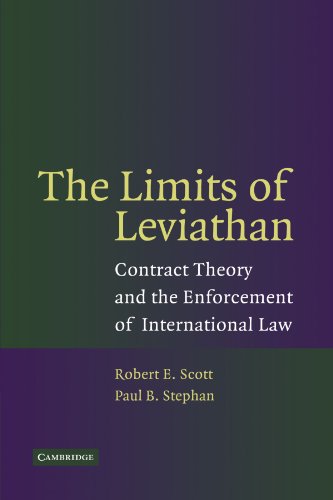
The Limits of Leviathan by Robert E Scott
Much of international law, like much of contract, is enforced not by independent sanctions but rather through cooperative interaction among the parties, with repeat dealings, reputation, and a preference for reciprocity doing most of the enforcement work. Originally published in 2006, The Limits of Leviathan identifies areas in international law where formal enforcement provides the most promising means of promoting cooperation and where it does not. In particular, it looks at the International Criminal Court, the rules for world trade, efforts to enlist domestic courts to enforce orders of the International Court of Justice, domestic judicial enforcement of the Geneva Convention, the domain of international commercial agreements, and the question of odious debt incurred by sovereigns. This book explains how international law, like contract, depends largely on the willingness of responsible parties to make commitments.
Review of the hardback: 'Professors Scott and Stephan have produced an important and thought-provoking book on the intersection of contract theory and international lawThe authors contend that there is too much enforcement of international law by private parties who file complaints before international tribunals and domestic courts armed with the power to sanction nations that fail to live up to their treaty bargains. This is a provocative claim, one that challenges the widely-held views of international lawyers and political scientists that the international legal system is weak and needs to be strengthened. The authors support their theory of optimal enforcement of international agreements with numerous examples ranging across human rights, trade, international criminal law, and intellectual property. And they include specific prescriptions for governments and policymakers. Scholars of international cooperation and treaty design would do well to give The Limits of Leviathan the careful attention that it deserves.' Laurence R. Helfer, Professor of Law, Vanderbilt University Law School
Review of the hardback: 'The Limits of Leviathan is an original and an important book. It is the first use of modern contract theory to explain and to improve the relation between formal and informal enforcement of treaties and other international agreements. Much international law rests on these consensual arrangements, and contract theory is meant to explain consensual arrangements. The book's lucid explanations and critiques of existing practice thus will be very helpful to international lawyers, and they will also extend the reach of contract theory itself.' Alan Schwartz, Sterling Professor of Law, Yale Law School
Review of the hardback: 'One of the most significant developments in international law in the past decades has been the rise of institutionalized international tribunals - like the WTO dispute resolution mechanisms, various EU courts, and the International Criminal Court - that can enforce international law against states. The Limits of Leviathan employs economic theories of contract formation and enforcement to explain the rise and operation of these institutions. Scott and Stephan show how a combination of formal institutional sanctions and more traditional informal sanctioning methods (such as retaliation and reputational loss) work together to foster cooperation among nations. They also provide a framework for explaining how institutionalized enforcement can go too far and retard cooperation among nations. The Limits of Leviathan is a realistic, hard-nosed examination of the promise and perils of international enforcement institutions, and an important contribution to the burgeoning use of social science methodologies to explain international relations.' Jack L. Goldsmith, Henry L. Shattuck Professor of Law, Harvard Law School
Review of the hardback: 'The Limits of Leviathan is an original and an important book. It is the first use of modern contract theory to explain and to improve the relation between formal and informal enforcement of treaties and other international agreements. Much international law rests on these consensual arrangements, and contract theory is meant to explain consensual arrangements. The book's lucid explanations and critiques of existing practice thus will be very helpful to international lawyers, and they will also extend the reach of contract theory itself.' Alan Schwartz, Sterling Professor of Law, Yale Law School
Review of the hardback: 'One of the most significant developments in international law in the past decades has been the rise of institutionalized international tribunals - like the WTO dispute resolution mechanisms, various EU courts, and the International Criminal Court - that can enforce international law against states. The Limits of Leviathan employs economic theories of contract formation and enforcement to explain the rise and operation of these institutions. Scott and Stephan show how a combination of formal institutional sanctions and more traditional informal sanctioning methods (such as retaliation and reputational loss) work together to foster cooperation among nations. They also provide a framework for explaining how institutionalized enforcement can go too far and retard cooperation among nations. The Limits of Leviathan is a realistic, hard-nosed examination of the promise and perils of international enforcement institutions, and an important contribution to the burgeoning use of social science methodologies to explain international relations.' Jack L. Goldsmith, Henry L. Shattuck Professor of Law, Harvard Law School
Paul B. Stephan is the John C. Jeffries, Jr. Distinguished Professor of Law, David H. Ibbeken '71 Research Professor, and Graduate Studies Program Director at the University of Virginia School of Law. An expert on international business and Soviet and post-Soviet legal systems, Stephan has advised governments and international organizations, organized conferences, edited books and lectured to professionals, university groups and high school students on a variety of issues raised by the globalization of the world economy and the transition away from Soviet-style socialism. During 2006-07, he served as counselor on international law in the U.S. Department of State. Other interests for Stephan, who joined the University of Virginia's law faculty in 1979, include international law, taxation and constitutional law.
| SKU | Unavailable |
| ISBN 13 | 9780521367974 |
| ISBN 10 | 0521367972 |
| Title | The Limits of Leviathan |
| Author | Robert E Scott |
| Condition | Unavailable |
| Binding Type | Paperback |
| Publisher | Cambridge University Press |
| Year published | 2011-07-14 |
| Number of pages | 264 |
| Cover note | Book picture is for illustrative purposes only, actual binding, cover or edition may vary. |
| Note | Unavailable |