
Man-Eaters of Tsavo


Man-Eaters of Tsavo
Regular price
Checking stock...
Regular price
Checking stock...
The feel-good place to buy books
- Free UK delivery over £5
- 10% off preloved books when you join +Plus
- Buying preloved emits 46% less CO2 than new
- Give your books a new home - sell them back to us!
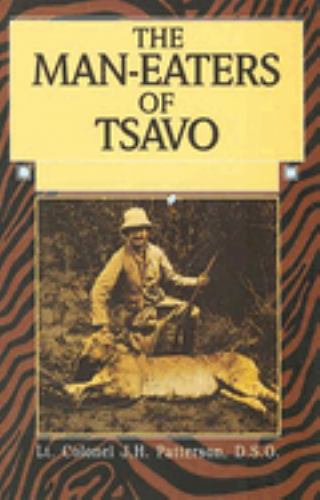
Man-Eaters of Tsavo by John Patterson
In 1898 John H. Patterson arrived in East Africa with a mission to build a railway bridge over the Tsavo River. Over the course of several weeks Patterson and his mostly Indian workforce were systematically hunted by two man-eating lions . In all, 100 workers were killed, and the entire bridge-building project was delayed. As well as being stalked by lions, Patterson had to guard his back against his own increasingly hostile and mutinous workers as he set out to track and kill the man-eaters. Patterson's account of the lions' reign of terror and his own attempts to kill them is the stuff of great adventure. Consider this description of the aftermath of an attack by the lions: "...we at once set out to follow the brutes, Mr. Dalgairns feeling confident that he had wounded one of them, as there was a trail on the sand like that of the toes of a broken limb.... we saw in the gloom what we at first took to be a lion cub; closer inspection, however, showed it to be the remains of the unfortunate coolie, which the man-eaters had evidently abandoned at our approach. The legs, one arm and half the body had been eaten, and it was the stiff fingers of the other arm trailing along the sand which had left the marks we had taken to be the trail of a wounded lion...." This classic tale of death, courage, and terror in the African bush is still a page-turner, even after all these years.
Patterson, J. H.: - Lieutenant-Colonel John Henry Patterson, DSO (10 November 1867 - 18 June 1947), known as J. H. Patterson, was a British soldier, hunter, author and Christian Zionist, best known for his book The Man-Eaters of Tsavo (1907), which details his experiences while building a railway bridge over the Tsavo river in British East Africa (now Kenya) in 1898-99. The book has inspired three Hollywood films - Bwana Devil (1952), Killers of Kilimanjaro (1959) and The Ghost and the Darkness (1996) in which he was portrayed by Val Kilmer. In the First World War, Patterson was the commander of the Jewish Legion, the first Jewish fighting force in nearly two millennia, and has been described as the godfather of the modern Israel Defense Forces. Patterson was born in 1867 in Forgney, Ballymahon, County Longford, Ireland, to a Protestant father and Roman Catholic mother.[2] He joined the British Army at the age of seventeen and eventually attained the rank of Lieutenant-Colonel[3] and was awarded the Distinguished Service Order (DSO). He finally retired from the military in 1920. In 1898, Patterson was commissioned by the Uganda Railway committee in London to oversee the construction of a railway bridge over the Tsavo River in present-day Kenya. He arrived at the site in March of that year. Almost immediately after Patterson's arrival, lion attacks began to take place on the workforce, with the lions dragging men out of their tents at night and feeding on their victims. Despite the building of thorn barriers (bomas) around the camps, bonfires at night, and strict after-dark curfews, the attacks escalated dramatically, to the point where the bridge construction eventually ceased due to a fearful, mass departure by the workers. Along with the obvious financial consequences of the work stoppage, Patterson faced the challenge of maintaining his authority and even his personal safety at this remote site against the increasingly hostile and superstitious workers, many of whom were convinced that the lions were in fact evil spirits, come to punish those who worked at Tsavo, and that he was the cause of the misfortune because the attacks had coincided with his arrival.
| SKU | Unavailable |
| ISBN 13 | 9781592281879 |
| ISBN 10 | 1592281877 |
| Title | Man-Eaters of Tsavo |
| Author | John Patterson |
| Condition | Unavailable |
| Binding Type | Paperback |
| Publisher | Rowman & Littlefield |
| Year published | 2004-09-01 |
| Number of pages | 346 |
| Cover note | Book picture is for illustrative purposes only, actual binding, cover or edition may vary. |
| Note | Unavailable |