


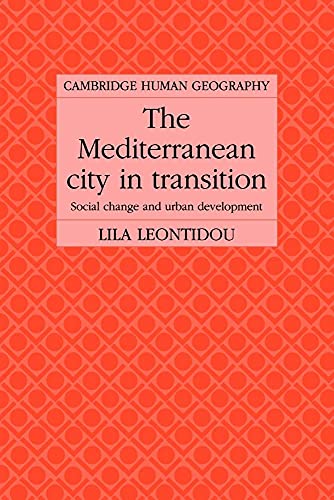
The Mediterranean City in Transition by Lila Leontidou
Postwar capitalist development has involved a transition from polarization toward diffuse urbanization and flexibility. The timing and form of this transition and its effects on spatial structures have varied, as is especially evident in the case of Mediterranean Europe. Focusing upon Greater Athens between 1948 and 1981 - the crucial period of the transition - Lila Leontidou explores the role of social classes in urban development. The emergence of new processes in cities such as Athens, Salonica, Rome, Naples, Milan, Madrid, Barcelona and Lisbon is different in both timing and manner from that of northern European cities, but, as Dr Leontidou argues, this should not be attributed to poverty or inexplicable cultural peculiarities. Instead interaction between popular spontaneity, economic forces and State control has played a major role.
Using secondary sources for comparisons with other Mediterranean cities and archival studies for Athens, Leontidou has amassed considerable evidence--much of it presented in tables and maps--about how working-class migrants provided shelter for themselves in an unregulated building economyTaken as an empirical account, Leontidou's book fills a gap in the literature. Josef W. Konvitz, Journal of Interdisciplinary History
| SKU | Unavailable |
| ISBN 13 | 9780521025256 |
| ISBN 10 | 0521025257 |
| Title | The Mediterranean City in Transition |
| Author | Lila Leontidou |
| Series | Cambridge Human Geography |
| Condition | Unavailable |
| Binding Type | Paperback |
| Publisher | Cambridge University Press |
| Year published | 2006-03-30 |
| Number of pages | 316 |
| Cover note | Book picture is for illustrative purposes only, actual binding, cover or edition may vary. |
| Note | Unavailable |