


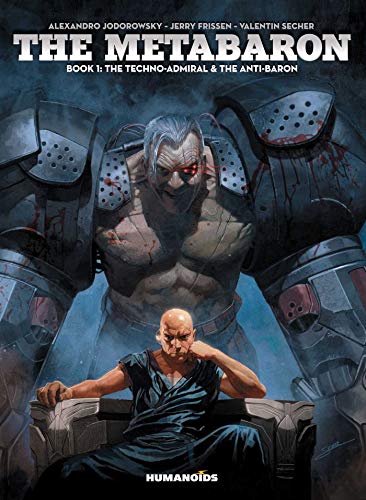
The Metabaron Vol.1 by Alejandro Jodorowsky
The Metabaron once single-handedly brought the Techno-Techno Empire to its knees. But in the chaos that followed, a new regime within the Techno-Techno civilization has rebuilt by seizing control of the galaxy's most precious fuel, the Epiphyte. When this tyrannical new force learns that the Metabaron is back and headed towards Marmola, the only known source of Epiphyte, the Empire dispatches its most trusted servant: the notoriously invulnerable and cruel Wilhelm-100, The Techno-Admiral. Can the Metabaron save the universe once more, or has he finally met his match?
"..it tosses Greek mythology, Frank Herbert’s Dune, and a bit of the old ultraviolence into a blender and presses frappé. ...stunningly illustrated and utterly bananas." - Publishers Weekly "This strong science fiction story will not only appeal to readers familiar with the Metabaron catalog and the strong output of Humanoids in the field, but should also be on the radar for audiences weaned on Image Comics' recent presence in the genre over the past few years with titles such as Saga, Prophet, and much more." - icv2
Alejandro Jodorowsky Prullansky (Spanish: [xoðo'?ofski]; born 17 February 1929) is a Chilean and French avant-garde filmmaker. Best known for his films El Topo (1970), The Holy Mountain (1973) and Santa Sangre (1989), Jodorowsky has been "venerated by cult cinema enthusiasts" for his work which "is filled with violently surreal images and a hybrid blend of mysticism and religious provocation".[1]
Born to Jewish-Ukrainian parents in Chile, Jodorowsky experienced an unhappy and alienated childhood, and so immersed himself in reading and writing poetry. Dropping out of college, he became involved in theater and in particular mime, working as a clown before founding his own theater troupe, the Teatro Mimico, in 1947. Moving to Paris in the early 1950s, Jodorowsky studied traditional mime under Étienne Decroux, and put his miming skills to use in the silent film Les têtes interverties (1957), directed with Saul Gilbert and Ruth Michelly. From 1960 onwards he divided his time between Mexico City and Paris, where he co-founded Panic Movement, a surrealist performance art collective that staged violent and shocking theatrical events. In 1966 he created his first comic strip, Anibal 5, and in 1967 he directed his first feature film, the surrealist Fando y Lis, which caused a huge scandal in Mexico, eventually being banned.
His next film, the acid western El Topo (1970), became a hit on the midnight movie circuit in the United States, considered the first-ever midnight cult film, and garnered high praise from John Lennon, who convinced former Beatles manager Allen Klein to provide Jodorowsky with $1 million to finance his next film. The result was The Holy Mountain (1973), a surrealist exploration of western esotericism. Disagreements with Klein, however, led to both The Holy Mountain and El Topo failing to gain widespread distribution, although both became classics on the underground film circuit.[1] After a cancelled attempt at filming Frank Herbert's 1965 science fiction novel Dune, Jodorowsky produced five more films: the family film Tusk (1980); the surrealist horror Santa Sangre (1989); the failed blockbuster The Rainbow Thief (1990); and the first two films in a planned five-film autobiographical series The Dance of Reality (2013) and Endless Poetry (2016).
Jodorowsky is also a comic book writer, most notably penning the science fiction series The Incal throughout the 1980s, which has been described as having a claim to be "the best comic book" ever written.[2] Other comic books he has written include The Technopriests and Metabarons. Jodorowsky has also extensively written and lectured about his own spiritual system, which he calls "psychomagic" and "psychoshamanism", which borrows from alchemy, the tarot, Zen Buddhism and shamanism.[3] His son Cristóbal has followed his teachings on psychoshamanism; this work is captured in the feature documentary Quantum Men, directed by Carlos Serrano Azcona.[4]
Jerry Frissen (born Thierry Frissen in Belgium) is an American comic book writer and toy & graphic designer. He is the Editor-in-Chief of the recently relaunched comics anthology magazine Metal Hurlant in France, as well as the author of several best-selling graphic novels, including the anthology comic book series Lucha Libre (Unfabulous Five, The Tikitis), The Fire of Theseus, Exo, Simak, and the new cycle of the internationally acclaimed series The Metabarons, co-written with Alejandro Jodorowsky and illustrated by Valentin Sécher, Niko Henrichon, and Pete Woods.
His book The Zombies That Ate The World, illustrated by Guillermo Del Toro collaborator Guy Davis, was recently adapted by RKSS of Turbo Kid for the silver screen as We Are Zombies.
At only 29, Valentin has already been published by Titan Comics (Khaal) and Humanoids (The Metabaron Book 1 & 3). A rising star in the European comics scene, he took up the challenge of following in the footsteps of Juan Gimenez, creating his own version of Jodorowsky's universes: cinematic landscapes and beautiful, realistic fight scenes.
Born to Jewish-Ukrainian parents in Chile, Jodorowsky experienced an unhappy and alienated childhood, and so immersed himself in reading and writing poetry. Dropping out of college, he became involved in theater and in particular mime, working as a clown before founding his own theater troupe, the Teatro Mimico, in 1947. Moving to Paris in the early 1950s, Jodorowsky studied traditional mime under Étienne Decroux, and put his miming skills to use in the silent film Les têtes interverties (1957), directed with Saul Gilbert and Ruth Michelly. From 1960 onwards he divided his time between Mexico City and Paris, where he co-founded Panic Movement, a surrealist performance art collective that staged violent and shocking theatrical events. In 1966 he created his first comic strip, Anibal 5, and in 1967 he directed his first feature film, the surrealist Fando y Lis, which caused a huge scandal in Mexico, eventually being banned.
His next film, the acid western El Topo (1970), became a hit on the midnight movie circuit in the United States, considered the first-ever midnight cult film, and garnered high praise from John Lennon, who convinced former Beatles manager Allen Klein to provide Jodorowsky with $1 million to finance his next film. The result was The Holy Mountain (1973), a surrealist exploration of western esotericism. Disagreements with Klein, however, led to both The Holy Mountain and El Topo failing to gain widespread distribution, although both became classics on the underground film circuit.[1] After a cancelled attempt at filming Frank Herbert's 1965 science fiction novel Dune, Jodorowsky produced five more films: the family film Tusk (1980); the surrealist horror Santa Sangre (1989); the failed blockbuster The Rainbow Thief (1990); and the first two films in a planned five-film autobiographical series The Dance of Reality (2013) and Endless Poetry (2016).
Jodorowsky is also a comic book writer, most notably penning the science fiction series The Incal throughout the 1980s, which has been described as having a claim to be "the best comic book" ever written.[2] Other comic books he has written include The Technopriests and Metabarons. Jodorowsky has also extensively written and lectured about his own spiritual system, which he calls "psychomagic" and "psychoshamanism", which borrows from alchemy, the tarot, Zen Buddhism and shamanism.[3] His son Cristóbal has followed his teachings on psychoshamanism; this work is captured in the feature documentary Quantum Men, directed by Carlos Serrano Azcona.[4]
Jerry Frissen (born Thierry Frissen in Belgium) is an American comic book writer and toy & graphic designer. He is the Editor-in-Chief of the recently relaunched comics anthology magazine Metal Hurlant in France, as well as the author of several best-selling graphic novels, including the anthology comic book series Lucha Libre (Unfabulous Five, The Tikitis), The Fire of Theseus, Exo, Simak, and the new cycle of the internationally acclaimed series The Metabarons, co-written with Alejandro Jodorowsky and illustrated by Valentin Sécher, Niko Henrichon, and Pete Woods.
His book The Zombies That Ate The World, illustrated by Guillermo Del Toro collaborator Guy Davis, was recently adapted by RKSS of Turbo Kid for the silver screen as We Are Zombies.
At only 29, Valentin has already been published by Titan Comics (Khaal) and Humanoids (The Metabaron Book 1 & 3). A rising star in the European comics scene, he took up the challenge of following in the footsteps of Juan Gimenez, creating his own version of Jodorowsky's universes: cinematic landscapes and beautiful, realistic fight scenes.
| SKU | Unavailable |
| ISBN 13 | 9781594651533 |
| ISBN 10 | 1594651531 |
| Title | The Metabaron Vol.1 |
| Author | Alejandro Jodorowsky |
| Condition | Unavailable |
| Binding Type | Hardback |
| Publisher | Humanoids, Inc |
| Year published | 2016-10-18 |
| Number of pages | 112 |
| Cover note | Book picture is for illustrative purposes only, actual binding, cover or edition may vary. |
| Note | Unavailable |