


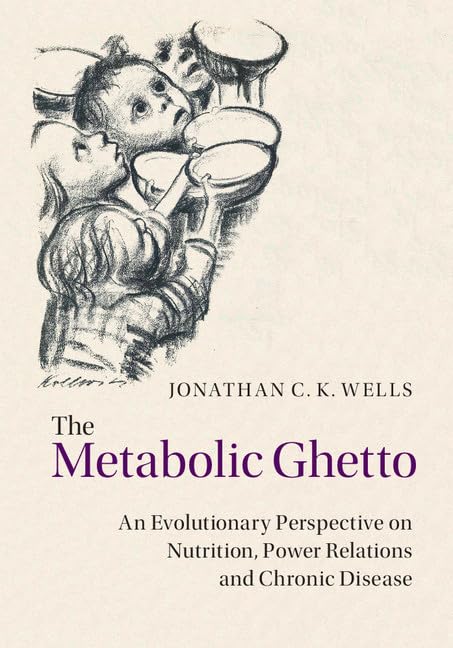
The Metabolic Ghetto by Jonathan C K Wells
Chronic diseases have rapidly become the leading global cause of morbidity and mortality, yet there is poor understanding of this transition, or why particular social and ethnic groups are especially susceptible. In this book, Wells adopts a multidisciplinary approach to human nutrition, emphasising how power relations shape the physiological pathways to obesity, diabetes, hypertension and cardiovascular disease. Part I reviews the physiological basis of chronic diseases, presenting a 'capacity-load' model that integrates the nutritional contributions of developmental experience and adult lifestyle. Part II presents an evolutionary perspective on the sensitivity of human metabolism to ecological stresses, highlighting how social hierarchy impacts metabolism on an intergenerational timescale. Part III reviews how nutrition has changed over time, as societies evolved and coalesced towards a single global economic system. Part IV integrates these physiological, evolutionary and politico-economic perspectives in a unifying framework, to deepen our understanding of the societal basis of metabolic ill-health.
'Is it really possible to bring together philosophy, economics, history, evolutionary biology, epidemiology, nutrition and metabolism to understand obesity and chronic disease? Jonathan CK. Wells has done it in an immensely readable and insightful way. A wonderful book.' Michael Marmot, University College London
'No other book before has provided such a sophisticated and eloquent argument integrating knowledge about foetal and childhood environment and nutrition, with impacts of social, economic and historical factors. Jonathan C. K. Wells persuasively argues that a broad scope and an evolutionary framework are necessary to build our understanding of chronic and globally important diseases. Consequently, [he] succeeds in achieving a true consilience of very disparate perspectives on our health.' Grazyna Jasienska, Jagiellonian University, Poland
' [T]his book is a sobering look at how social hierarchy can undermine the health of the lower-ranked within a society and within the global economic order. A significant strength of the book lies in the variety of perspective and conceptual models evaluated. … It is an ambitious book that tackles big questions …' Darna L. Dufour, American Journal of Human Biology
'The Metabolic Ghetto is both a scholarly book and a call to action. Wells's arguments are carefully presented and well documented … Readers who are interested in the ways in which social structures affect health and who would like to understand the central role of nutrition in mediating the effects of socioeconomic inequalities on health will learn much from this book. Readers who are interested in global health will especially welcome Wells's international perspective and his concern for the health of people in low- and middle-income countries as well as for those in economically advantaged societies. … the readers who will be most attracted to the book are those who, in Marx's words, believe that the task of natural philosophers is not only to interpret the world but to change it.' Robert L. Perlman, American Journal of Physical Anthropology
'No other book before has provided such a sophisticated and eloquent argument integrating knowledge about foetal and childhood environment and nutrition, with impacts of social, economic and historical factors. Jonathan C. K. Wells persuasively argues that a broad scope and an evolutionary framework are necessary to build our understanding of chronic and globally important diseases. Consequently, [he] succeeds in achieving a true consilience of very disparate perspectives on our health.' Grazyna Jasienska, Jagiellonian University, Poland
' [T]his book is a sobering look at how social hierarchy can undermine the health of the lower-ranked within a society and within the global economic order. A significant strength of the book lies in the variety of perspective and conceptual models evaluated. … It is an ambitious book that tackles big questions …' Darna L. Dufour, American Journal of Human Biology
'The Metabolic Ghetto is both a scholarly book and a call to action. Wells's arguments are carefully presented and well documented … Readers who are interested in the ways in which social structures affect health and who would like to understand the central role of nutrition in mediating the effects of socioeconomic inequalities on health will learn much from this book. Readers who are interested in global health will especially welcome Wells's international perspective and his concern for the health of people in low- and middle-income countries as well as for those in economically advantaged societies. … the readers who will be most attracted to the book are those who, in Marx's words, believe that the task of natural philosophers is not only to interpret the world but to change it.' Robert L. Perlman, American Journal of Physical Anthropology
Jonathan C. K. Wells is Professor of Anthropology and Paediatric Nutrition at the Institute of Child Health, University College London, and a leading international researcher in the field of paediatric nutrition. His empirical research focuses on human growth, body composition and metabolism, and is complemented by the development of evolutionary perspectives on these topics. He has contributed extensively to the scientific literature and is the author of The Evolutionary Biology of Human Body Fatness: Thrift and Control (Cambridge, 2010).
| SKU | Unavailable |
| ISBN 13 | 9781107009479 |
| ISBN 10 | 1107009472 |
| Title | The Metabolic Ghetto |
| Author | Jonathan C K Wells |
| Condition | Unavailable |
| Publisher | Cambridge University Press |
| Year published | 2016-07-21 |
| Number of pages | 622 |
| Cover note | Book picture is for illustrative purposes only, actual binding, cover or edition may vary. |
| Note | Unavailable |