


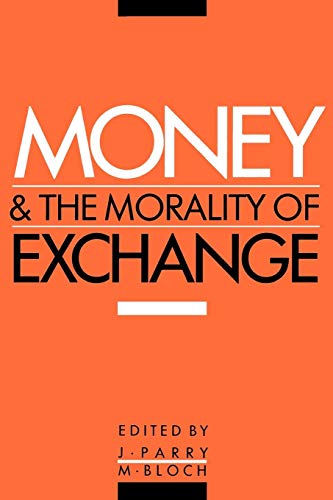
Money and the Morality of Exchange by Jonathan Parry
This volume deals with the way in which money is symbolically represented in a range of different cultures, from South and South-east Asia, Africa and South America. It is also concerned with the moral evaluation of monetary and commercial exchanges as against exchanges of other kinds. The essays cast radical doubt on many Western assumptions about money: that it is the acid which corrodes community, depersonalises human relationships, and reduces differences of quality to those of mere quantity; that it is the instrument of man's freedom, and so on. Rather than supporting the proposition that money produces easily specifiable changes in world view, the emphasis here is on the way in which existing world views and economic systems give rise to particular ways of representing money. But this highly relativistic conclusion is qualified once we shift the focus from money to the system of exchange as a whole. One rather general pattern that then begins to emerge is of two separate but related transactional orders, the majority of systems making some ideological space for relatively impersonal, competitive and individual acquisitive activity. This implies that even in a non-monetary economy these features are likely to exist within a certain sphere of activity, and that it is therefore misleading to attribute them to money. By so doing, a contrast within cultures is turned into a contrast between cultures, thereby reinforcing the notion that money itself has the power to transform the nature of social relationships.Jonathan Parry is Professor Emeritus at the Department of Anthropology in the London School of Economics. He has conducted field research in various parts of India on various different topics. His first study was in a rural area in the sub-Himalayan region where he focused on the classic anthropological themes of caste, kinship, and marriage. He subsequently worked in the city of Banaras where he studied the various communities of 'sacred specialists' in one way or another concerned with the 'business' of death-specialists who preside over rituals concerned with the disposal of the corpse, the fate of the soul, and the purification of the mourners. More recently, Professor Parry has been doing fieldwork on industrial workers in the central Indian steel town of Bhilai (in the Chhattisgarh region of Madhya Pradesh) which was built on a 'green field' site with Soviet collaboration and technology in the late 1950s and early 1960s. The public sector Bhilai Steel Plant is now one of the largest steel plants in Asia, and has served as a magnet for a great deal of private sector industrial development. Part of the fieldwork has focused on shopfloor organisation, but much of it has been conducted in the ex-villages-cum-labour colonies in which the workers have their homes. Professor Parry has also written more widely on the theoretical topics of death, the body, and exchange.
Ajay T.G. is a freelance documentary filmmaker and worked as Professor Parry's research assistant throughout most of the fieldwork on which this monograph reports.
| SKU | Unavailable |
| ISBN 13 | 9780521367745 |
| ISBN 10 | 0521367743 |
| Title | Money and the Morality of Exchange |
| Author | Jonathan Parry |
| Condition | Unavailable |
| Binding Type | Paperback |
| Publisher | Cambridge University Press |
| Year published | 1989-11-09 |
| Number of pages | 288 |
| Cover note | Book picture is for illustrative purposes only, actual binding, cover or edition may vary. |
| Note | Unavailable |