


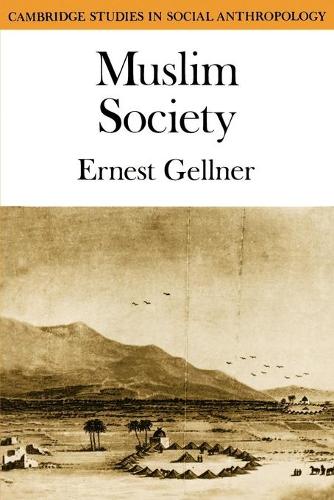
Muslim Society by Ernest Gellner
Of all the great world religions, Islam appears to have the most powerful political appeal in the twentieth century. It sustains some severely traditional and conservative regimes, but it is also capable of generating intense revolutionary ardour and of blending with extreme social radicalism. As an agent of political mobilisation, it seems to be overtaking Marxism, arid surpassing all other religions. The present book seeks the roots of this situation in the past. The traditional Muslim society of the arid zone has, in the past, displayed remarkable stability and homogeneity, despite great political fragmentation, and the absence of a centralised religious hierarchy. The book explores the mechanisms which have contributed to this result - a civilisation in which (in the main) weak states co-existed with a strong culture, which had a powerful hold over the populations under its sway. A literate Great Tradition, in the keeping of urban scholars, lived side by side with a more emotive, ecstatic folk tradition, ill tile keeping of holy lineages, religious brotherhoods and freelance saints. One tradition was sustained by the urban trading class and periodically swept the rest of the society in waves of revivalist enthusiasm; the other was based on the multiple functions it performed in rural tribal society and amongst the urban poor. The two traditions were intertwined, yet remained in latent tension which from time to time came to tile surface. The book traces the manner in which the impact of the modern world, acting through colonialism arid industrialisation upset the once stable balance, and helped the erstwhile urban Great Tradition to become the pervasive arid dominant one, culminating in the zealous arid radical Islam which is so prominent now. The argument is both formulated in the abstract and illustrated by a series of case studies and examinations of specific aspects, and critical examinations of rival interpretations.-
 Outline of a Theory of Practice
-
 Kinship and Marriage
-
 The Anthropology of Numbers
-
 Ritual and Religion in the Making of Humanity
-
 Production and Reproduction
-
 The Sacred Void
-
 The Architecture of Memory
-
 Kinship and Class in the West Indies
-
 World Conqueror and World Renouncer
-
 Power and Intimacy in the Christian Philippines
-
 Contesting Culture
-
 Spirits of Protest
-
 The Roads of Chinese Childhood
-
 Resources and Population
-
 Mangrove Man
-
 The Trading Crowd
-
 Mass Culture and Modernism in Egypt
-
 The Making of the Modern Greek Family
-
 Power and Religiosity in a Post-Colonial Setting
-
 Social Inequality in a Portuguese Hamlet
-
 People and the State
-
 Individual and Society in Guiana
-
 Priests, Witches and Power
-
 Religion and Custom in a Muslim Society
-
 Tradition as Truth and Communication
-
 Bartered Brides
-
 Hunters and Herders of Southern Africa
-
 Spirit Possession and Personhood among the Kel Ewey Tuareg
-
 Varieties of Javanese Religion
-
 Strategies and Norms in a Changing Matrilineal Society
-
 The New Racism in Europe
-
 South Coast New Guinea Cultures
-
 Overlooking Nazareth
-
 The Fish People
-
 Identity through History
-
 A Place of their Own
-
 Tradition and Modernity in the Mediterranean
-
 Stealing People's Names
-
 Casting out Anger
-
 Elite Politics in Rural India
-
 The Making of the Basque Nation
-
 The Abandoned Narcotic
-
 People of the Zongo
-
 Native Lords of Quito in the Age of the Incas
-
 The Bedouin of Cyrenaica
-
 Women and Property in Morocco


'The boldest and most ingenious … attempt in recent years to present a general account of the fundamental features of social life in the Islamic World' Clifford Geertz, New York Review of Books
'Building on the Khaldunian core Professor Gellner has provided us with a series of brilliant essays whose sustained originality, compact argumentation and pervasive wit cannot be adequately described in a review of limited length.' Serif Mardin, Government and Opposition
'The vast amount of information it contains, together with the questions which it successfully raises, makes this in any case the kind of exposé that can be read with genuine intellectual pleasure. Whatever the debate it may provoke amongst specialists, it has enriched the way in which we look at the Muslim world.' Jacques Berque, The Times Literary Supplement
'His conclusions are supported by a keen observation and wide knowledge of his subject, but because they are based exclusively on the North African political scence, how applicable they are elsewhere in the Muslim world remains a question. Nevertheless, Gellner has made an important contribution to the study of Islamic culture.' Abbas Kelidar, SOAS Bulletin
'Brilliant work … Professor Gellner has continued a work to this field that all scholars of Islam, and especially those who uphold the faith, must read with care.' M. A. Zaki Badawi, Arabia
'The revival of Islam … proves to be an apparently insuperable obstacle to modernization, Western-style. From Morocco to Indonesia there are signs of unrest, of the desire for 'purification', with Iran merely the most spectacular illustration. Professor Ernest Gellner is almost uniquely qualified to discuss the implications of this development.' Ralf Dahrendorf, Millenium: Journal of International Studies
' … the first essay … which is much the longest in the book … I consider … to be of outstanding importance. It should be compulsory reading for all novice readers of social anthropology.' Sir Edmund Leach, New Society
'Building on the Khaldunian core Professor Gellner has provided us with a series of brilliant essays whose sustained originality, compact argumentation and pervasive wit cannot be adequately described in a review of limited length.' Serif Mardin, Government and Opposition
'The vast amount of information it contains, together with the questions which it successfully raises, makes this in any case the kind of exposé that can be read with genuine intellectual pleasure. Whatever the debate it may provoke amongst specialists, it has enriched the way in which we look at the Muslim world.' Jacques Berque, The Times Literary Supplement
'His conclusions are supported by a keen observation and wide knowledge of his subject, but because they are based exclusively on the North African political scence, how applicable they are elsewhere in the Muslim world remains a question. Nevertheless, Gellner has made an important contribution to the study of Islamic culture.' Abbas Kelidar, SOAS Bulletin
'Brilliant work … Professor Gellner has continued a work to this field that all scholars of Islam, and especially those who uphold the faith, must read with care.' M. A. Zaki Badawi, Arabia
'The revival of Islam … proves to be an apparently insuperable obstacle to modernization, Western-style. From Morocco to Indonesia there are signs of unrest, of the desire for 'purification', with Iran merely the most spectacular illustration. Professor Ernest Gellner is almost uniquely qualified to discuss the implications of this development.' Ralf Dahrendorf, Millenium: Journal of International Studies
' … the first essay … which is much the longest in the book … I consider … to be of outstanding importance. It should be compulsory reading for all novice readers of social anthropology.' Sir Edmund Leach, New Society
Gellner, Ernest: -
Ernest Gellner was Professor of Philosophy at the London School of Economics from 1962 to 1984, when he became Professor of Social Anthropology at Cambridge University. Before his death in 1995, he was Research Professor and Director of the Center for the Study of Nationalism at the Central European University in Prague. His many books include Words and Things, Thoughts and Change, Saints of the Atlas, Nations and Nationalism, Culture, Identity and Politics, Plough, Sword, and Book, and Conditions of Liberty
| SKU | Unavailable |
| ISBN 13 | 9780521274074 |
| ISBN 10 | 0521274079 |
| Title | Muslim Society |
| Author | Ernest Gellner |
| Series | Cambridge Studies In Social And Cultural Anthropology |
| Condition | Unavailable |
| Binding Type | Paperback |
| Publisher | Cambridge University Press |
| Year published | 1983-03-03 |
| Number of pages | 284 |
| Cover note | Book picture is for illustrative purposes only, actual binding, cover or edition may vary. |
| Note | Unavailable |