


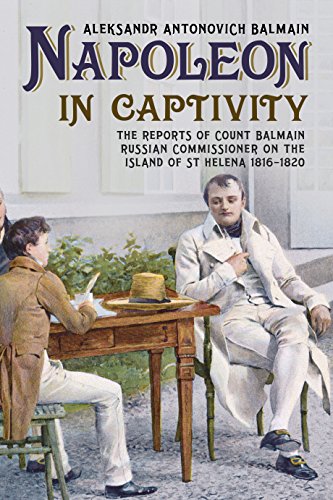
Napoleon in Captivity by Aleksandr Antonovich Gra Balmain
The 1815 Treaty of Paris was signed between France on the one hand and the victorious Allied powers of Britain, Austria, Prussia and Russia on the other. One of the treaty terms allowed each nation to send a commissioner to St. Helena to observe Napoleon's captivity. Russia accepted this and sent Count Balmain to report back to St. Petersburg. The reports of Count Balmain are infinitely superior in value and interest to all other accounts; they are very witty and interesting -- witty, perhaps. They are certainly vivid and readable, and he took vast pains to make them so because he knew his emperor read them carefully. Balmain went into great detail about the island, the inhabitants, the cost of food and all sorts of minutiae which he felt would appeal to and interest his master back in St. Petersburg. It is the 'gossipy nature' of the book as well as the detail it contains which makes the text so readable and fresh. A classic account of Napoleon's imprisonment. 'As it is scarcely possible to give a description of St. Helena other than that already well known in Europe, I content myself with repeating that it seems to me to be that spot in the world which is the saddest, the most isolated, the most unapproachable, the easiest to defend, the hardest to attack, the most unsociable, the poorest, the dearest, and especially the most appropriate for the use to which it is now put. Such is the general idea which one must have of it. Any attempt against the island would be pure madness. 1 believe that I can already assure you of that. Nature has contributed the first and the greatest obstacles, and the English Governor does not cease to add to the means of defense, the greater part of which seems unnecessary. Three regiments of infantry, five companies of artillery, a detachment of dragoons for the service of a rather considerable staff, form the extent of the garrison. Two frigates, one of them of 50 guns, some brigs and sloops guard the sea, and the number of cannon disposable on the coasts and the interior of the country is striking
Alexandre Antonovich, Comte de Balmain, was descended from a Scottish family, the Ramsays of Balmain, which had left Scotland in 1685 and emigrated to Russia. His father had occupied the high post of governor-general of the Kursk Government. In 1801, aged twenty but already a captain, Balmain was dismissed from his cavalry regiment for having struck a policeman in a street row, but, restored to imperial favour a few days afterward when Tsar Alexander suddenly came to the throne, he elected for the diplomatic service. There is where, no doubt, he belonged, for he was clever, somewhat unscrupulous, ambitious, fond of society, which soon became fond of him. During his missions at Naples, Vienna, and London, he did very little work, but already, in his fourth decade, he felt physically tired out from the occupations of a homeless, idle, diplomatic career, and morally from his elegant, easy-going scepticism. It was rather becoming to him, and he seems to have increased the pose; for one thing, he knew that it pleased women. In 1813 he re-entered the army and saw active service culminating at Waterloo. As a reward he was offered the post of commissioner to St. Helena. Professor Julian Park, (1888-1965) was the first dean of Arts and Sciences (1919-1954) of The University at Buffalo, and served as the University's first historian (1959-1965). He served as French Consul for Western New York; served on the council of the American Association of University Professors; was president of the Buffalo Assoc. of the Sons of the Revolution. He was lecturer; Geneva School of International Studies; appointed Chevelier (knight) of the Legion of Honor; director of the Pan-American League Against Cancer; and even ran for a seat in the US Congress on the Demoratic ticket in 1942, saying "it had always seemed to me that we who teach and preach politics ought to get a practical taste of it." He was promoted to "Officer of the Legion of Honor" by the President of France for his contributions to strengthen the bonds of friendship between France and the US. From 1955-1959 he was President of the Buffalo Historical Society and presented the prestigious Red Jacket Award from the Buffalo and Erie County Historical Society.
| SKU | Unavailable |
| ISBN 13 | 9781781551202 |
| ISBN 10 | 1781551200 |
| Title | Napoleon in Captivity |
| Author | Aleksandr Antonovich Gra Balmain |
| Condition | Unavailable |
| Binding Type | Paperback |
| Publisher | Fonthill Media Ltd |
| Year published | 2013-09-01 |
| Number of pages | 160 |
| Cover note | Book picture is for illustrative purposes only, actual binding, cover or edition may vary. |
| Note | Unavailable |