


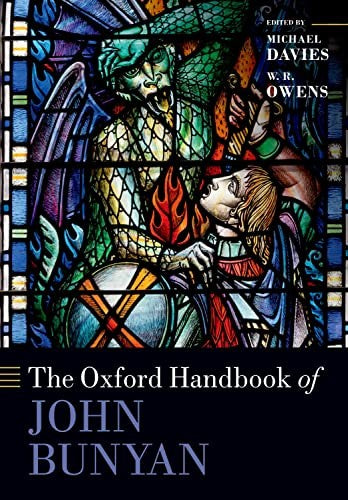
The Oxford Handbook of John Bunyan by Michael Davies
The Oxford Handbook of John Bunyan is the most extensive volume of original essays ever published on the seventeenth-century nonconformist preacher and writer, John Bunyan. Its thirty-eight chapters examine Bunyan's life and works, their religious and historical contexts, and the critical reception of his writings, in particular his allegorical narrative, The Pilgrim's Progress. Interdisciplinary and comprehensive, it provides unparalleled scope and expertise, ranging from literary theory to religious history and from theology to post-colonial criticism. The Handbook is structured in four sections. The first, 'Contexts', deals with the historical Bunyan in relation to various aspects of his life, background, and work as a nonconformist: from basic facts of biography to the nature of his church at Bedford, his theology, and the religious and political cultures of seventeenth-century Dissent. Part 2 considers Bunyan's literary output: from his earliest printed tracts to his posthumously published works. Offering discrete chapters on Bunyan's major works - Grace Abounding to the Chief of Sinners (1666), The Pilgrim's Progress, Parts I and II (1678; 1684); The Life and Death of Mr. Badman (1680), and The Holy War (1682) - this section nevertheless covers Bunyan's oeuvre in its entirety: controversial and pastoral, narrative and poetic. Section 3, 'Directions in Criticism', engages with Bunyan in literary critical terms, focusing on his employment of form and language and on theoretical approaches to his writings: from psychoanalytic to post-secular criticism. Section 4, 'Journeys', tackles some of the ways in which Bunyan's works, and especially The Pilgrim's Progress, have travelled throughout the world since the late seventeenth century, assessing Bunyan's place within key literary periods and their distinctive developments: from the eighteenth-century novel to the writing of 'empire'.
The surprising facility with which Bunyan's works have been appropriated in the service of widely divergent philosophical, political, and aesthetic arguments is beautifully exemplified by this wonderfully readable, interesting, and useful volume* Mark Burden, The Seventeenth Century *
There can be no doubting the worth of this remarkable collection of essays on all things Bunyan. It is a celebration of the last fruitful few decades in which Bunyan Studies has come into its own. This is also a monumental work: nearly seven-hundred pages long; structured with elegant coherence in four parts; comprising no less than 38 essays plus an introduction; and including the mature work of so many capable scholars at the top of their game. The sheer magnitude of the volume, together with the vision, labour and ambition of the editors, is impressive. * Tim Cooper, The Journal of Andrew Fuller Studies *
This beautifully produced volume is coherent, wide-ranging, and full of delights. It brings together a global roster of Bunyan experts from the United Kingdom, United States, Canada, France, Japan and Israel who write with confidence on topics that they have pursued throughout their careers. Contributors cite each other's work frequently, creating a strong sense of respect for foregoing scholarship and creating a dynamic of long-running conversations being picked up and pursued. A volume could not contain more expertise than this. * Tessa Whitehouse, XVII-XVIII: Revue de la Société d'études anglo-américaines des XVIIe et XVIIIe siècles *
With an impressive range of high-quality contributions from the best scholars in the field, The Oxford Handbook of John Bunyan was always likely to become the most important single volume guide to this hugely significant puritan writer for a generation; what cannot have been foreknown (although it must have been pre-planned at length) is the sheer delight with which the reader peruses this elegantly constructed and beautifully readable account of the order and structure of Bunyan's mental and physical worlds. * Mark Burden, University of Bristol, The Seventeenth Century *
[The book] is an extensive resource that will be consulted by people seeking an informative yet focussed introduction to the man, his works, his times and his influence. * Stephen Copson, Baptist Quarterly *
This is the ideal book for all Bunyan enthusiasts both within and without the churches ... the editors are to be congratulated not only on a wide-ranging choice of essay topics ... Oxford University Press has produced a handsome volume which would be welcome on most book lovers' shelves. * Alan Argent, Congregational History Society Magazine *
There can be no doubting the worth of this remarkable collection of essays on all things Bunyan. It is a celebration of the last fruitful few decades in which Bunyan Studies has come into its own. This is also a monumental work: nearly seven-hundred pages long; structured with elegant coherence in four parts; comprising no less than 38 essays plus an introduction; and including the mature work of so many capable scholars at the top of their game. The sheer magnitude of the volume, together with the vision, labour and ambition of the editors, is impressive. * Tim Cooper, The Journal of Andrew Fuller Studies *
This beautifully produced volume is coherent, wide-ranging, and full of delights. It brings together a global roster of Bunyan experts from the United Kingdom, United States, Canada, France, Japan and Israel who write with confidence on topics that they have pursued throughout their careers. Contributors cite each other's work frequently, creating a strong sense of respect for foregoing scholarship and creating a dynamic of long-running conversations being picked up and pursued. A volume could not contain more expertise than this. * Tessa Whitehouse, XVII-XVIII: Revue de la Société d'études anglo-américaines des XVIIe et XVIIIe siècles *
With an impressive range of high-quality contributions from the best scholars in the field, The Oxford Handbook of John Bunyan was always likely to become the most important single volume guide to this hugely significant puritan writer for a generation; what cannot have been foreknown (although it must have been pre-planned at length) is the sheer delight with which the reader peruses this elegantly constructed and beautifully readable account of the order and structure of Bunyan's mental and physical worlds. * Mark Burden, University of Bristol, The Seventeenth Century *
[The book] is an extensive resource that will be consulted by people seeking an informative yet focussed introduction to the man, his works, his times and his influence. * Stephen Copson, Baptist Quarterly *
This is the ideal book for all Bunyan enthusiasts both within and without the churches ... the editors are to be congratulated not only on a wide-ranging choice of essay topics ... Oxford University Press has produced a handsome volume which would be welcome on most book lovers' shelves. * Alan Argent, Congregational History Society Magazine *
Michael Davies is Senior Lecturer in English at the University of Liverpool. Among his publications is Graceful Reading: Theology and Narrative in the Works of John Bunyan (2002). He is currently preparing a critical edition of The Bunyan Church Book, 1656-1710 for Oxford University Press.
W. R. Owens is Emeritus Professor of English Literature at the Open University, and Visiting Professor at the University of Bedfordshire. His publications include volumes XII and XIII of The Miscellaneous Works of John Bunyan (1994), editions of Grace Abounding (1987) and The Pilgrim's Progress (2003), The Canonisation of Daniel Defoe (co-author, 1988), A Critical Bibliography of Daniel Defoe (co-author, 1998), The Works of Daniel Defoe (joint General Editor, 44 volumes, 2000-2009), and an edition of The Gospels: Authorized King James Version (2011).
| SKU | Unavailable |
| ISBN 13 | 9780192855688 |
| ISBN 10 | 0192855689 |
| Title | The Oxford Handbook of John Bunyan |
| Author | Michael Davies |
| Series | Oxford Handbooks |
| Condition | Unavailable |
| Binding Type | Paperback |
| Publisher | Oxford University Press |
| Year published | 2021-10-12 |
| Number of pages | 734 |
| Prizes | Winner of Winner of the Richard L. Greaves Prize of the. |
| Cover note | Book picture is for illustrative purposes only, actual binding, cover or edition may vary. |
| Note | Unavailable |