


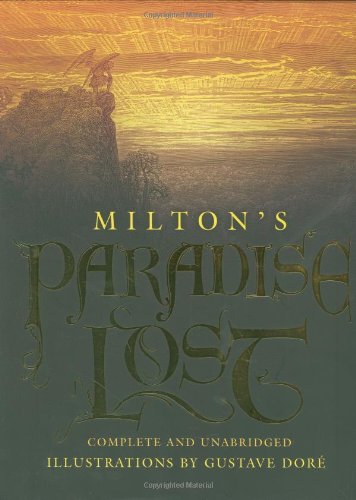
Paradise Lost by John Milton
This book is a result of an effort made by us towards making a contribution to the preservation and repair of original classic literature. In an attempt to preserve, improve and recreate the original content, we have worked towards: 1. Type-setting & Reformatting: The complete work has been re-designed via professional layout, formatting and type-setting tools to re-create the same edition with rich typography, graphics, high quality images, and table elements, giving our readers the feel of holding a 'fresh and newly' reprinted and/or revised edition, as opposed to other scanned & printed (Optical Character Recognition - OCR) reproductions. 2. Correction of imperfections: As the work was re-created from the scratch, therefore, it was vetted to rectify certain conventional norms with regard to typographical mistakes, hyphenations, punctuations, blurred images, missing content/pages, and/or other related subject matters, upon our consideration. Every attempt was made to rectify the imperfections related to omitted constructs in the original edition via other references. However, a few of such imperfections which could not be rectified due to intentionalunintentional omission of content in the original edition, were inherited and preserved from the original work to maintain the authenticity and construct, relevant to the work. We believe that this work holds historical, cultural and/or intellectual importance in the literary works community, therefore despite the oddities, we accounted the work for print as a part of our continuing effort towards preservation of literary work and our contribution towards the development of the society as a whole, driven by our beliefs. We are grateful to our readers for putting their faith in us and accepting our imperfections with regard to preservation of the historical content. HAPY READING
Milton, John: - John Milton (9 December 1608 - 8 November 1674) was an English poet, polemicist, man of letters, and civil servant for the Commonwealth of England under its Council of State and later under Oliver Cromwell. He wrote at a time of religious flux and political upheaval, and is best known for his epic poem Paradise Lost (1667), written in blank verse. Writing in English, Latin, Greek, and Italian, he achieved international renown within his lifetime, and his celebrated Areopagitica (1644), written in condemnation of pre-publication censorship, is among history's most influential and impassioned defences of freedom of speech and freedom of the press. His desire for freedom extended into his style: he introduced new words (coined from Latin) to the English language, and was the first modern writer to employ non-rhymed verse outside of the theatre or translations. William Hayley's 1796 biography called him the greatest English author, [1] and he remains generally regarded as one of the preeminent writers in the English language, [2] though critical reception has oscillated in the centuries since his death (often on account of his republicanism). Samuel Johnson praised Paradise Lost as a poem which...with respect to design may claim the first place, and with respect to performance, the second, among the productions of the human mind, though he (a Tory and recipient of royal patronage) described Milton's politics as those of an acrimonious and surly republican.[3] Poets such as William Blake, William Wordsworth and Thomas Hardy revered him. The phases of Milton's life parallel the major historical and political divisions in Stuart Britain. Milton studied, travelled, wrote poetry mostly for private circulation, and launched a career as pamphleteer and publicist under the increasingly personal rule of Charles I and its breakdown into constitutional confusion and war. The shift in accepted attitudes in government placed him in public office under the Commonwealth of England, from being thought dangerously radical and even heretical, and he even acted as an official spokesman in certain of his publications. The Restoration of 1660 deprived Milton, now completely blind, of his public platform, but this period saw him complete most of his major works of poetry. Milton's views developed from his very extensive reading, as well as travel and experience, from his student days of the 1620s to the English Civil War.[4] By the time of his death in 1674, Milton was impoverished and on the margins of English intellectual life, yet famous throughout Europe and unrepentant for his political choices. John Milton was born in Bread Street, London on 9 December 1608, the son of composer John Milton and his wife Sarah Jeffrey. The senior John Milton (1562-1647) moved to London around 1583 after being disinherited by his devout Catholic father Richard the Ranger Milton for embracing Protestantism.[5] In London, the senior John Milton married Sarah Jeffrey (1572-1637) and found lasting financial success as a scrivener.[6] He lived in and worked from a house on Bread Street, where the Mermaid Tavern was located in Cheapside. The elder Milton was noted for his skill as a musical composer, and this talent left his son with a lifelong appreciation for music and friendships with musicians such as Henry Lawes.[7]
| SKU | Unavailable |
| ISBN 13 | 9781841932514 |
| ISBN 10 | 1841932515 |
| Title | Paradise Lost |
| Author | John Milton |
| Condition | Unavailable |
| Binding Type | Hardback |
| Publisher | Arcturus Publishing Ltd |
| Year published | 2010-09-28 |
| Number of pages | 384 |
| Cover note | Book picture is for illustrative purposes only, actual binding, cover or edition may vary. |
| Note | Unavailable |