


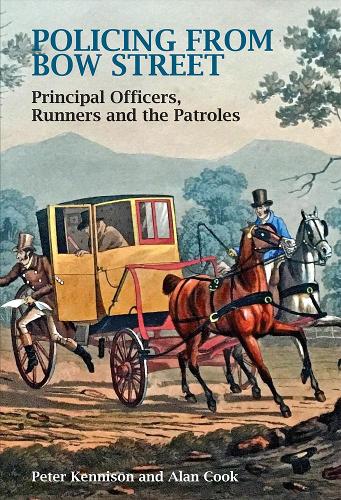
Policing From Bow Street by Peter Kennison
The starting point for many scholars studying the art and science of crime investigation wrongly begins with the creation of Robert Peel's New Police in 1829, yet basic policing and investigative elements had been tried and tested at least 80 years before that. In mid-Georgian times, the playwright and magistrate Henry Fielding realised the ineffectiveness of the Parish Police Parochial Watch system that press-ganged traders and merchants into doing their civil duty as Constables. Each Parish Watch operated independently within its own boundary, but since crime fails to respect boundaries many perpetrators escaped. Crimes committed often went unreported for want of a real central police organisation. An innovative plan was needed, and through Fielding's determination the Bow Street Public Office became the "Centre Office" for victims reporting their crimes in and around London. This was the first police station and court building; a hub for crime administration, accommodation for police officers, a place to detain prisoners. Fielding established the Criminal Records system of searchable registers at the Centre Office. Gathering intelligence on crime and criminals not only provided for the first time an understanding of criminality, but also allowed offenders to be caught after the crime had been committed. Fielding also formed the Foot Patroles, an organised and regulated body of men, to combat riots, gangs and street disorder, thus establishing an early police sub-culture. This detailed narrative seeks to go behind the scenes of Bow Street to a secret world denied to the majority. The professional and private lives of the Justices and Officers - often called the 'Runners' - are examined here for the first time, revealing their secrets, their experiences and their brave exploits which established them as honest thief-takers, constables and the first early detectives.
ALAN MOSS, a Classics graduate from Durham University, served as a Metropolitan Police officer for 30 years, retiring as a Chief Superintendent in 1997. He has worked abroad in police training and consultancy, was involved in planning for a Metropolitan Police museum at Bow Street, has co-authored a number of books about policing history with Keith Skinner, has made a number of TV appearances about policing history and operates a website about the history of London policing at www.historybytheyard.co.uk. DAVID SWINDEN MSC., DMS., PgDip (History) retired from the Metropolitan Police as a Superintendent in 1994. His 36 years' Police service was spent in north and east London and at New Scotland Yard. He also carried out police consultancy projects in the USA, Uganda and Gibraltar. After retiring from the Police service he became a senior lecturer in Human Resources Management at the University of East London, and was responsible for a number of educational programmes worldwide. PETER KENNISON BA, MA, PhD has been a practitioner and academic for over 35 years. He joined the Metropolitan Police in 1970 and over a career spanning nearly three decades he served on five Police divisions in north and east London, the Police Training School at Hendon, and in the Complaints Investigation Branch (CIB3) at New Scotland Yard. His interests include policing (including its historical context), child protection and community safety. Peter is now fully retired having been a senior lecturer in Criminology at the Universities of Middlesex and Brighton.
| SKU | Unavailable |
| ISBN 13 | 9781911273387 |
| ISBN 10 | 1911273388 |
| Title | Policing From Bow Street |
| Author | Peter Kennison |
| Condition | Unavailable |
| Binding Type | Hardback |
| Publisher | Mango Books |
| Year published | 2019-03-29 |
| Number of pages | 440 |
| Cover note | Book picture is for illustrative purposes only, actual binding, cover or edition may vary. |
| Note | Unavailable |