


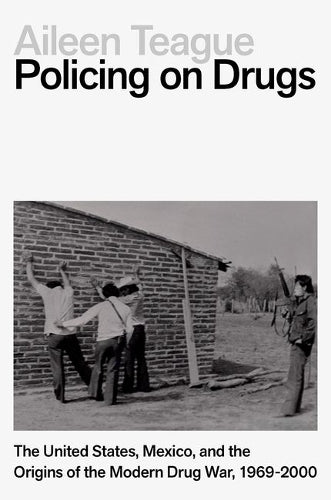
Policing on Drugs by Aileen Teague
Today, images of cartels, security agents donning face coverings, graphs depicting egregious murder rates, and military guards at US border crossings influence the world's perception of Mexico. Mexico's so-called drug war, as generally conceived by journalists and academics, was the product of recent cartel turf wars, the end of the PRI's single party rule in 2000, and enhanced US border security measures post-9/11. These explanations are compelling, but they overlook state actions beginning in the 1970s that set the foundation for drug violence over the longer term. In Policing on Drugs, Aileen Teague chronicles a largely ignored but critical prehistory of intensified bilateral antidrug efforts by exploring their origins and inherent contradictions in Mexico. Beginning in the 1960s, US leaders externalized their aggressive domestic drug control practices by forcing junior partners such as Mexico into adopting their policies. Leaders on both sides of the border situated counternarcotics within a larger paradigm of militarized policing, which increased the power and influence of the military and aggressive counternarcotics in both countries. However, different security imperatives motivated US and Mexican agents, complicating enforcement in Mexico. Between 1969 and 2000, Mexico's embrace of America's punitive antidrug policies strengthened the coercive capacities of the Mexican state, exacerbated crime, and were so ineffective in an era of open trade blocs that they hastened the expansion of the drug trade. Drawing on such sources as records from the Drug Enforcement Administration (DEA), the US State Department, interviews with key officials, accounts from Mexican journalists, and rarely seen Mexican intelligence reports, Teague relates the war on drugs as a transnational story with deep historical roots in US and Mexican conceptions of policing and security. The negative impacts of US-led counternarcotics policies in Mexico can be attributed to the complex relationship between the United States' and Mexico's shared approach to the drug war--with critical implications for present-day relations.
Policing on Drugs is an impressively researched and powerfully relevant history of how the United States and Mexico built a militarized drug enforcement campaign whose failures are well known but whose origins are either forgotten or poorly understoodAileen Teague shows that this was not simply imposed by Washington but served distinct interests on both sides of the border * even as it persistently failed and generated counterproductive consequences. The book is essential reading for anyone who wants to understand the origins of today's fully militarized drug war in Mexico.Peter Andreas, author of Border Games: The Politics of Policing the U.S.-Mexico Divide *
Aileen Teague's outstanding exploration of the relationship between Mexican and American efforts to control the War on Drugs provides revealing research from both countries' archives, focusing on a wide range of actors, including the military, intelligence, police, diplomats, politicians, and opposition movements in Mexico. By interweaving Mexico's dirty war on leftists' groups in her analysis of strategies against drug traffickers, readers' will deepen their understanding of the complexities of domestic and international collaboration. * Roderic Ai Camp, Philip McKenna Professor Emeritus of the Pacific Rim, Claremont McKenna College *
Policing on Drugs offers a much-needed historical perspective on the militarization of drug enforcement. Mexico and the US influenced each other through their collaboration, confrontations and shared, stubborn policy mistakes. This is a thorough, clear, and at times surprising reconstruction of the entrenched policy failure that today shapes both countries' societies and politics. * Pablo Piccato, author of A Brief History of Violence in Mexico *
Even after the War on Drugs was declared a failure, the idea that violence was collateral damage remained untouched. Aileen Teague's carefully crafted Policing on Drugs disabuses us of this conviction. Disentangling the threads of US and Mexican governments' political interests and social dilemmas, Teague reveals that at the core of the militarized drug control paradigm instituted in the last quarter of the 20th century lays a political project of policing dissent and racial and ethnic 'others.' With untapped governmental documents, including intelligence sources, and a clear narrative, Teague confirms what many of us suspected: the War on Drugs was not about drugs, and its violence was not an undesirable byproduct but its most intentional weapon of choice. * Lina Britto, Associate Professor of History, Northwestern University, and author of Marijuana Boom: The Rise and Fall of Colombia's First Drug Paradise *
Aileen Teague's outstanding exploration of the relationship between Mexican and American efforts to control the War on Drugs provides revealing research from both countries' archives, focusing on a wide range of actors, including the military, intelligence, police, diplomats, politicians, and opposition movements in Mexico. By interweaving Mexico's dirty war on leftists' groups in her analysis of strategies against drug traffickers, readers' will deepen their understanding of the complexities of domestic and international collaboration. * Roderic Ai Camp, Philip McKenna Professor Emeritus of the Pacific Rim, Claremont McKenna College *
Policing on Drugs offers a much-needed historical perspective on the militarization of drug enforcement. Mexico and the US influenced each other through their collaboration, confrontations and shared, stubborn policy mistakes. This is a thorough, clear, and at times surprising reconstruction of the entrenched policy failure that today shapes both countries' societies and politics. * Pablo Piccato, author of A Brief History of Violence in Mexico *
Even after the War on Drugs was declared a failure, the idea that violence was collateral damage remained untouched. Aileen Teague's carefully crafted Policing on Drugs disabuses us of this conviction. Disentangling the threads of US and Mexican governments' political interests and social dilemmas, Teague reveals that at the core of the militarized drug control paradigm instituted in the last quarter of the 20th century lays a political project of policing dissent and racial and ethnic 'others.' With untapped governmental documents, including intelligence sources, and a clear narrative, Teague confirms what many of us suspected: the War on Drugs was not about drugs, and its violence was not an undesirable byproduct but its most intentional weapon of choice. * Lina Britto, Associate Professor of History, Northwestern University, and author of Marijuana Boom: The Rise and Fall of Colombia's First Drug Paradise *
Aileen Teague is an Assistant Professor of International Affairs at the Bush School of Government and Public Service at Texas A&M University. She is a former Marine Corps officer and a fellow at the Quincy Institute for Responsible Statecraft. Her writing has appeared in the Washington Post and Time, among other outlets.
| SKU | Unavailable |
| ISBN 13 | 9780197761861 |
| ISBN 10 | 0197761860 |
| Title | Policing on Drugs |
| Author | Aileen Teague |
| Condition | Unavailable |
| Binding Type | Hardback |
| Publisher | Oxford University Press Inc |
| Year published | 2026-01-06 |
| Number of pages | 232 |
| Cover note | Book picture is for illustrative purposes only, actual binding, cover or edition may vary. |
| Note | Unavailable |