
Political Determinants of Corporate Governance


The feel-good place to buy books
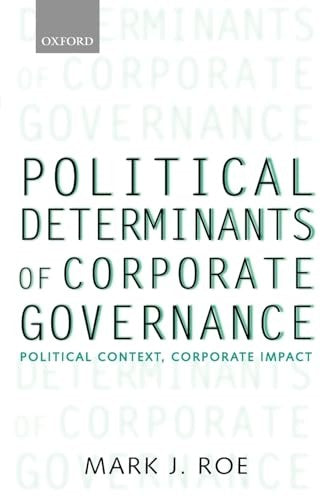
Political Determinants of Corporate Governance by Mark J Roe
Before a nation can produce, it must achieve social peace. That social peace has been reached in different nations by differing means, some of which have then been embedded in business firms, in corporate ownership patterns, and in corporate governance structures. The large publicly held, diffusely owned firm dominates business in the United States despite its infirmities, namely the frequently fragile relations between stockholders and managers. But in other economically advanced nations, ownership is not diffuse but concentrated. It is concentrated in no small measure because the delicate threads that tie managers to shareholders in the public firm fray easily in common political environments, such as those in the continental European social democracies. Social democracies press managers to stabilize employment, to forego some profit-maximizing risks with the firm, and to use up capital in place rather than to downsize when markets no longer are aligned with the firm's production capabilities. Since managers must have discretion in the public firm, how they use that discretion is crucial to stockholders, and social democratic pressures induce managers to stray farther than otherwise from their shareholders' profit-maximizing goals. Moreover, the means that align managers with diffuse stockholders in the United States-incentive compensation, hostile takeovers, and strong shareholder-wealth maximization norms-are weaker and sometimes denigrated in continental social democracies.Hence, public firms there have higher managerial agency costs, and large-block shareholding has persisted as shareholders' best remaining way to control those costs. Social democracies may enhance total social welfare, but if they do, they do so with fewer public firms than less socially responsive nations. The author therefore uncovers not only a political explanation for ownership concentration in Europe, but also a crucial political prerequisite to the rise of the public firm in the United States, namely the weakness of social democratic pressures on the American business firm.
Review from previous edition Review from other book by this author Strong Managers, Weak Owners does for corporate governance what Alfred Chandler's The Visiting Hand did for the corporation: makes history essential to understanding current practice and policy* Robert Teitelman, Institutional Investor *
Roe has provided a powerful and original explanation of the emergence and persistence of managerial autonomy in the United States. * David Vogel, University of California, Berkeley *
A seminal work that should become [a] mainstay for years to come. * Peter H. Aranson, Emory University *
I definitely recommend this book to all scholars of corporate governance and anybody else interested in the origins of corporate governance systems ... a joy to read ... Roe's book is a welcome and stimulating addition to the field. * Marc Goergen (Manchester School of Management and European Corporate Governance Institute), Corporate Governance: An International Review *
Roe has provided a powerful and original explanation of the emergence and persistence of managerial autonomy in the United States. * David Vogel, University of California, Berkeley *
A seminal work that should become [a] mainstay for years to come. * Peter H. Aranson, Emory University *
I definitely recommend this book to all scholars of corporate governance and anybody else interested in the origins of corporate governance systems ... a joy to read ... Roe's book is a welcome and stimulating addition to the field. * Marc Goergen (Manchester School of Management and European Corporate Governance Institute), Corporate Governance: An International Review *
Mark J. Roe is Berg Professor Law at the Harvard Law School. He has previously held positions at Columbia University School of Law; University of Pennsylvania School of Law; and Rutgers University School of Law. His publications include Corporate Reorganization and Bankruptcy: Legal and Financial Materials (Foundation Press, 2000) and Strong Managers, Weak Owners: The Political Roots of American Corporate Finance (Princeton University Press, 1994).
| SKU | Unavailable |
| ISBN 13 | 9780199205301 |
| ISBN 10 | 0199205302 |
| Title | Political Determinants of Corporate Governance |
| Author | Mark J Roe |
| Series | Clarendon Lectures In Management Studies |
| Condition | Unavailable |
| Binding Type | Paperback |
| Publisher | Oxford University Press |
| Year published | 2006-07-20 |
| Number of pages | 244 |
| Cover note | Book picture is for illustrative purposes only, actual binding, cover or edition may vary. |
| Note | Unavailable |