
The Prince and the Pauper (Illustrated by Franklin Booth)


The Prince and the Pauper (Illustrated by Franklin Booth)
The feel-good place to buy books
- Free UK delivery over £5
- 10% off preloved books when you join +Plus
- Buying preloved emits 46% less CO2 than new
- Give your books a new home - sell them back to us!
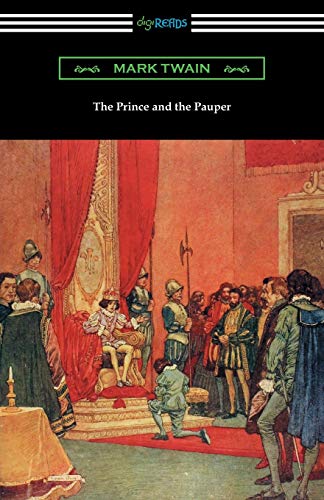
The Prince and the Pauper (Illustrated by Franklin Booth) by Mark Twain
Mark Twain's first attempt at historical fiction, The Prince and the Pauper, was first published in 1881. It is a story set in the time of Prince Edward, of house Tudor, who at age nine would become King Edward VI. When young Prince Edward meets a Pauper, Tom Canty, who likes a lot like him, he convinces the two to switch clothes so that they can be mistaken for each other and end up switching places. While they play out their new roles, Prince Edward learns of the struggles of the commoners of England while Tom discovers what it is like to be a Prince and then a King. Twain wrote with regards to his novel that, My idea is to afford a realizing sense of the exceeding severity of the laws of that day by inflicting some of their penalties upon the King himself and allowing him a chance to see the rest of them applied to others. . . A delightfully comedic tale, The Prince and the Pauper is at its heart a social commentary on judging others simply by their appearance. This edition is printed on premium acid-free paper and includes the illustrations of Franklin Booth.
Mark Twain was born Samuel Langhorne Clemens on November 30, 1835, in Florida, Missouri; his family moved to the port town of Hannibal four years later. His father, an unsuccessful farmer, died when Twain was eleven. Soon afterward the boy began working as an apprentice printer, and by age sixteen he was writing newspaper sketches. He left Hannibal at eighteen to work as an itinerant printer in New York, Philadelphia, St. Louis, and Cincinnati. From 1857 to 1861 he worked on Mississippi steamboats, advancing from cub pilot to licensed pilot. After river shipping was interrupted by the Civil War, Twain headed west with his brother Orion, who had been appointed secretary to the Nevada Territory. Settling in Carson City, he tried his luck at prospecting and wrote humorous pieces for a range of newspapers. Around this time he first began using the pseudonym Mark Twain, derived from a riverboat term. Relocating to San Francisco, he became a regular newspaper correspondent and a contributor to the literary magazine the Golden Era. He made a five-month journey to Hawaii in 1866 and the following year traveled to Europe to report on the first organized tourist cruise. The Celebrated Jumping Frog of Calaveras County and Other Sketches (1867) consolidated his growing reputation as humorist and lecturer. After his marriage to Livy Langdon, Twain settled first in Buffalo, New York, and then for two decades in Hartfort, Connecticut. His European sketches were expanded into The Innocents Abroad (1869), followed by Roughing It (1872), an account of his Western adventures; both were enormously successful. Twain's literary triumphs were offset by often ill-advised business dealings (he sank thousands of dollars, for instance, in a failed attempt to develop a new kind of typesetting machine, and thousands more into his own ultimately unsuccessful publishing house) and unrestrained spending that left him in frequent financial difficulty, a pattern that was to persist throughout his life. Following The Gilded Age (1873), written in collaboration with Charles Dudley Warner, Twain began a literary exploration of his childhood memories of the Mississippi, resulting in a trio of masterpieces--The Adventures of Tom Sawyer (1876), Life on the Mississippi (1883), and finally The Adventures of Huckleberry Finn (1885), on which he had been working for nearly a decade. Another vein, of historical romance, found expression in The Prince and the Pauper (1882), the satirical A Connecticut Yankee in King Arthur's Court (1889), and Personal Recollections of Joan of Arc (1896), while he continued to draw on his travel experiences in A Tramp Abroad (1880) and Following the Equator (1897). His close associates in these years included William Dean Howells, Bret Harte, and George Washington Cable, as well as the dying Ulysses S. Grant, whom Twain encouraged to complete his memoirs, published by Twain's publishing company in 1885. For most of the 1890s Twain lived in Europe, as his life took a darker turn with the death of his daughter Susy in 1896 and the worsening illness of his daughter Jean. The tone of Twain's writing also turned progressively more bitter. The Tragedy of Pudd'nhead Wilson (1894), a detective story hinging on the consequences of slavery, was followed by powerful anti-imperialist and anticolonial statements such as 'To the Person Sitting in Darkness' (1901), 'The War Prayer' (1905), and 'King Leopold's Soliloquy' (1905), and by the pessimistic sketches collected in the privately published What Is Man? (1906). The unfinished novel The Mysterious Stranger was perhaps the most uncompromisingly dark of all Twain's later works. In his last years, his financial troubles finally resolved, Twain settled near Redding, Connecticut, and died in his mansion, Stormfield, on April 21, 1910.
| SKU | Unavailable |
| ISBN 13 | 9781420954722 |
| ISBN 10 | 1420954725 |
| Title | The Prince and the Pauper (Illustrated by Franklin Booth) |
| Author | Mark Twain |
| Condition | Unavailable |
| Binding Type | Paperback |
| Publisher | Digireads.com |
| Year published | 2017-01-29 |
| Number of pages | 154 |
| Cover note | Book picture is for illustrative purposes only, actual binding, cover or edition may vary. |
| Note | Unavailable |