


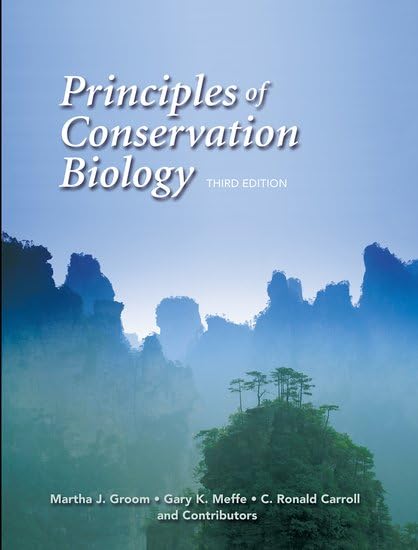
Principles of Conservation Biology by Martha J Groom
Principles of Conservation Biology, Third Edition, features a wholly revised organization, emphasizing analyses of different categories of threat and approaches to conservation. Coverage has been expanded to incorporate both terrestrial and marine conservation issues, and efforts in the U.S. and across the globe.The book's eighteen chapters introduce the major themes and concepts of this diverse and dynamic field. The biological and social underpinnings of conservation problems and potential solutions are interwoven throughout the text, which is divided into three sections: foundations of the field, threats to biodiversity, and approaches to solving conservation problems. Guest essays and case studies provide a diversity of perspectives and real-world examples that add insight and provoke discussion. The text is richly illustrated, and concludes with an extensive glossary and bibliography.This book is intended for use in conservation biology courses at the advanced undergraduate and graduate levels, as well as by researchers and practitioners, and assumes a basic background in biology and ecology.Companion WebsiteThe Principles of Conservation Biology, Third Edition, companion website contains a variety of study materials and supplemental resources to accompany the textbook. Study questions, suggested readings, and Web links for each chapter help the student to master the material presented in the textbook and provide direction for further study. In addition, essays, case studies and boxes expand on the book's coverage of selected topics.Instructor's Resource CD Available to qualified adopters, the third edition Instructor's Resource CD contains all of the illustrations and tables from the textbook, for use in lecture presentations and other course documents. All figures are provided as JPEG files and are also included in ready-to-use PowerPoint presentations. In addition, the IRCD includes a set of suggested exercises for instructors to use with their classes.
The preface also calls attention to the multiple voices that are represented by the many diverse contributors to the volumeThese voices blend together incredibly well, and although they speak to different topics, they combine to produce an integrated whole. The result is more than an outstanding textbook for advanced undergraduates and beginning graduate students. It is also a state-of-the-art reference for anyone seeking an authoritative introduction to the weighty subject of conservation biology. * Karen B. Strier, The Quarterly Review of Biology *
I would like to recommend this book not only to teachers of conservation or their students, but also to other biologists, ecologists, and of course to people responsible for developing political instruments that accompany the ecological view on biodiversity conservation. * Folia Geobotanica *
I would like to recommend this book not only to teachers of conservation or their students, but also to other biologists, ecologists, and of course to people responsible for developing political instruments that accompany the ecological view on biodiversity conservation. * Folia Geobotanica *
Martha J. Groom is an Associate Professor in the Interdisciplinary Arts and Sciences program at the University of Washington, Bothell and the Department of Biology, University of Washington, Seattle. She teaches conservation biology, ecology, landscape planning and topical courses on science, policy, and society. She has won several teaching awards. Her research focuses on the influences of fragmentation and landscape context on species persistence.
Gary K. Meffe is an Adjunct Professor in the Department of Wildlife Ecology and Conservation at the University of Florida. He is senior author of Ecosystem Management: Adaptive, Community-Based Conservation, coauthor of Conserving Biodiversity on Military Lands: A Handbook for Natural Resources Managers, and coeditor of Ecology and Evolution of Livebearing Fishes. Since 1997 he has served as Editor of the international journal Conservation Biology.
C. Ronald Carroll is the former Director of the Institute of Ecology at the University of Georgia and currently the Director for Science in the River Basin Science and Policy Center at the University of Georgia. He is the series editor for the newly initiated Southern Environment Series of the UGA Press. He teaches conservation ecology and conducts research on invasive species in the southeastern United States. He is also engaged in a large conservation and sustainable development project in Ecuador known as the Chocó-Andean Corridor Project. The project is located in northwestern Ecuador and embraces two globally significant hotspots of biological diversity, the Chocó and the Western Andean slopes.
| SKU | Unavailable |
| ISBN 13 | 9780878935970 |
| ISBN 10 | 0878935975 |
| Title | Principles of Conservation Biology |
| Author | Martha J Groom |
| Condition | Unavailable |
| Binding Type | Paperback |
| Publisher | Oxford University Press Inc |
| Year published | 2005-08-05 |
| Number of pages | 816 |
| Cover note | Book picture is for illustrative purposes only, actual binding, cover or edition may vary. |
| Note | Unavailable |