


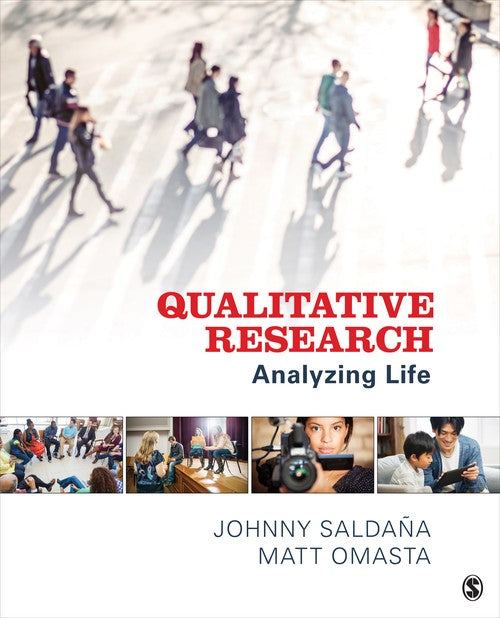
Qualitative Research by Matt Omasta
This innovative text explores qualitative research through a unique analytic lens and elaborates on methods in each chapter, showing that analysis is - in its broadest sense - a process undertaken throughout the entire research experience. Renowned authors Johnny Saldana and Matt Omasta prepare readers to work strategically with their empirical materials in their own fieldwork.
"Very accessible and comprehensive text with a unique approach to teaching qualitative research" -- Sharon Lynn Casapulla
"Qualitative Research: Analyzing Life presents students with the most important dimensions of qualitative research through a unique analytic lens. It offers students an intimate exploration of the fascinating world of naturalistic inquiry through a nuanced examination of material essential to their success as qualitative researchers." -- Nathan R. Durdella
"Johnny Saldaña and Matt Omasta flawlessly weave together powerful examples, valuable sample material, and complex ideas to create a methods text for everyone. It both enriches and demystifies the work of qualitative researchers." -- Sally Campbell Galman
"This book is exceptional and unique for starting with the basics of doing analysis in the first chapter and then having each chapter add further analysis as more qualitative methods are discussed. I know students will love it." -- Karla B. Hackstaff
"The authors provide accessibility to the topic of scientific research practices for the student qualitative researcher. [Qualitative Research: Analyzing Life] provides interesting activities and nicely articulated step-by-step instructions on major areas of focus including interviewing, coding, and analysis." -- Kristina N. Kahl
"This is a creative and deeply explanatory text that takes new qualitative researchers through the depths of doing methods work." -- Lauren Moret
"This book offers a refreshing approach to teaching qualitative research that will most certainly give students a deeper understanding of what it means to engage in qualitative inquiry." -- Eric D. Teman
"Saldaña and Omasta have written a user-friendly, comprehensive text with enlightening examples for those desiring to learn how to become qualitative researchers. They remind us at every turn that each aspect of the process is analytical, and they provide the necessary tools for us to be thoughtful, creative, and consistent in our choices as researchers from start to finish." -- Silvia Bettez
"Saldaña and Omasta’s Analyzing Life provides a text for both emerging and experienced scholars. Through their methodological examples, ontological thinking, and theoretical guiding, this book demystifies the process of analyzing qualitative data." -- Cassie F. Quigley,
"This book marks an important transition in the teaching of qualitative research methods by emphasizing in a clear and practical way the importance of analytic insight throughout the research process." -- Rachel Campbell
"This book provides the most readable, comprehensive overviews of qualitative methods that I have ever encountered. In addition to covering all the basics, with examples and detailed ‘how-to’ descriptions, it includes a number of creative ways of analyzing data that enhances the findings and promotes theory building." -- Shirley A. Hill
"This is a thoughtful and imminently useful book that offers readers a glimpse into, and instruction for, the doing of qualitative research. It provides tricks of the trade that will prove helpful to novice and senior researchers alike." -- Matthew B. Ezzell
"A highly beneficial contribution for qualitative research—the chapters are easily accessible for emerging researchers and scholars, and those looking to investigate new and unfamiliar qualitative methodologies. Readers are provided practical guidance that broadens their qualitative research understanding with relatable exemplars and makes researching achievable." -- Leah E. LeFebvre
"This book is inviting, engaging, and impressive in the way it deals with complex, key issues of conducting qualitative research. Warmly recommended." -- Liora Bresler
"Qualitative Research: Analyzing Life presents students with the most important dimensions of qualitative research through a unique analytic lens. It offers students an intimate exploration of the fascinating world of naturalistic inquiry through a nuanced examination of material essential to their success as qualitative researchers." -- Nathan R. Durdella
"Johnny Saldaña and Matt Omasta flawlessly weave together powerful examples, valuable sample material, and complex ideas to create a methods text for everyone. It both enriches and demystifies the work of qualitative researchers." -- Sally Campbell Galman
"This book is exceptional and unique for starting with the basics of doing analysis in the first chapter and then having each chapter add further analysis as more qualitative methods are discussed. I know students will love it." -- Karla B. Hackstaff
"The authors provide accessibility to the topic of scientific research practices for the student qualitative researcher. [Qualitative Research: Analyzing Life] provides interesting activities and nicely articulated step-by-step instructions on major areas of focus including interviewing, coding, and analysis." -- Kristina N. Kahl
"This is a creative and deeply explanatory text that takes new qualitative researchers through the depths of doing methods work." -- Lauren Moret
"This book offers a refreshing approach to teaching qualitative research that will most certainly give students a deeper understanding of what it means to engage in qualitative inquiry." -- Eric D. Teman
"Saldaña and Omasta have written a user-friendly, comprehensive text with enlightening examples for those desiring to learn how to become qualitative researchers. They remind us at every turn that each aspect of the process is analytical, and they provide the necessary tools for us to be thoughtful, creative, and consistent in our choices as researchers from start to finish." -- Silvia Bettez
"Saldaña and Omasta’s Analyzing Life provides a text for both emerging and experienced scholars. Through their methodological examples, ontological thinking, and theoretical guiding, this book demystifies the process of analyzing qualitative data." -- Cassie F. Quigley,
"This book marks an important transition in the teaching of qualitative research methods by emphasizing in a clear and practical way the importance of analytic insight throughout the research process." -- Rachel Campbell
"This book provides the most readable, comprehensive overviews of qualitative methods that I have ever encountered. In addition to covering all the basics, with examples and detailed ‘how-to’ descriptions, it includes a number of creative ways of analyzing data that enhances the findings and promotes theory building." -- Shirley A. Hill
"This is a thoughtful and imminently useful book that offers readers a glimpse into, and instruction for, the doing of qualitative research. It provides tricks of the trade that will prove helpful to novice and senior researchers alike." -- Matthew B. Ezzell
"A highly beneficial contribution for qualitative research—the chapters are easily accessible for emerging researchers and scholars, and those looking to investigate new and unfamiliar qualitative methodologies. Readers are provided practical guidance that broadens their qualitative research understanding with relatable exemplars and makes researching achievable." -- Leah E. LeFebvre
"This book is inviting, engaging, and impressive in the way it deals with complex, key issues of conducting qualitative research. Warmly recommended." -- Liora Bresler
Johnny Saldaña is Professor Emeritus from Arizona State University’s (ASU) School of Film, Dance, and Theatre in the Herberger Institute for Design and the Arts, where he taught from 1981 to 2014. He received his BFA in Drama and English Education in 1976, and MFA in Drama Education in 1979 from the University of Texas at Austin.
Saldaña is the author of Longitudinal Qualitative Research: Analyzing Change through Time (AltaMira Press, 2003); Fundamentals of Qualitative Research (Oxford University Press, 2011); Ethnotheatre: Research from Page to Stage (Left Coast Press, 2011); Thinking Qualitatively: Methods of Mind (Sage Publications, 2015); a commissioned title for Routledge’s World Library of Educationalists Series, Writing Qualitatively: The Selected Works of Johnny Saldaña (Routledge, 2018); co-author with the late Matthew B. Miles and A. Michael Huberman for Qualitative Data Analysis: A Methods Sourcebook (4th ed., Sage Publications, 2020); co-author with Matt Omasta for Qualitative Research: Analyzing Life (Sage Publications, 2018); and the editor of Ethnodrama: An Anthology of Reality Theatre (AltaMira Press, 2005). Previous editions of The Coding Manual for Qualitative Researchers have been translated into Korean, Turkish, and Chinese-Simplified.
Saldaña’s methods works have been cited and referenced in more than 16,000 research studies conducted in over 130 countries in disciplines such as K-12 and higher education, medicine and health care, technology and social media, business and economics, government and social services, the fine arts, the social sciences, human development, and communication. He has published a wide range of research articles in journals such as Research in Drama Education, The Qualitative Report, Multicultural Perspectives, Youth Theatre Journal, Journal of Curriculum and Pedagogy, Teaching Theatre, Research Studies in Music Education, Cultural Studies ? Critical Methodologies, the International Journal of Qualitative Methods, the International Review of Qualitative Research, and Qualitative Inquiry, and has contributed several chapters to research methods handbooks. His most popular journal article, “Blue-Collar Qualitative Research: A Rant” (Qualitative Inquiry, 2014), has been downloaded by over 3,000 readers, according to ResearchGate.
Saldaña’s research in qualitative inquiry, data analysis, and performance ethnography has received awards from the American Alliance for Theatre & Education, the National Communication Association-Ethnography Division, the American Educational Research Association’s Qualitative Research Special Interest Group, New York University’s Program in Educational Theatre, the Children’s Theatre Foundation of America, and the ASU Herberger Institute for Design and the Arts.
Matt Omasta is Associate Professor and Theatre Education Program Director at Utah State University. He received his BA from Ithaca College, his MA from Emerson College, and his PhD from Arizona State University. He is the author of Play, Performance, and Identity: How Institutions Structure Ludic Spaces (Routledge), Playwriting and Young Audiences (Intellect), and numerous articles in journals including Research in Drama Education: The Journal of Applied Theatre and Performance, Youth Theatre Journal, Theatre for Young Audiences Today, Theatre Topics, and the International Journal of Education and the Arts among others. Omasta′s work has been recognized by honors including the Founders′ Award from the Educational Theatre Association, the Lin Wright Special Recognition Award and the Research Award from the American Alliance for Theatre & Education, and the Arts and Learning Special Interest Group (A & L SIG) Dissertation Award from the American Educational Research Association (AERA).
| SKU | Unavailable |
| ISBN 13 | 9781506305493 |
| ISBN 10 | 1506305490 |
| Title | Qualitative Research |
| Author | Matt Omasta |
| Condition | Unavailable |
| Binding Type | Paperback |
| Publisher | Sage Publications, Inc |
| Year published | 2017-03-23 |
| Number of pages | 472 |
| Cover note | Book picture is for illustrative purposes only, actual binding, cover or edition may vary. |
| Note | Unavailable |