


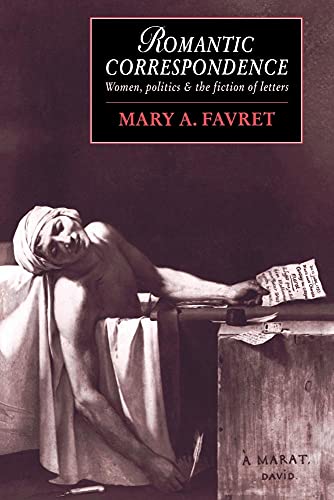
Romantic Correspondence by Mary A Favret
The literary importance of letters did not end with the demise of the eighteenth-century epistolary novel. In the turbulent period between 1789 and 1830, the letter was used as a vehicle for political rather than sentimental expression. Against a background of severe political censorship, seditious Corresponding Societies, and the rise of the modern Post Office, letters as they are used by Romantic writers, especially women, become the vehicle for a distinctly political, often disruptive force. Mary Favret's study of Romantic correspondence reexamines traditional accounts of epistolary writing, and redefines the letter as a 'feminine' genre. The book deals not only with letters which circulated in the novels of Austen or Mary Shelley, but also with political pamphlets, incendiary letters and spy letters available for public consumption.
Favret, Mary A.: - Mary A. Favret is Professor of English at Johns Hopkins University. She is the author of War at a Distance: Romanticism and the Making of Modern Wartime and Romantic Correspondence: Women, Politics and the Fiction of Letters and co-editor, with Nicola J. Watson, of At the Limits of Romanticism: Essays in Cultural, Feminist and Materialist Criticism.
| SKU | Unavailable |
| ISBN 13 | 9780521604284 |
| ISBN 10 | 0521604281 |
| Title | Romantic Correspondence |
| Author | Mary A Favret |
| Series | Cambridge Studies In Romanticism |
| Condition | Unavailable |
| Binding Type | Paperback |
| Publisher | Cambridge University Press |
| Year published | 2005-01-27 |
| Number of pages | 284 |
| Cover note | Book picture is for illustrative purposes only, actual binding, cover or edition may vary. |
| Note | Unavailable |