
A Selection from the Discourses of Epictetus with the Encheiridion


The feel-good place to buy books
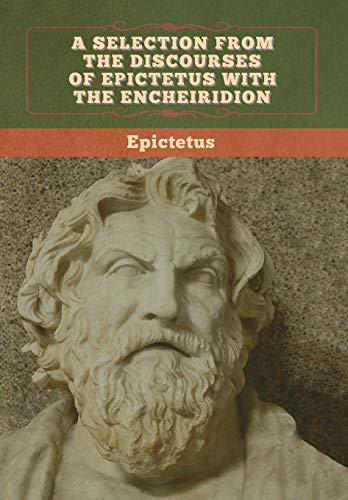
A Selection from the Discourses of Epictetus with the Encheiridion by Epictetus
Epictetus (55 - 135 AD) was a Greek Stoic philosopher. He was born a slave at Hierapolis, Phrygia (present day Pamukkale, Turkey) and lived in Rome until his banishment, when he went to Nicopolis in northwestern Greece for the rest of his life. His teachings were written down and published by his pupil Arrian in his Discourses and Enchiridion.
Epictetus taught that philosophy is a way of life and not just a theoretical discipline. To Epictetus, all external events are beyond our control; we should accept calmly and dispassionately whatever happens. However, individuals are responsible for their own actions, which they can examine and control through rigorous self-discipline.
Epictetus was born c. 55 A.D., presumably at Hierapolis, Phrygia. The name his parents gave him is unknown; the word epiktetos in Greek simply means gained or acquired; the Greek philosopher Plato, in his Laws, uses the term as property that is added to one's hereditary property. He spent his youth as a slave in Rome to Epaphroditos, a wealthy freedman and secretary to Nero.
Early in life, Epictetus acquired a passion for philosophy and, with the permission of his wealthy owner, he studied Stoic philosophy under Musonius Rufus, which allowed him to rise in respectability as he grew more educated. Somehow, he became crippled. Origen stated that his leg was deliberately broken by his master. Simplicius stated that he had been lame from childhood.
Epictetus obtained his freedom sometime after the death of Nero in 68 A.D., and he began to teach philosophy in Rome. About 93 A.D. Emperor Domitian banished all philosophers from the city, and Epictetus went to Nicopolis in Epirus, Greece, where he founded a philosophical school.
He lived a life of great simplicity, with few possessions. He lived alone for a long time, but in his old age he adopted a friend's child who otherwise would have been left to die, and raised him with the aid of a woman. It is unclear whether Epictetus and she were married. He died sometime around 135 A.D. After his death, according to Lucian, his oil lamp was purchased by an admirer for 3,000 drachmae. (wikipedia.org)
| SKU | Unavailable |
| ISBN 13 | 9781647993375 |
| ISBN 10 | 1647993377 |
| Title | A Selection from the Discourses of Epictetus with the Encheiridion |
| Author | Epictetus |
| Condition | Unavailable |
| Publisher | Bibliotech Press |
| Year published | 2020-02-27 |
| Number of pages | 130 |
| Cover note | Book picture is for illustrative purposes only, actual binding, cover or edition may vary. |
| Note | Unavailable |