


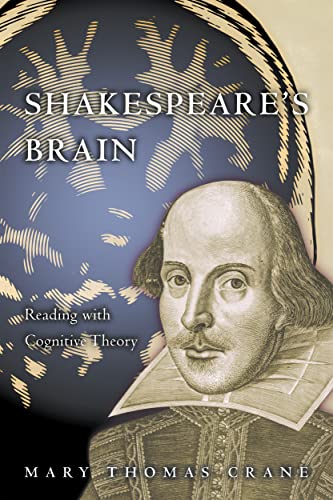
Shakespeare's Brain by Mary Thomas Crane
Considers the brain as a site where body and culture meet to form the subject and its expression in language. This book takes Shakespeare as a case study, and demonstrates the explanatory power of cognitive theory. It reveals in Shakespeare's texts a web of structures and categories through which meaning is created.
"Shakespeare's Brain will inevitably be described as a 'cognitive' analysis because it pays attention to cognitive aspects of meaning, but it is no less 'historical,' 'theoretical,' and 'nterpretive'The book gives rich treatments of the historical aspects of the plays and their production, the history of criticism, and literary theory. To this richness it adds the embodied mind of the writer writing, and the ways in which the plays investigate what is involved in conceiving of oneself as an embodied mind. Shakespeare's Brain offers old wine (Shakespeare) in new bottles (cognitive science), giving us not only a picture of the future of cognitive literary study but also some valuable new interpretations of the plays."—Mark Turner, University of Maryland
"Mary Thomas Crane lays out with easy authority and admirable lucidity what criticism might hope to gain from considering the insights of cognitive neuroscience. Taking on a wide range of experimental and theoretical cognitive science as well as the beginnings of its absorption into historical and literary studies, she proves to be a gifted explainer. Moreover, her 'adjustment' of Saussure, Lacan, and Derrida has an unassuming brilliance, bold but modestly teacherly, controversial without being controversialist."—James Richardson, Princeton University
"The implications of Mary Thomas Crane's approach are manifold and momentous, and she presents these in an introduction as striking for its lucidity as for its significance. Crane's scholarship is rich and extensive, and the book is beautifully written."—Judith H. Anderson, Indiana University
"Mary Thomas Crane lays out with easy authority and admirable lucidity what criticism might hope to gain from considering the insights of cognitive neuroscience. Taking on a wide range of experimental and theoretical cognitive science as well as the beginnings of its absorption into historical and literary studies, she proves to be a gifted explainer. Moreover, her 'adjustment' of Saussure, Lacan, and Derrida has an unassuming brilliance, bold but modestly teacherly, controversial without being controversialist."—James Richardson, Princeton University
"The implications of Mary Thomas Crane's approach are manifold and momentous, and she presents these in an introduction as striking for its lucidity as for its significance. Crane's scholarship is rich and extensive, and the book is beautifully written."—Judith H. Anderson, Indiana University
Mary Thomas Crane is Associate Professor of English at Boston College. She is the author of Framing Authority: Sayings, Self, and Society in Sixteenth-Century England (Princeton) and coeditor, with Amy Boesky, of Form and Reform in Renaissance England: Essays in Honor of Barbara Kiefer Lewalski.
| SKU | Unavailable |
| ISBN 13 | 9780691069920 |
| ISBN 10 | 0691069921 |
| Title | Shakespeare's Brain |
| Author | Mary Thomas Crane |
| Condition | Unavailable |
| Binding Type | Paperback |
| Publisher | Princeton University Press |
| Year published | 2000-11-05 |
| Number of pages | 288 |
| Cover note | Book picture is for illustrative purposes only, actual binding, cover or edition may vary. |
| Note | Unavailable |