


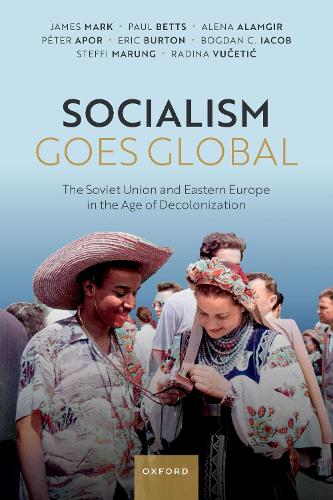
Socialism Goes Global by James Mark
This collectively written monograph is the first work to provide a broad history of the relationship between Eastern Europe and the decolonising world. It ranges from the late nineteenth to the late twentieth century, but at its core is the dynamic of the post-1945 period, when socialism's importance as a globalising force accelerated and drew together what contemporaries called the 'Second' and 'Third Worlds'. At the centre of this history is the encounter between the Soviet Union and Eastern Europe on one hand, and a wider world casting off European empires or struggling against western imperialism on the other. The origins of these connections are traced back to new forms of internationalism enabled by the Russian Revolution; the interplay between the first 'decolonisation' of the twentieth century in Eastern Europe and rising anti-colonial movements; and the global rise of fascism, which created new connections between East and South. The heart of the book, however, lies in the Cold War, when these contacts and relationships dramatically intensified. A common embrace of socialist modernisation and anti-imperial culture opened up possibilities for a new and meaningful exchange between the peripheries of Eastern Europe, Latin America, Africa and Asia. Such linkages are examined across many different fields - from health to archaeology, economic development to the arts - and through many people - from students to experts to labour migrants -who all helped to shape a different form and meaning of globalisation.
Wide-ranging and incisive, Socialism Goes Global marks the culmination of a decade's intensive efforts to understand the global place of central and Eastern Europe before and during the Cold WarCovering everything from development to diplomacy, from race to rights, the book also points the way forward, and will guide fruitful work for decades to come. Required reading for anyone interested in the region's past, present, and future. * David C. Engerman, Yale University, author of The Price of Aid: The Economic Cold War in India *
This fascinating book provides an innovative overview of the relationship between Eastern Europe and the Global South, documenting the wealth of interactions in economic relations, politics, military relations, intellectual life, culture, health, mobility, labour, and human rights. The book breaks new ground, both historiographically and methodologically, and will become a mandatory reference for anyone studying the global reach of Eastern European socialism. * Theodora Dragostinova, Ohio State University, author of The Cold War from the Margins: A Small Socialist State on the Global Cultural Scene *
This insightful, well-arranged volume elucidates multiple encounters between "Second" and "Third Worlds" in what is now referred to as the global Cold War. Essential reading for students of imperialism and anti-colonialism. * Saul Dubow, Cambridge University *
An excellent overview of a much neglected topic: the crucial links that existed between socialist countries and newly liberated countries in post-colonial regions. The thematic approach helps show both the significance of these connections and their limitations. * Odd Arne Westad, Yale University, author of The Cold War: A World History *
Rich in evidence and imaginative in conception, it is a testament to the value of collective scholarship in the writing of global history. * George Roberts, Journal of Contemporary History 58 *
This fascinating book provides an innovative overview of the relationship between Eastern Europe and the Global South, documenting the wealth of interactions in economic relations, politics, military relations, intellectual life, culture, health, mobility, labour, and human rights. The book breaks new ground, both historiographically and methodologically, and will become a mandatory reference for anyone studying the global reach of Eastern European socialism. * Theodora Dragostinova, Ohio State University, author of The Cold War from the Margins: A Small Socialist State on the Global Cultural Scene *
This insightful, well-arranged volume elucidates multiple encounters between "Second" and "Third Worlds" in what is now referred to as the global Cold War. Essential reading for students of imperialism and anti-colonialism. * Saul Dubow, Cambridge University *
An excellent overview of a much neglected topic: the crucial links that existed between socialist countries and newly liberated countries in post-colonial regions. The thematic approach helps show both the significance of these connections and their limitations. * Odd Arne Westad, Yale University, author of The Cold War: A World History *
Rich in evidence and imaginative in conception, it is a testament to the value of collective scholarship in the writing of global history. * George Roberts, Journal of Contemporary History 58 *
James Mark is Professor of Modern European History at the University of Exeter. He has published widely on the social and cultural history of Communism, history and memory, and the global history of Eastern Europe. He is the author of three monographs, most recently co-authoring 1989: A Global History of Eastern Europe with Bogdan Iacob, Tobias Rupprecht, and Ljubica Spaskovska. Paul Betts is Professor of Professor of Modern European History at St Antony's College, Oxford, and previously taught at the University of Sussex and the University of North Carolina at Charlotte. He has published widely on 20th century European cultural history, and is the author of three monographs, most recently Ruin and Renewal: Civilising Europe after World War II (2020).
| SKU | Unavailable |
| ISBN 13 | 9780198904113 |
| ISBN 10 | 0198904118 |
| Title | Socialism Goes Global |
| Author | James Mark |
| Condition | Unavailable |
| Binding Type | Paperback |
| Publisher | Oxford University Press |
| Year published | 2024-05-07 |
| Number of pages | 384 |
| Cover note | Book picture is for illustrative purposes only, actual binding, cover or edition may vary. |
| Note | Unavailable |