


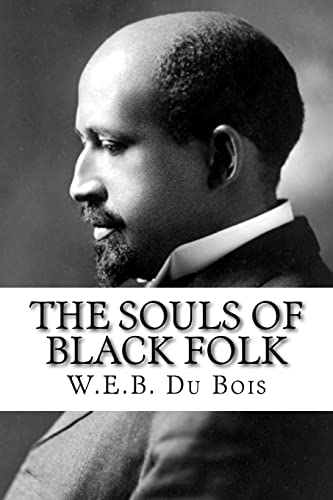
The Souls of Black Folk by W E B Du Bois
One of the Most Important Books on Civil Rights, Race, and Freedom Ever Written. A groundbreaking challenge to white supremacy. --The New York Times It is no exaggeration to say that Du Bois] anticipated, and influenced, many of the events that led to the making of the modern world. --Washington Post A classic work of American literature, African-American history, and sociology by W. E. B. Du Bois, The Souls of Black Folk is a monumental collection of essays that examines race and racism in America during the early 1900s and prior. Du Bois derived much of the book's content from his own personal experience as an African-American living during these tumultuous times, which resulted in an expertly crafted firsthand account of the trials of oppression and segregation existing in America. Many of the book's essays formulated Du Bois's then-perceived radical thought and platform for change, and eventually became catalysts that sparked protest movements across the country. Featuring a brand-new foreword by estProfessor Melvin Rogers, this stunning new trade edition of The Souls of Black Folk is perfect for anyone interested in African-America literature and history.
Du Bois, W. E. B.: - William Edward Burghardt Du Bois (/djuːˈbɔɪs/ dew-BOYSS;[1][2] February 23, 1868 - August 27, 1963) was an American sociologist, socialist, historian, civil rights activist, Pan-Africanist, author, writer and editor. Born in Great Barrington, Massachusetts, Du Bois grew up in a relatively tolerant and integrated community, and after completing graduate work at the University of Berlin and Harvard, where he was the first African American to earn a doctorate, he became a professor of history, sociology and economics at Atlanta University. Due to his contributions in the African-American community he was seen as a member of a Black elite that supported some aspects of eugenics for blacks. Du Bois was one of the founders of the National Association for the Advancement of Colored People (NAACP) in 1909. Before that, Du Bois had risen to national prominence as the leader of the Niagara Movement, a group of African-American activists that wanted equal rights for blacks. Du Bois and his supporters opposed the Atlanta compromise, an agreement crafted by Booker T. Washington which provided that Southern blacks would work and submit to white political rule, while Southern whites guaranteed that blacks would receive basic educational and economic opportunities. Instead, Du Bois insisted on full civil rights and increased political representation, which he believed would be brought about by the African-American intellectual elite. He referred to this group as the Talented Tenth, a concept under the umbrella of Racial uplift, and believed that African Americans needed the chances for advanced education to develop its leadership. Racism was the main target of Du Bois's polemics, and he strongly protested against lynching, Jim Crow laws, and discrimination in education and employment. His cause included people of color everywhere, particularly Africans and Asians in colonies. He was a proponent of Pan-Africanism and helped organize several Pan-African Congresses to fight for the independence of African colonies from European powers. Du Bois made several trips to Europe, Africa and Asia. After World War I, he surveyed the experiences of American black soldiers in France and documented widespread prejudice and racism in the United States military. Du Bois was a prolific author. His collection of essays, The Souls of Black Folk, is a seminal work in African-American literature; and his 1935 magnum opus, Black Reconstruction in America, challenged the prevailing orthodoxy that blacks were responsible for the failures of the Reconstruction Era. Borrowing a phrase from Frederick Douglass, he popularized the use of the term color line to represent the injustice of the separate but equal doctrine prevalent in American social and political life. He opens The Souls of Black Folk with the central thesis of much of his life's work: The problem of the twentieth century is the problem of the color-line.
| SKU | Unavailable |
| ISBN 13 | 9781505223378 |
| ISBN 10 | 1505223377 |
| Title | The Souls of Black Folk |
| Author | W E B Du Bois |
| Condition | Unavailable |
| Binding Type | Paperback |
| Publisher | Createspace Independent Publishing Platform |
| Year published | 2014-11-28 |
| Number of pages | 124 |
| Cover note | Book picture is for illustrative purposes only, actual binding, cover or edition may vary. |
| Note | Unavailable |