


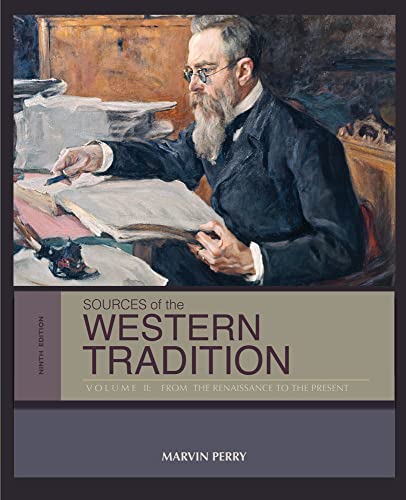
Sources of the Western Tradition by Marvin Perry
With a collection of over 375 sources, each accompanied by an introductory essay and review questions, this two-volume primary source reader emphasizes the intellectual history and values of the Western tradition. Sources are grouped around important themes in European history--such as religion, education, and art and culture--so that readers can analyze and compare multiple documents. The ninth edition features additional sources by and about women, completely revised chapters on modern Europe and its place in the contemporary world, and updates to introductions and review questions.
Part I: EARLY MODERN EUROPE1. The Rise of Modernity. 1. The Humanists' Fascination with Antiquity. 2. Human Dignity. 3. Break with Medieval Political Theory. 4. The Lutheran Reformation. 5. Justification of Absolute Monarchy by Divine Right. 6. A Secular Defense of Absolutism. 7. The Triumph of Constitutional Monarchy in England: The Glorious Revolution. 8. The Atlantic Slave Trade. 2. The Scientific Revolution. 1. The Copernican Revolution. 2. Galileo: Confirming the Copernican System. 3. Prophet of Modern Science. 4. The Autonomy of the Mind. 5. The Mechanical Universe. 6. The Limitations of Science. 3. The Enlightenment. 1. The Enlightenment Outlook. 2. Political Liberty. 3. Attack on Religion. 4. Epistemology. 5. Compendium of Knowledge. 6. Rousseau: Political Reform. 7. Humanitarianism. 8. Literature as Satire: Critiques of European Society. 9. Madame du Chatelet: A Woman of Brilliance. 10. On the Progress of Humanity. Part II: MODERN EUROPE. 4. Era of the French Revolution. 1. Abuses of the Old Regime. 2. The Role of the Philosophes. 3. Liberty, Equality, Fraternity. 4. Expansion of Human Rights. 5. The Jacobin Regime. 6. Napoleon: Destroyer and Preserver of the Revolution. 5. The Industrial Revolution. 1. Early Industrialization. 2. The New Science of Political Economy. 3. The Dark Side of Industrialization. 4. Factory Discipline. 5. The Capitalist Ethic. 6. Reformers. 6. Romanticism, Reaction, Revolution. 1. Romanticism. 2. Conservatism. 3. Liberalism. 4. The Spread of Liberal Ideals to Russia. 5. Rise of Modern Nationalism. 6. Repression. 7. 1848: The Year of Revolutions. 7. Thought and Culture in an Age of Science and Industry. 1. Realism in Literature. 2. Theory of Evolution. 3. The Socialist Revolution. 4. The Evolution of Liberalism. 8. Politics and Society, 1845-1914. 1. The Lower Classes. 2. Feminism and Antifeminism. 3. German Racial Nationalism. 4. Anti-Semitism: Regression to the Irrational. 9. European Imperialism. 1. The Spirit of British Imperialism. 2. European Rule in Africa. 3. Chinese Resentment of Western Imperialism. 4. Imperialism Debated. 10. Modern Consciousness. 1. The Futility of Reason and the Power of the Will. 2. The Overman and the Will to Power. 3. The Unconscious. 4. The Political Potential of the Irrational. Part III: WESTERN CIVILIZATION IN CRISIS. 11. World War I. 1. Militarism. 2. Pan-Serbism: Nationalism and Terrorism. 3. War as Celebration: The Mood in European Capitals. 4. Trench Warfare. 5. Women at War. 6. The Paris Peace Conference. 7. The Bolshevik Revolution. 8. The War and European Consciousness. 12. Era of Totalitarianism. 1. Modernize or Perish. 2. Forced Collectivization. 3. Famine in Ukraine. 4. Soviet Indoctrination. 5. Stalin's Terror. 6. The Rise of Italian Fascism. 7. The Fledgling Weimar Republic. 8. The Rise of Nazism. 9. The Leader-State. 10. The Nazification of Culture and Society. 11. Persecution of the Jews. 12. The Anguish of the Intellectuals. 13. World War II. 1. Remilitarization of the Rhineland. 2. The Anschluss, March 1938. 3. The Munich Agreement. 4. World War II Begins. 5. The Fall of France. 6. The Battle of Britain. 7. Nazi Propaganda: For Volk, Fuhrer, and Fatherland. 8. Stalingrad: A Turning Point. 9. The Holocaust. 10. Resistance. 11. D-Day, June 6, 1944. 12. The End of the Third Reich. 13. The Defeat of Japan. 14. Europe: A New Era. 1. The Aftermath: Devastation and Demoralization. 2. The Cold War. 3. Communist Repression. 4. The New Germany: Economic Miracle and Confronting the Past. 5. The Twilight of Imperialism. 6. The Soviet Union: Restructuring and Openness. Part IV: THE CONTEMPORARY WORLD. 15. The West in an Age of Globalism. 1. The Collapse of Communism. 2. Globalization: Patterns and Problems. 3. War in the 21st Century. 4. Ethnic Cleansing: Genocide in Rwanda. 5. Female Oppression. 6. Radical Islamic Terrorists. 7. Islam in Europe: Failure of Assimilation. 8. Resurgence of Anti-Semitism. 9. In Defense of European Values.
Marvin Perry, now retired, taught history at Baruch College, City University of New York. He has published several successful Cengage Learning texts, including WESTERN CIVILIZATION: IDEAS, POLITICS, AND SOCIETY (senior author and general editor); WESTERN CIVILIZATION: A BRIEF HISTORY; the leading Western Civilization reader, SOURCES OF THE WESTERN TRADITION; AN INTELLECTUAL HISTORY OF MODERN EUROPE; SOURCES OF EUROPEAN HISTORY SINCE 1900 (senior editor); HUMANITIES IN THE WESTERN TRADITION (senior author and general editor); and WORLD WAR II IN EUROPE: A CONCISE HISTORY. His scholarly work includes ARNOLD TOYNBEE AND THE WESTERN TRADITION (1996); ANTISEMITISM: MYTH AND HATE FROM ANTIQUITY TO THE PRESENT (coauthor, 2002); ANTISEMITIC MYTHS: A HISTORICAL AND CONTEMPORARY ANTHOLOGY (coeditor, 2008); and THE THEORY AND PRACTICE OF ISLAMIC TERRORISM: AN ANTHOLOGY (coeditor, 2008). Dr. Perry's scholarly work focuses on the history of ideas.
| SKU | Unavailable |
| ISBN 13 | 9781133935285 |
| ISBN 10 | 1133935281 |
| Title | Sources of the Western Tradition |
| Author | Marvin Perry |
| Condition | Unavailable |
| Binding Type | Paperback |
| Publisher | Cengage Learning, Inc |
| Year published | 2012-12-28 |
| Number of pages | 560 |
| Cover note | Book picture is for illustrative purposes only, actual binding, cover or edition may vary. |
| Note | Unavailable |