


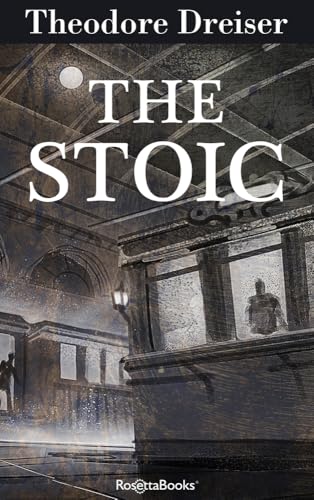
The Stoic Volume 3 by Theodore Dreiser
The conclusion to the trilogy based on a real railway tycoon's life, with "an amazingly intricate description of high-rolling 19th-century finance" (The Wall Street Journal).Based on the life of railway tycoon Charles Tyson Yerkes, the epic Trilogy of Desire weaves a tale of American capitalism through the rise and fall of Frank Cowperwood. Following The Financier and The Titan, the third novel follows Cowperwood as he heads across the sea to London for a chance to develop a new underground railway system. Though still married to his estranged wife, Aileen, he has found a new paramour in Berenice--among others. Doing what he does best, Frank puts his plans in motion to conquer London's transportation market, guaranteeing the bulk of the profits for himself. However, as his age begins to catch up with him, an illness makes it clear these are the last years of his life, and he must negotiate personal and financial challenges to make his lasting mark on the world--a quest that will ultimately be completed by one of the women in his life.
Theodore Dreiser, one of the principal exponents of naturalism in American literature, was born in Terre Haute, Indiana, on August 27, 1871, into a large family of German ancestry. He endured a rootless upbringing as his parents moved their ten children to different towns in search of employment. Along the way Dreiser received an erratic education in various parochial and public schools; he read voraciously from an early age and was largely self-taught. He began his writing career in 1892 as a cub reporter for the Chicago Daily Globe, an experience he recalled in A Book About Myself (1922; republished as Newspaper Days in 1931), and later wrote for the St. Louis Globe-Democrat and the Pittsburgh Dispatch. His years as a journalist proved instrumental in developing the exhaustively detailed style that is the hallmark of his fiction. In 1894 Dreiser arrived in New York City and became editor of Ev'ry Month, a moderately successful literary magazine. Encouraged by a publishing colleague, he turned out short stories and entertained thoughts about writing a novel. In October 1899 Dreiser inscribed two words--'Sister Carrie'--on a clean sheet of paper and proceeded to compose a breakthrough work that propelled American literature into the twentieth century. 'I have found a masterpiece . . . it must be published, ' said Frank Norris, a reader for Doubleday, Page and Company, to whom Dreiser submitted the manuscript. (The firm had just brought out Norris's novel McTeague, another unretouched picture of American life.) Despite the strong objections of senior partner Frank Doubleday, who detested the book and refused to promote it, Sister Carrie was published on November 8, 1900. The reviews were violently adverse, and the novel sold poorly. Genteel readers perceived the unsparing story of Caroline Meeber's rise to riches as a direct affront to the standards by which respectable Americans claimed to live. 'Ultimately, what shocked the world in Dreiser's work was not so much the things that he presented as the fact that he himself was not shocked by them, ' observed Robert Penn Warren. The commercial failure of Sister Carrie forced Dreiser to abandon fiction temporarily, and over the next decade he occupied editorial positions on several popular magazines. With the encouragement of H. L. Mencken, one of his most persistent defenders and promoters, Dreiser eventually resumed writing. His second novel, Jennie Gerhardt, was both a commercial and a popular success when it appeared in 1911, though many regarded this frank story about the sexual experiences of a young girl as a threat to moral standards. After its publication Dreiser pledged all of his creative energy to literature, writing The Financier (1912), a story about the rise of an unscrupulous tycoon, which became the first book in a trilogy that included The Titan (1914) and The Stoic (1947). Dreiser's next novel, The 'Genius' (1915), a highly autobiographical work portraying the artist as Nietzschean superman who lives beyond conventional moral codes, was threatened with censorship. The successful campaign to save it from suppression proved a pivotal victory in the fight for American literary freedom. During this period Dreiser also wrote two engaging memoirs, A Traveler at Forty (1913) and A Hoosier Holiday (1916); a compendium of philosophical essays, Hey Rub-a-Dub-Dub (1920); two volumes of drama, Plays of the Natural and the Supernatural (1916) and The Hand of the Potter (1919); as well as several collections of short stories, sketches, and articles, including Free and Other Stories (1918), Twelve Men (1919), and The Color of a Great City (1923). The publication of An American Tragedy in 1925 established Dreiser as the foremost American novelist of his time. Based on newspaper accounts of a sensational murder case, the work was dramatized on Broadway and sold to Paramount Pictures, which released a film version in 1931. Yet afterward Dreiser virtually abandoned the novel as an art form. He composed two books of poetry, Moods, Cadenced and Declaimed (1926) and The Aspirant (1929). He also wrote Chains (1927), a second volume of short stories, and A Gallery of Women (1929), a collection of biographical sketches. Dawn, another work of autobiography, came out in 1931. Dreiser became increasingly preoccupied with philosophical and political issues during the last two decades of his life. Two volumes of essays, Dreiser Looks at Russia (1928) and Tragic America (1932), reflect his growing involvement with socialism. America Is Worth Saving (1941), the last book Dreiser published during his lifetime, announced his complete conversion to Communism. In 1944, the year before his death, he was honored with an Award of Merit by the American Academy of Arts and Letters. Theodore Dreiser died of a heart attack at his home in Hollywood on December 28, 1945. His two last novels, The Bulwark (1946) and The Stoic (1947), appeared soon afterward, along with The Best Short Stories of Theodore Dreiser (1947). Several works drawn from Dreiser's unpublished papers and diaries appeared in later years, notably Letters of Theodore Dreiser (1959), Theodore Dreiser: A Selection of Uncollected Prose (1977), American Diaries, 1902-1926 (1982), and An Amateur Laborer (1983). Three volumes of his early journalism were also issued posthumously: Selected Magazine Articles of Theodore Dreiser (1985), Journalism, Volume One (1988), and Theodore Dreiser's 'Heard in the Corridors' Articles and Related Writings (1988). 'Dreiser more than any other man, marching alone, usually unappreciated, often hated, has cleared the trail from Victorian timidity and gentility in American fiction to honesty and boldness and passion of life, ' concluded Sinclair Lewis.
| SKU | Unavailable |
| ISBN 13 | 9780795351839 |
| ISBN 10 | 0795351836 |
| Title | The Stoic Volume 3 |
| Author | Theodore Dreiser |
| Series | The Trilogy Of Desire |
| Condition | Unavailable |
| Binding Type | Paperback |
| Publisher | Rosetta Books |
| Year published | 2018-09-18 |
| Number of pages | 110 |
| Cover note | Book picture is for illustrative purposes only, actual binding, cover or edition may vary. |
| Note | Unavailable |