


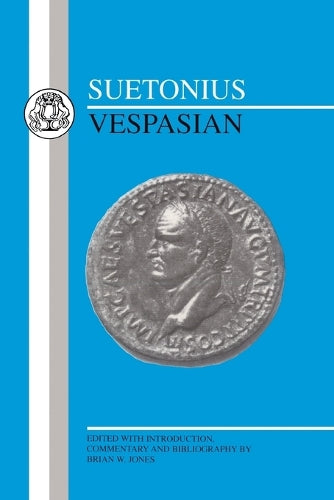
Suetonius Vespasian by Suetonius
The emperor Vespasian (AD69-79) is universally regarded as one of the better Roman emperors. Coming to the throne after the demise of Nero and the bitterness of a year-long civil war, he restored the empire's finances and inaugurated a period of peace and prosperity. Tacitus, Pliny and Josephus had a high regard for Vespasian, portraying him as an astute commander and an excellent emperor. In comparison with the comments of these contemporary or near-contemporary writers, Suetonius' biography, produced some fifty years after the emperor's death, is quite detailed. He too admired Vespasian. For him, Vespasian was a very shrewd administrator, who liked to be seen as having the common touch and as an ex-soldier with a ribald sense of humour. These and other aspects of his character are revealed in a series of anecdotes, always amusing and always opposite. This edition (the first since 1930) offers a newly revised text with a general introduction and detailed commentary. Comparison is continually drawn between Vespasian and other accounts of the reign, especially that of Dio Cassius, the only other substantial account but written a century after that of Suetonius.
Suetonius: - Gaius Suetonius Tranquillus (c. 69 - after 122 AD), was a Roman historian who wrote during the early Imperial era of the Roman Empire. He was probably born about 69 AD, a date deduced from his remarks describing himself as a young man twenty years after Nero's death. His place of birth is disputed, but most scholars place it in Hippo Regius, a small north African town in Numidia, in modern-day Algeria. It is certain that Suetonius came from a family of moderate social position, that his father, Suetonius Laetus, was a tribune belonging to the equestrian order (tribunus angusticlavius) in the Legio XIII Gemina, and that Suetonius was educated when schools of rhetoric flourished in Rome. Suetonius was a close friend of senator and letter-writer Pliny the Younger. Pliny describes him as quiet and studious, a man dedicated to writing. Pliny helped him buy a small property and interceded with the Emperor Trajan to grant Suetonius immunities usually granted to a father of three, the ius trium liberorum, because his marriage was childless. Through Pliny, Suetonius came into favour with Trajan and Hadrian. Suetonius may have served on Pliny's staff when Pliny was Proconsul of Bithynia and Pontus (northern Asia Minor) between 110 and 112. Under Trajan he served as secretary of studies (precise functions are uncertain) and director of Imperial archives. Under Hadrian, he became the Emperor's secretary. But Hadrian later dismissed Suetonius for the latter's alleged affair with the empress Sabina. His most important surviving work is a set of biographies of twelve successive Roman rulers, from Julius Caesar to Domitian, entitled De Vita Caesarum. Other works by Suetonius concern the daily life of Rome, politics, oratory, and the lives of famous writers, including poets, historians, and grammarians. A few of these books have partially survived, but many have been lost.
| SKU | Unavailable |
| ISBN 13 | 9781853995842 |
| ISBN 10 | 1853995843 |
| Title | Suetonius Vespasian |
| Author | Suetonius |
| Series | Latin Texts |
| Condition | Unavailable |
| Binding Type | Paperback |
| Publisher | Bloomsbury Publishing PLC |
| Year published | 2000-09-21 |
| Number of pages | 162 |
| Cover note | Book picture is for illustrative purposes only, actual binding, cover or edition may vary. |
| Note | Unavailable |