


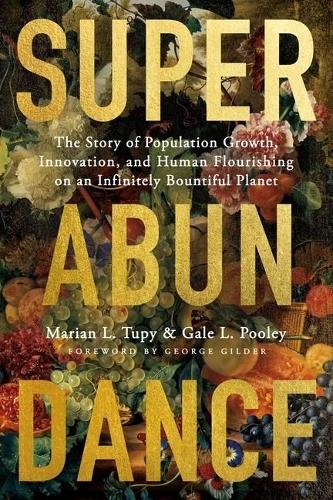
Superabundance by Marian L Tupy
Generations of people have been taught to believe that population growth makes resources scarcer. In 2021, for example, one widely publicized report argued that the world's rapidly growing population is consuming the planet's natural resources at an alarming rate ... the world currently needs 1.6 Earths to satisfy the demand for natural resources ... a figure that] could rise to 2 planets by 2030. But is that true? In Superabundance, Marian Tupy and Gale Pooley have analyzed prices of hundreds of commodities, goods, and services--with some data going back to 1850. They found that resources became cheaper or more abundant at an accelerating rate. That's especially true when examining time prices or the length of time that people must work to earn enough money to buy something. To great surprise, the authors found that resources became more abundant at a faster rate than the population grew--a relationship that they call Superabundance. On average, every additional human being created more value than they consumed. This relationship between population growth and abundance is deeply counterintuitive, yet it is no less true. Why? Unlike other animals, human beings can innovate their way out of the problems they encounter. They produce new ideas, which lead to new inventions. They test those inventions in the marketplace to separate the useful from the useless. At the end of that process of discovery, they are left with innovations that spur economic growth and raise standards of living. But more people are not enough to sustain Superabundance--just think of China and India before and after their respective economic reforms in 1978 and 1991. To innovate, people must be allowed to think, speak, publish, associate, and disagree. They must be allowed to save, invest, trade and profit. In a word, they must be free.
Ronald Bailey is the science correspondent for Reason, where he writes a weekly science and technology column. Bailey is the author of the book The End of Doom: Environmental Renewal in the Twenty-first Century (Thomas Dunne Books, 2015) and Liberation Biology: The Moral and Scientific Case for the Biotech Revolution (Prometheus, 2005), and his work was featured in The Best American Science and Nature Writing 2004. Marian L. Tupy is the editor of HumanProgress.org and a senior policy analyst at the Center for Global Liberty and Prosperity. He specializes in globalization and global well-being, and the political economy of Europe and sub-Saharan Africa. His articles have been published in the Financial Times, Washington Post, Los Angeles Times, Wall Street Journal, U.S. News and World Report, The Atlantic, Newsweek, The U.K. Spectator, Weekly Standard, Foreign Policy, Reason magazine, and various other outlets both in the United States and overseas.
| SKU | Unavailable |
| ISBN 13 | 9781952223396 |
| ISBN 10 | 1952223393 |
| Title | Superabundance |
| Author | Marian L Tupy |
| Condition | Unavailable |
| Binding Type | Hardback |
| Publisher | Cato Institute |
| Year published | 2022-08-31 |
| Number of pages | 580 |
| Cover note | Book picture is for illustrative purposes only, actual binding, cover or edition may vary. |
| Note | Unavailable |