


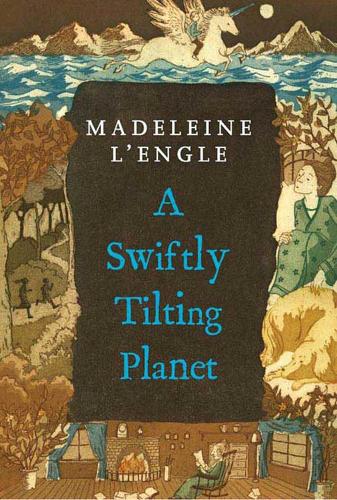
A Swiftly Tilting Planet by Madeleine L'engle
The third book in Madeleine L'Engle's A Wrinkle in Time Quintet. Read the ground-breaking science fiction and fantasy series that has delighted children for over 60 years!
* "An intricately woven fantasy." --Booklist, starred review
When Charles Wallace Murry shouts out in desperation an ancient rune meant to ward off the dark, a radiant creature appears. It is Gaudior, unicorn and time traveler. Charles Wallace and Gaudior must travel into the past on the winds of time to try to find a Might-Have-Been--a moment in the past when the entire course of events leading to the present can be changed, and the future of Earth--this small, swiftly tilting planet--saved.
Includes a personal interview with Madeleine L'Engle!
Praise for A Wrinkle in Time:
-NEWBERY MEDAL WINNER
-TIME MAGAZINE'S 100 BEST FANTASY BOOKS OF ALL TIME
-NOW A MAJOR MOTION PICTURE FROM DISNEY
Books by Madeleine L'Engle
A Wrinkle in Time
A Wind in the Door
A Swiftly Tilting Planet
Many Waters
An Acceptable Time
A Wrinkle in Time: The GraphicNovel by Madeleine L'Engle; adapted & illustrated by HopeLarson: A graphic novel adaptation of Madeleine L'Engle's ground-breakingscience fiction and fantasy classic.
Intergalactic P.S. 3 by Madeleine L'Engle; illustrated by Hope Larson: Astandalone story set in the world of A Wrinkle in Time!
The Austin Family Chronicles
Meet the Austins (Volume 1)
The Moon by Night (Volume 2)
The Young Unicorns (Volume 3)
A Ring of Endless Light (Volume 4) A Newbery Honor book!
Troubling a Star (Volume 5)
The Polly O'Keefe books
The Arm of the Starfish
Dragons in the Waters
A House Like a Lotus
And Both Were Young
Camilla
The Joys of Love
Madeleine L'Engle is the author of more than forty-five books for children and adults, including the Newbery Medal-winning A Wrinkle in Time, A Ring of Endless Light, A Swiftly Tilting Planet, winner of the American Book Award, and the Austin family series, of which Troubling a Star is the fifth installment. Margaret A. L'Engle received the Margaret A. L'Engle Award in 1998. Edwards Award, which recognizes her lifetime commitment to young writing. L'Engle was an only child growing up in an adult environment when she was born in 1918 in New York City, late in her parents' lives. Her father was a foreign correspondent for a newspaper, and although suffering from mustard gas illness during World War I, his job required him to travel extensively.
Her mother was a musician, and her parents' friends included painters, writers, and musicians. She claims that their lives were so busy that they didn't have time for a child. As a result, I turned to writing to pass the time. L'Engle and her family went to the French Alps when she was 12 years old in quest of cleaner air for her father's lungs.
She was sent to an English boarding school, which she describes as awful. Her family returned to America when she was 14, and she returned to Ashley Hall, a boarding school in Charleston, South Carolina, which she loved. Her father died when she was 17 years old. L'Engle attended Smith College for the next four years.
She and a group of pals moved to a Greenwich Village apartment after graduating cum laude. I still wanted to be a writer; I'd always wanted to be a writer, but I needed money, so I worked in the theater, she says. Her time on the road as an actor appears to have acted as a trigger for her. While on tour with Eva Le Gallienne in Uncle Harry, she penned her first book, The Little Rain.
She met Hugh Franklin, to whom she was married until his death in 1986, while rehearsing The Cherry Orchard, and they married on the road while touring with Ethel Barrymore's The Joyous Season. Upon her marriage, L'Engle withdrew from the stage, and the Franklins relocated to northwest Connecticut and opened a general store. The surrounding area was mostly dairy country at the time, and it was quite rural. She recalls that several in the students had never seen a book before their first year of school.
Josephine, Maria, and Bion Franklin were the Franklins' three children. Meet the Austins, L'Engle's first book in the Austin series and an ALA Notable Children's Book, has strong parallels with L'Engle's life in the country. However she claims that she is more like Vicky than Mrs. Austin, because I share all of Vicky's insecurities, passions, and sad and growing periods.
L'Engle was overjoyed when the family returned to New York after a decade in Connecticut. In some respects, I felt like I'd returned to reality. Franklin began acting and rose to prominence in the television series All My Children as Charles Tyler. L'Engle's heartwarming and critically praised narrative of their long and loving marriage is Two-Part Invention.
A Wrinkle in Time, A Wind in the Door, A Swiftly Tilting Planet, Many Waters, and An Acceptable Time are among her most well-known works, although getting a publisher to accept A Wrinkle in Time took years. It was rejected by every major publisher. She claims that no one knew what to do with it. When the work was finally approved by Farrar, Straus & Giroux, she requested that it be published as a children's book.
It was the start of their children's to-do list. L'Engle now lives in New York City and Connecticut, where she writes at home and at the Cathedral of St. John the Divine. She works as a librarian and a writer-in-residence at St. John the Divine. It varies depending on what they choose to call me on any given day.
On a volunteer basis, I keep the library collection open, which consists primarily of religion, philosophy, and a huge number of valuable reference volumes. Author Fun Facts: Born November 29 in New York City, It was about a little G-R-U-L, which is how I spelled girl when I was five years old. I wrote because I was curious about what was going on.
My father had been gassed in the first World War before I was born, and I was curious as to why there were conflicts, why people hurt each other, why we couldn't get along, and what made people tick. That's why I began writing stories. I loved Lucy Maud Montgomery's books as a child, especially her Anne of Green Gables stories, but I also enjoyed Emily of New Moon. Emily, like myself, was an only child.
Emily, like myself, grew up on an island. Notwithstanding their differences, Manhattan Island and Prince Edward Island are both islands. Emily's father, like mine, was suffering from deteriorating lungs. Emily, like myself, had a awful relative.
She struggled in school, but she also saw that there is more to life than what can be explained by encyclopedias and facts. Facts alone are insufficient. Emily is one of my favorite people. I'm also a fan of E.
I read fairy tales and myths from all across the world, as did Nesbit, a nineteenth-century writer of fantasy and family stories. And whatever else I could lay my paws on. I enjoy reading fiction as an adult. Good murder mystery writers, generally women and frequently English, fascinate me because they understand the human psyche and why people commit dark and dreadful things.
Because this is religion, I also read a lot in the fields of particle physics and quantum mechanics. This is about what it means to be human. This is the essence of life. I make an effort to read as extensively as possible.
When we lived in a little dairy farm village in New England, I wrote A Wrinkle in Time. Life was difficult for me because I had three tiny children to nurture. Within two years, we lost four of our closest friends to death--statistically, that's a lot of death. And I wasn't finding the answers to my big questions in the places where they should have been.
As a result, I was introduced to the field of particle physics at the time. I came across Einstein and his theory of relativity. I read in Einstein's book that anyone who isn't lost in rapturous amazement at the majesty and glory of the mind behind the cosmos is as good as a smoldering candle. Oh, I've found my theologian, what a lovely thing, I thought.
I started reading more in that field. A Wrinkle in Time arose from these inquiries, as well as my discovery of the post-utopian sciences, which threw everything we thought we knew about science into disarray. A Wrinkle in Time was never widely distributed. There isn't a single major publisher who hasn't rejected it.
There were numerous reasons behind this. One claim was that it was too difficult for children. My children were 7, 10, and 12 at the time I wrote it. I'd read what I'd written during the day to them at night, and they'd exclaim, Ooh, mother, get back to the keyboard!
And it dealt with topics that aren't usually found in children's novels, or weren't at the time. My agency returned it after we'd gone through forty-odd publishers. We had given up. Then, when my mother came to visit for Christmas, I hosted a tea party for her and several of her old friends.
One of them was a member of a tiny writing group led by John Farrar of Farrar, Straus & Giroux, which didn't have a juvenile list at the time. She urged that I meet John in any case, so I trudged down with my tattered copy in hand. John had enjoyed my first work and was as enthusiastic about this one. That's how it went down.
The most frequently asked question I get is, Where do you get your ideas? When I was younger, I told a story about Johann Sebastian Bach. Papa Bach, a pupil inquired, Where do you obtain the inspiration for all of these melodies? That's how ideas are; they're all over the place.
One of the most often asked questions is one I received in Japan. How tall are you, this little girl asked, holding up her hand? Every week, I receive over a hundred letters. There are letters that always stand out.
One came from a 12-year-old girl in North Carolina who wrote to me many years ago, claiming that I am Jewish and that most of my friends are Christian. Only Christians, according to my Christian acquaintances, can be rescued. What are your thoughts? We corresponded for about two decades.
I advised her to go back and study some of the great Jewish authors to learn more about her own heritage. Another letter inquired, In school, we're studying the Crusades. Is it possible for a Holy War to exist? It's also an honor to hear from children who say, Your books have made me trust you.
The questions don't necessarily revolve around the literature. They can touch on some of life's most serious concerns. What was the reasoning behind my parents' decision to place my grandma in a nursing home? The letters are instructive, especially when they are written for the child's own pleasure rather than as a school project.
One of the nicest collections of letters I have received was from a high school biology class. As part of their project, the teacher required them to read A Wind in the Door, a book about cellular biology. What a creative teacher, I thought. That was a great deal of pleasure.
I have some tips for aspiring writers. It makes no difference to me if they're 5 or 500. There are three things that are critical: first, if you wish to write, you must keep an unpublished journal that no one but you reads. Where you simply write down your thoughts on life, stuff, and what you believe is fair and what you believe is unfair.
Then there's the matter of reading. You can't be a writer unless you enjoy reading. Great authors are the ones who teach us how to write. The third step is to start writing.
Simply jot down a few lines every day. Write, write, write, even if it's only for a half-hour.
| SKU | Unavailable |
| ISBN 13 | 9780312368562 |
| ISBN 10 | 0312368569 |
| Title | A Swiftly Tilting Planet |
| Author | Madeleine L'engle |
| Series | A Wrinkle In Time Quintet |
| Condition | Unavailable |
| Binding Type | Paperback |
| Publisher | St Martin's Press |
| Year published | 2007-05-01 |
| Number of pages | 320 |
| Cover note | Book picture is for illustrative purposes only, actual binding, cover or edition may vary. |
| Note | Unavailable |