
Tense Bees and Shell-Shocked Crabs


Tense Bees and Shell-Shocked Crabs
Regular price
Checking stock...
Regular price
Checking stock...
The feel-good place to buy books
- Free UK delivery over £5
- 10% off preloved books when you join +Plus
- Buying preloved emits 46% less CO2 than new
- Give your books a new home - sell them back to us!
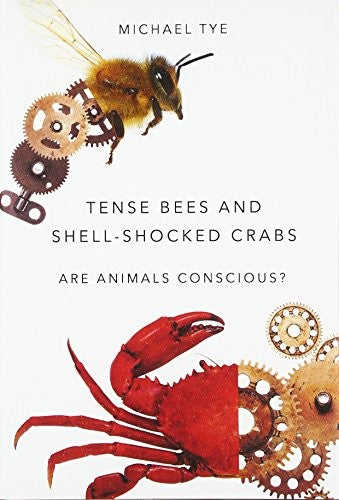
Tense Bees and Shell-Shocked Crabs by Michael Tye
In the seventeenth century, the famous French philosopher, Rene Descartes, held that nonhuman animals, lacking souls, are organic automata without any consciousness. This led him to participate in vivisections on dogs, dismissing their howls as mere noises. Voltaire later ridiculed Descartes' view; and it is certainly a position to which hardly anyone would subscribe today. But just which animals are conscious? Most people would admit mammals generally; but what about fish? Honeybees? Crabs? Turning to the artificial realm, what about suitably complex robots? These questions are hard to answer in part because feelings and experiences are subjective things, and we have no direct access to the feelings and experiences of others. Exacerbating the issue is the fact that there are differences between human brains and the brains of nonhuman creatures. With the differences in neurophysiology, perhaps the crucial feature underwriting any spark of consciousness is missing with the result that the animals simply function in ways that are similar to us along various dimensions without feeling as we do on the inside or feeling anything at all for that matter. In some cases, the differences in neurophysiology seem acute. Take fish, for example, or insects. Fish lack a neocortex, as do insects, and, in humans, consciousness is often held to require cortical activity. The present book suggests a methodology for dealing with these questions, without endorsing any specific theory of the nature of consciousness (about which there is little agreement anyway), and offers concrete answers. In the final chapter, there is a discussion of the ethical treatment of animals and related issues, including whether we should be vegetarians.
Arguing from straightforward principles, he comes to the conclusion that consciousness is widespreadAlong the way, he marshals an impressive array of empirical evidence, focusing on the traditionally overlooked corners of the animal world...a book devoted to the complexity and wonder of sections of the animal kingdom mostly overlooked in ordinary ethical discussions. This is a book rich in empirical examples, which is sure to generate discussion and controversy on a timely topic. * Colin Klein, Notre Dame Philosophical Reviews *
Michael Tye encountered philosophy at Oxford and taught at Temple University, St. Andrews, and the University of London before coming to the University of Texas at Austin in 2003, where he is the Dallas TACA Centennial Professor in Liberal Arts.
| SKU | Unavailable |
| ISBN 13 | 9780190278014 |
| ISBN 10 | 0190278013 |
| Title | Tense Bees and Shell-Shocked Crabs |
| Author | Michael Tye |
| Condition | Unavailable |
| Publisher | Oxford University Press Inc |
| Year published | 2017-01-19 |
| Number of pages | 256 |
| Cover note | Book picture is for illustrative purposes only, actual binding, cover or edition may vary. |
| Note | Unavailable |