


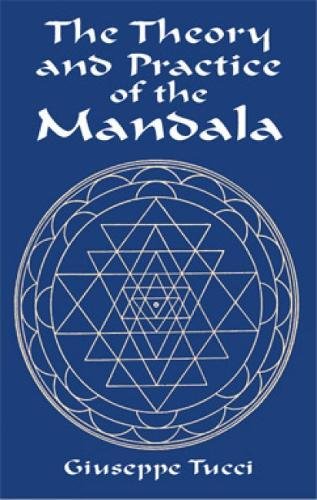
The Theory and Practice of the Mandala by Giuseppe Tucci
Mandalas are complex arrangements of patterns or pictures used in Hindu and Buddhist Tantrism to represent the cosmos (or wholeness) and to give expression to the infinite possibilities of the human subconscious. Though mandala means circle in Sanskrit, mandalas are more often squares or rectangles, filled with images and geometric figures that symbolize forces of the individual and collective psyche and the flow of energy to and from a central point. Believers use this powerful figure as a focus of ritual and a support for meditations -- through its use gaining possession of the energies signified by its images or symbols.This intriguing, thought-provoking study by one of the world's leading authorities on the subject examines the basic doctrine behind the theory and practice of the mandala in India and Tibet, by both Hindus and Buddhists. As a whole, as the author says in his preface, the spiritual background is the same: . the yearning to find out a way from time to eternity, to help the primeval consciousness . to recovery of its integrity. Individual chapters consider the doctrinal basis of the mandala, the mandala and its various parts, the liturgy of the mandala, and the mandala in the human body. Of special interest to students of Eastern philosophy and art, this volume will also fascinate New Agers and anyone interested in the symbols and psychology of Asian cultures.
| SKU | Unavailable |
| ISBN 13 | 9780486416076 |
| ISBN 10 | 0486416070 |
| Title | The Theory and Practice of the Mandala |
| Author | Giuseppe Tucci |
| Condition | Unavailable |
| Binding Type | Paperback |
| Publisher | Dover Publications Inc. |
| Year published | 2001-03-16 |
| Number of pages | 160 |
| Cover note | Book picture is for illustrative purposes only, actual binding, cover or edition may vary. |
| Note | Unavailable |