


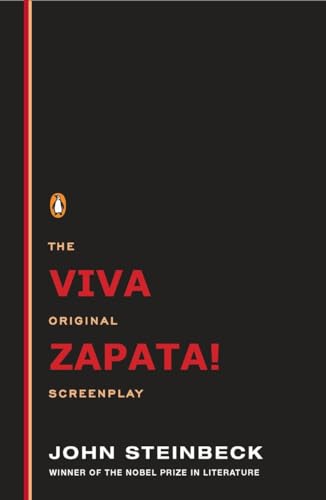
Viva Zapata! by John Steinbeck
An Academy Award-nominated screenplay from the winner of the Nobel Prize in Literature. The hitherto unpublished script for Viva Zapata was written by John Steinbeck between 1948 and 1950; it is his only completely original screenplay. The film, directed by Elia Kazan and released by Twentieth Century-Fox in 1952, garnered several Academy Award nominations: best story and screenplay for Steinbeck, best actor in the title role for Marlon Brando, and best supporting actor for Anthony Quinn, who won for his role of Eufemio. This classic film and story about the part played by Emiliano Zapata in the Mexican Revolution, championing the cause of the peasants during the years between 1909 and 1919, treats themes familiar to readers of The Grapes of Wrath and In Dubious Battle. In his perceptive introductory essay, Robert E. Morsberger states that the screenplay puts into final focus issues with which Steinbeck had been concerned for the previous twenty years and clarifies the relationship of issues to individuals and leaders to people. The conflict between creative dissent and intolerant militancy has a timeless relevancy, and Zapata deserves a close analysis both as a social statement and a work of art. Any previously unpublished work of John Steinbeck is a welcome gift to American letters. This moving book combines two of the author's lifelong interests, his concern for the underdog and the artistic potential of the American film. Steinbeck Viva --Budd Schulberg
John Steinbeck, born in Salinas, California, in 1902, grew up in a fertile agricultural valley, about twenty-five miles from the Pacific Coast. Both the valley and the coast would serve as settings for some of his best fiction. In 1919 he went to Stanford University, where he intermittently enrolled in literature and writing courses until he left in 1925 without taking a degree. During the next five years he supported himself as a laborer and journalist in New York City, all the time working on his first novel, Cup of Gold (1929). After marriage and a move to Pacific Grove, he published two California books, The Pastures of Heaven (1932) and To a God Unknown (1933), and worked on short stories later collected in The Long Valley (1938). Popular success and financial security came only with Tortilla Flat (1935), stories about Monterey's paisanos. A ceaseless experimenter throughout his career, Steinbeck changed courses regularly. Three powerful novels of the late 1930s focused on the California laboring class: In Dubious Battle (1936), Of Mice and Men (1937), and the book considered by many his finest, The Grapes of Wrath (1939). The Grapes of Wrath won both the National Book Award and the Pulitzer Prize in 1939. Early in the 1940s, Steinbeck became a filmmaker with The Forgotten Village (1941) and a serious student of marine biology with Sea of Cortez (1941). He devoted his services to the war, writing Bombs Away (1942) and the controversial play-novelette The Moon is Down (1942).Cannery Row (1945), The Wayward Bus (1948), another experimental drama, Burning Bright(1950), and The Log from the Sea of Cortez (1951) preceded publication of the monumental East of Eden (1952), an ambitious saga of the Salinas Valley and his own family's history. The last decades of his life were spent in New York City and Sag Harbor with his third wife, with whom he traveled widely. Later books include Sweet Thursday (1954), The Short Reign of Pippin IV: A Fabrication (1957), Once There Was a War (1958), The Winter of Our Discontent (1961), Travels with Charley in Search of America (1962), America and Americans (1966), and the posthumously published Journal of a Novel: The East of Eden Letters (1969), Viva Zapata!(1975), The Acts of King Arthur and His Noble Knights (1976), and Working Days: The Journals of The Grapes of Wrath (1989). Steinbeck received the Nobel Prize in Literature in 1962, and, in 1964, he was presented with the United States Medal of Freedom by President Lyndon B. Johnson. Steinbeck died in New York in 1968. Today, more than thirty years after his death, he remains one of America's greatest writers and cultural figures. John Seelye was a graduate research professor of American literature at the University of Florida. He is the author of The True Adventures of Huckleberry Finn, Mark Twain at the Movies, Prophetic Waters: The River in Early American Literature, Beautiful Machine: Rivers and the Early Republic, Memory's Nation: The Place of Plymouth Rock, and War Games: Richard Harding Davis and the New Imperialism. He also served as the consulting editor for Penguin Classics in American literature.
| SKU | Unavailable |
| ISBN 13 | 9780670005796 |
| ISBN 10 | 0670005797 |
| Title | Viva Zapata! |
| Author | John Steinbeck |
| Condition | Unavailable |
| Binding Type | Paperback |
| Publisher | Penguin Putnam Inc |
| Year published | 1975-01-16 |
| Number of pages | 192 |
| Cover note | Book picture is for illustrative purposes only, actual binding, cover or edition may vary. |
| Note | Unavailable |