


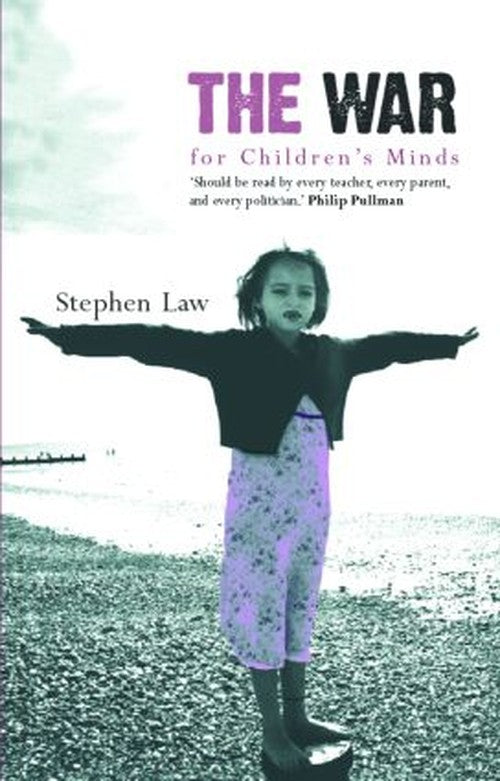
The War for Children's Minds by Stephen Law
This controversial book presents a staunch defence of the humane, liberal life. Tackling questions, such as how do we raise good children? And packed with topical examples, Law asks us to re-evaluate the liberal tradition of thinking about morality.'The War for Children's Minds is a brilliantly clear and convincingly argued defence of liberalism in moral educationStephen Law examines and demolishes all the arguments in favour of authoritarian ways of teaching, and shows that in spite of the insistence of popular commentators from the religious right, a liberal and rational examination and discussion of moral questions does not lead to relativism and the decay of ethical behaviour, but can in fact be the best defence against them. This book won't be read by popular journalists: they will attack it without reading it. But it should be read by every teacher, every parent, and every politician. What's more, it should form the subject for discussion in every church, synagogue, mosque, and religious youth group. It's one of the most engaging as well as one of the most necessary books that I've ever read in the field of moral education.' Philip Pullman
Behind headlines on the conflict in Iraq and global terrorism, a much deeper battle is raging over children and the values they should adopt. Political and religious leaders including Blair and Bush have been joined by the popular press in Enlightenment-bashing and bitter attacks on ‘liberal parenting’, calling for a return to authority and religious tradition.
How do we raise good children? How do we make good citizens? In defiant yet acute fashion, Stephen Law urges us to re-evaluate the liberal tradition of thinking about morality. Tackling authoritarian rhetoric head-on, he argues that children should learn about right and wrong and respect for others, but that their education should be grounded in the hard-won values of the Enlightenment. Taking on neo-conservatives and religious and media commentators, The War for Children’s Minds is a candid and controversial call for a liberal, philosophically informed approach to raising children.
Rejecting accusations that liberal parenting is a Sixties hangover that entails an aimless ‘whatever’ attitude to morality, Stephen Law exposes the weaknesses of arguments calling for a return to authoritarian styles of moral education. He clearly shows that thinking for oneself does not mean that all moral points of view are equally good, or that we must reject faith in order to think freely.
A staunch defence of the humane, liberal life The War for Children’s Minds is a much-needed guide to an urgent moral conundrum.
Stephen Law is the author of the best-selling The Philosophy Files, The Outer Limits and The Philosophy Gym. He is a contributor to The Independent on Sunday and editor of the Royal Institute of Philosophy journal Think: Philosophy for Everyone. He lectures in Philosophy at Heythrop College, University of London.
'The War for Children's Minds is a brilliantly clear and convincingly argued defence of liberalism in moral education. Stephen Law examines and demolishes all the arguments in favour of authoritarian ways of teaching, and shows that in spite of the insistence of popular commentators from the religious right, a liberal and rational examination and discussion of moral questions does not lead to relativism and the decay of ethical behaviour, but can in fact be the best defence against them. This book won't be read by popular journalists: they will attack it without reading it. But it should be read by every teacher, every parent, and every politician. What's more, it should form the subject for discussion in every church, synagogue, mosque, and religious youth group. It's one of the most engaging as well as one of the most necessary books that I've ever read in the field of moral education.' - Philip Pullman
'Progressives schools, they say, promote the wishy-washy, anything goes mentality that is the source of our social malaise. In The War for Children’s Minds, Stephen Law does a splendid and philosophically thrilling job of cutting that argument to shreds.' - The Guardian
'...a succinct and eloquent defence of liberalism'. - The Economist
'A stirring defence of liberal values.' - Times Educational Supplement
'A passionate philosophical defence of a liberal approach to parenting and and education'. - The Guardian
'This defence of reason should be obligatory reading, not just in schools, but in parliament and the press. ' - Sunday Herald
'[The] debate about children’s education…seems to be dominated by the other side. It’s a side that believes Liberal is a dirty word, that the Enlightenment did more harm than good and that children should be taught in a much more formal way. In his book [Law] begs to differ. He suggests that children should be allowed to examine and discuss religious and moral issues in a liberal, philosophically informed and rational way.' - The Oxford Times
'...this volume has a hugely significant contribution to make. It is also highly readable, and provides a useful pocket guide to current philosophical thinking - a sort of religious Bill Bryson.' - Church Times
'Law stands up to the social and religious conservatives who blame society's moral decline on the enlightenment's liberal values and the 1960s.' - Romeike
Stephen Law is a lecturer in philosophy at the University of London, where he was formerly a Research Fellow in Philosophy at Queen's College, Oxford, and where he got his doctorate in philosophy. The Philosophy Gym and Very, Really Huge Questions are two of his books.
| SKU | Unavailable |
| ISBN 13 | 9780415378550 |
| ISBN 10 | 0415378559 |
| Title | The War for Children's Minds |
| Author | Stephen Law |
| Condition | Unavailable |
| Binding Type | Hardback |
| Publisher | Taylor & Francis Ltd |
| Year published | 2006-05-30 |
| Number of pages | 208 |
| Cover note | Book picture is for illustrative purposes only, actual binding, cover or edition may vary. |
| Note | Unavailable |