


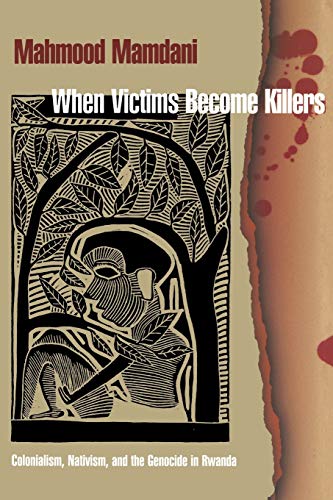
When Victims Become Killers by Mahmood Mamdani
Broadens understandings of citizenship and political identity in postcolonial Africa. This book provides a foundation for future studies of the Rwandan massacre. It also provides answers that point a way out of crisis: a direction for reforming political identity in central Africa and preventing future tragedies.
"The strengths of the book are clear and admirableFirst, it provides what might be called an intellectual history of the Hutu-Tutsi division that is invaluable... Anyone from now on who writes on identity in Central Africa--and there will be many--will have to wrestle with the case that Mamdani has made."--Jeffrey Herbst, Foreign Affairs "Mr Mamdani's political settlement is not democracy, which would simply restore the majority Hutus to power, but an acceptance of the Hutu and Tutsi with political, not cultural or class affiliations. He recommends a broad-based constitutional settlement that includes everyone prepared to give up violence whatever their ideology."--The Economist "[Mamdani's] analysis of Rwandese society, in particular the role of the church in the genocide, is fascinating... Mamdani believes that the tens of thousands of killers who wielded the machetes that murdered 800,000 people in three terrible months of 1994 saw themselves as victims who feared losing out in the struggle for power."--Victoria Brittain, The Guardian "Few are better qualified to explain the tensions of post-colonial Africa than Mahmood Mamdani, a Ugandan political scientist with a sharp perspective on the colonially inspired differences between 'subject races'. His Rwandan case-study provides powerful evidence that the Tutsis came to be crushed between colonist and native."--Richard Synge, The Independent "A welcome, powerful, and clear-sighted addition to this literature... When Victims Become Killers represents a great achievement. It is a passionate and strongly argued work, memorable both as scholarship and as a brilliant political polemic."--Journal of Colonialism and Colonial History "Nuanced and ground-breaking ... a book that, unlike any of its kind, holistically encompasses all the underlying factors of the 1994 Rwandan genocide. [It] would be useful to anyone who is interested in not only knowing more about Rwandan history, but also how such a tragedy could occur in the modern era."--African Studies Quarterly "A genuinely original contribution to understanding the Rwandan catastrophe."--Dissent "This book is a must-read. In terms of historical research and analytical depth, When Victims Become Killers is an invaluable academic work... [Mamdani's] arguments are compelling even to those who may wish to disagree with him."--Monitor (Kampala, Uganda) "[A] brilliant study of political identity and violence."--Elisa von Joeden-Forgey, H-Net Reviews
Mahmood Mamdani is Herbert Lehman Professor of Government and Director of the Institute of African Studies at Columbia University. He is the author of "Citizen and Subject: Contemporary Africa and the Legacy of Late Colonialism" (Princeton), which won the Herskovitz prize of the African Studies Association. Among his other books are "The Myth of Population Control, From Citizen to Refugee", and "Politics and Class Formation in Uganda". He is currently President of the Dakar-based Council for Development of Social Research in Africa (CODESRIA).
| SKU | Unavailable |
| ISBN 13 | 9780691102801 |
| ISBN 10 | 0691102805 |
| Title | When Victims Become Killers |
| Author | Mahmood Mamdani |
| Condition | Unavailable |
| Binding Type | Paperback |
| Publisher | Princeton University Press |
| Year published | 2002-09-01 |
| Number of pages | 384 |
| Cover note | Book picture is for illustrative purposes only, actual binding, cover or edition may vary. |
| Note | Unavailable |