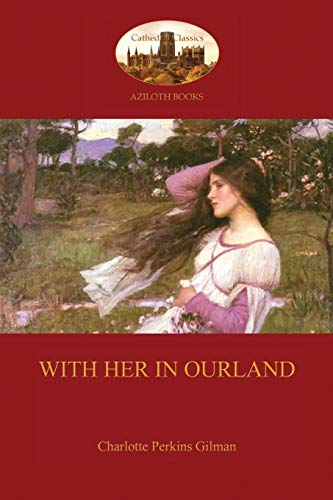
Charlotte Perkins Gilman (1860 - 1935) was born in in Hartford, Connecticut. Her father, Frederic Beecher Perkins, was the grandson of the theologian Lyman Beecher and nephew of Henry Ward Beecher and Harriet Beecher Stowe. Shortly after Charlotte's birth, her father left the family and thereafter provided only small support, thus forcing Charlotte, her mother, and her brother, Thomas, to move frequently over the next several years in search of work and financial help from relatives. After attending the Rhode Island School of Design, Charlotte worked as a governess and as an art teacher.
In 1884, she married her first husband, Charles Walter Stetson, by whom she had her only child, Katharine. Mrs. Stetson, however, could not endure domestic life with an overprotective and patronizing husband, and as a result suffered a nervous breakdown in 1885. Following a separation from her husband (they were divorced in 1894) and a recuperative move to California with her daughter, Charlotte Stetson began to devote herself to women's issues by lecturing and writing. Her powerful short story, The Yellow Wallpaper (1892), based on Mrs. Stetson's own experience, is the tale of a married woman who can escape from her domestic confinement and humiliation only through madness. Charlotte Stetson's feminist writings were influenced by the socialism of Edward Bellamy and the evolutionism of Charles Darwin. In her most influential work,
Women and Economics (1898), she argued that the socioeconomic system currently enslaving women was not a natural given but rather a situation that could be rectified by rational and ethical analysis. She criticized the social and economic system that degraded women by relegating them to the status of chattel. The only remedy to this situation was to fit women to be economically independent through a radical reorganization of society based on feminist and socialist principles. Mrs. Stetson's bitingly satirical and profoundly insightful work was an immediate international success; it was praised in the
Nation as the most significant utterance on the subject since Mill's
Subjectionof Women.
In 1900, Charlotte Stetson married her first cousin, George Houghton Gilman. But she remained resolutely independent, devoting herself to lecturing and writing. From 1909 to 1916, she edited and wrote
The Forerunner, a feminist monthly magazine. In her book
Man-Made World (1911), Mrs. Gilman described women as essentially peaceful and cooperative, while men were competitive and warlike. Until women claimed their rightful place, destructive male attributes would continue to dominate the world.
Charlotte Perkins Gilman was the leading intellectual of the American women's movement during the early twentieth century. In 1932, Mrs. Gilman was diagnosed with breast cancer. For three years she battled the disease; but once she determined that the cancer was undermining her ability to be useful to society, Mrs. Gilman committed suicide. Charlotte Perkins Gilman's other works include
The Home (1903), the novel
Herland (1915),
His Religion and Hers (1923), and her posthumously published autobiography,
The living of Charlotte Perkins Gilman (1935).