
200 Problems on Languages, Automata, and Computation


Summary
The feel-good place to buy books
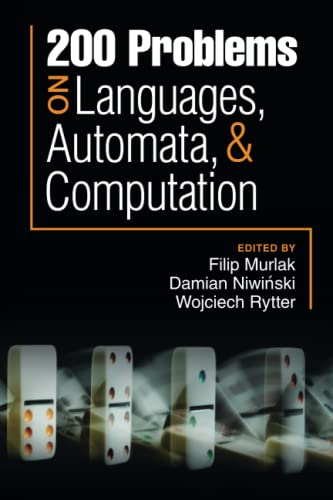
200 Problems on Languages, Automata, and Computation by Filip Murlak
Formal languages and automata have long been fundamental to theoretical computer science, but students often struggle to understand these concepts in the abstract. This book provides a rich source of compelling exercises designed to help students grasp the subject intuitively through practice. The text covers important topics such as finite automata, regular expressions, push-down automata, grammars, and Turing machines via a series of problems of increasing difficultly. Problems are organised by topic, many with multiple follow-ups, and each section begins with a short recap of the basic notions necessary to make progress. Complete solutions are given for all exercises, making the book well suited for self-study as well as for use as a course supplement. Developed over the course of the editors' two decades of experience teaching the acclaimed Automata, Formal Languages, and Computation course at the University of Warsaw, it is an ideal resource for students and instructors alike.
'This book is just enormously funOne can pick it up and quickly get lost in a fascinating problem. It's a book I would keep on my bookshelf and reach for when I have an exceptionally bright student I wish to challenge.' Anuj Dawar, University of Cambridge
'The book is a perfect companion for students and teachers in Languages, Automata, and Computation. It is written by leading experts in the field. The book is a pleasure to read and a sparkling source for significant problems of various levels of difficulty. The solutions are elegant and worked out in detail.' Volker Diekert, University of Stuttgart
'I began reading this book skeptical that I would find problems in it that I had not already seen. I was wrong. There are many great problems in this book, some for your students as homework, some to be the basis of lectures you will give your students … and some for your own edification.' William Gasarch, SIGACT News
'The book is a perfect companion for students and teachers in Languages, Automata, and Computation. It is written by leading experts in the field. The book is a pleasure to read and a sparkling source for significant problems of various levels of difficulty. The solutions are elegant and worked out in detail.' Volker Diekert, University of Stuttgart
'I began reading this book skeptical that I would find problems in it that I had not already seen. I was wrong. There are many great problems in this book, some for your students as homework, some to be the basis of lectures you will give your students … and some for your own edification.' William Gasarch, SIGACT News
Filip Murlak is Associate Professor at the University of Warsaw, where he lectures on automata, complexity, logic, and databases. His publications include the books Relational and XML Data Exchange (2010) and Foundations of Data Exchange (2014). Damian Niwiński is Professor at the University of Warsaw, where he lectures on automata theory, languages and computations, complexity, algorithmic game theory, and information theory. His publications include the monograph Rudiments of Mu-calculus (with A. Arnold, 2001). Wojciech Rytter is Professor at the University of Warsaw and a member of the Academia Europaea. He is the author of a large number of publications on automata, formal languages, parallel computing and text algorithms. He is a co-author of several books, including Efficient parallel algorithms (1987), Text algorithms (1994) and 125 Exercises in Text Algorithms (2021).
| SKU | Unavailable |
| ISBN 13 | 9781009073783 |
| ISBN 10 | 1009073788 |
| Title | 200 Problems on Languages, Automata, and Computation |
| Author | Filip Murlak |
| Condition | Unavailable |
| Binding Type | Paperback |
| Publisher | Cambridge University Press |
| Year published | 2023-04-20 |
| Number of pages | 254 |
| Cover note | Book picture is for illustrative purposes only, actual binding, cover or edition may vary. |
| Note | Unavailable |