


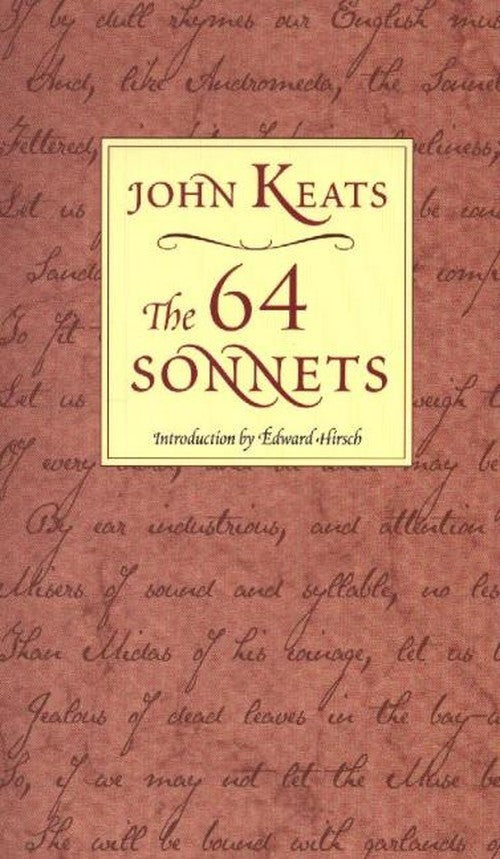
64 Sonnets by John Keats
John Keats is among the greatest English poets. (He himself imagined he would be counted so ) For some readers, his odes define the essence of poetry. We also discover in Keats a great composer of sonnets. Here, for the first time published in a separate edition, are all sixty-four sonnets, the first written when Keats was eighteen, the last just five years later. Reading these poems, you'll experience the wonder of Keats's growing poetic powers; you'll feel the shock of recognition when you come upon the great ones. Presented with an introduction by Edward Hirsch, and accompanying explanatory notes, the sonnets stand out as a triumph of their own.
Between 1814 and 1819, John Keats wrote sixty-four sonnets. He was eighteen years old when he composed his first sonnet; he was turning twenty-four when he completed his last one. He restlessly experimented with the fourteen-line form and used it to plunge into (and explore) his emotional depths. You can sit down and read these poems in a single night and have a complete Keatsian experience--he breathes close and offers himself to us; his presence is near. You can also read them throughout your adulthood and never really get to the bottom of them. These short, durable poems are filled with the mysteries of poetry.
In the sonnets, Keats conveys the range of his interests, his concerns, his attachments, his obsessions. Some are light and improvisatory, tossed off in fifteen minutes, a moment's thought. Some are polemics, or romantic period pieces; others are brooding testaments or compulsive outpourings, which seem to expand on the page. These sonnets are replete with a sensuous feeling for nature--'The poetry of earth is never dead'--that looks back to Wordsworth and forward to Frost. They also luxuriate in the spaces of imagination--'Much have I travell'd in the realms of gold'--and trigger the daydreaming capacities of the mind. --from the Introduction by Edward Hirsch
Edward Hirsch has published six books of poems: For the Sleepwalkers (1981), Wild Gratitude (1986), which won the National Book Critics Circle Award, The Night Parade (1989), Earthly Measures (1994), On Love (1998), and Lay Back the Darkness (2003). He has also written three prose books: How to Read a Poem and Fall in Love with Poetry (1999), a national bestseller, Responsive Reading (1999), and The Demon and the Angel: Searching for the Source of Artistic Inspiration (2002). He writes a weekly column on poetry for the Washington Post Book World. He has received the Prix de Rome, a Guggenheim Fellowship, the American Academy of Arts and Letters Award for Literature, and a MacArthur Fellowship. He taught for eighteen years at the University of Houston, and is now the fourth president of the John Simon Guggenheim Memorial Foundation.
John Keats was born in Moorfields in October 1795, the son of a livery stable manager. His father died of TB in 1804 and his mother in 1810. He had gotten a good education at John Clarke's Enfield private school by that time. He began his professional training as an apprentice to a surgeon in 1811 and completed it at Guy's Hospital in 1816. His decision to devote himself to poetry rather than a medical profession was bold, based more on a personal challenge than any genuine achievement. Early Mends like Charles Cowden Clarke and J.
H.Reynolds, and he met Leigh Hunt, whose Examiner had already published Keats' first poem, in October 1816. Poems (1817) was published only seven months later. Despite the Hunt circle's great hopes, it was a flop. By the time Endymion was published in 1818, Keats' name had become synonymous with Hunt's Cockney School, and the Conservative Blackwood's Magazine attacked him as a lower-class vulgarian who had no right to aspire to 'poetry.'
Yet, Keats' fame was based on posterity rather than contemporary literary politics. His inspiration and challenge came from Spenser, Shakespeare, Milton, and Wordsworth. From his letters, it is clear that Keats matured at an incredible rate. He wrote The Eve of St Agnes, La Belle Dame sans Merci, The Major Odes, Lamia, and the deeply exploratory Fall of Hyperion in 1819, after working on the magnificent epic fragment Hyperion in 1818.
Whilst preparing the 1820 book for the press, Keats was already ailing, and by the time it was published in July, he was very ill. In 1821, he died in Rome. Although Keats' final volume received considerable critical acclaim at the time, it wasn't until the later half of the nineteenth century that his place in English Romanticism became clear, and it wasn't until this century that it was fully realized.
| SKU | Unavailable |
| ISBN 13 | 9781589880146 |
| ISBN 10 | 1589880145 |
| Title | 64 Sonnets |
| Author | John Keats |
| Condition | Unavailable |
| Binding Type | Paperback |
| Publisher | Paul Dry Books, Inc |
| Year published | 2004-04-01 |
| Number of pages | 145 |
| Cover note | Book picture is for illustrative purposes only, actual binding, cover or edition may vary. |
| Note | Unavailable |