
American Power After the Financial Crisis


Summary
The feel-good place to buy books
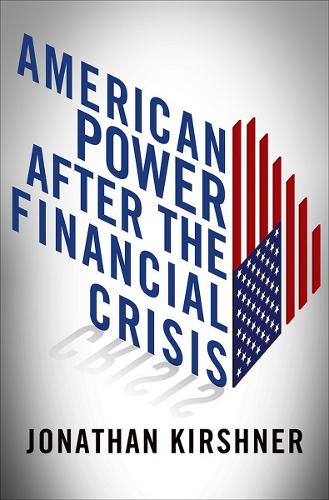
American Power After the Financial Crisis by Jonathan Kirshner
Jonathan Kirshner explains how the global financial crisis of 20072008 altered the international balance of power, affecting the patterns and pulse of world politics...[H]ighly recommended especially for those interested in understanding the paradigm shifts that happened in the 1970s and 1980s....[E]ssential reading.
-- Mehment Kerem Coban * Asian Journal of Public Affairs *It is always a pleasure to read somethign by Jonathan Kirshner. His style is lucid, informed, and replete with a wry sense of humor. Above all, he is emphatic. Not for Kirshner are the meek caveats of classical scholarship. His intention is to tell us what he really thinks, in as unvarnished a fashion as possible.
-- Benjamin J. Cohen * Political Science Quarterly *It is sometimes said that nobody saw the global financial crisis of 2008 coming. But that is not entirely accurate. There were analysts who predicted trouble ahead, and few did so with the uncanny clarity of Jonathan Kirshner.... It is worth taking note of what Kirshner has to say about the financial system today. His views are not reassuring. He argues that 'the fundamental causes' of the 2008 crisis have not been addressed. On the contrary, critical elements—banks that are too big to fail and risky financial practices—are still in place. As Kirshner puts it, the fire of the financial crisis was extinguished at great cost, but 'the firetrap remained.'... Kirshner's record suggests that he is better than most at looking beyond the transient moment and identifying the underlying trends. His latest book is provocative, interesting and well worth reading.
-- Gideon Rachman * Financial Times *Jonathan Kirshner contributes a timely and incisive analysis to the debate on American relative decline. While American Power after the Financial Crisis comprehensively deals with the fallout from the great recession in 2008, its real contribution is its placement of the crisis within its braoder historical context.
-- Kit Waterman * H-Diplo *Jonathan Kirshner's American Power After the Financial Crisis is a fascinating account of the origins of the crisis, the historical lessons that should have, but didn’t, prevent it, and most important, what long-term effects the crisis will have on American power and influence in world politics, particularly in Asia.... Kirshner begins his exceedingly well-written analysis by looking at 'the great teacher' of economics, the Great Depression, and explains how flawed ideas about global trade and finance led political leaders to adopt policies in response to the 1929 financial crisis that pushed the world economy into a downward spiral, ultimately exacerbating tensions that contributed to the Second World War.... In Kirshner’s excellent account, there is a bright side yet. One of the effects of the crisis is that it 'has brought about what I term "a new heterogeneity of thinking" with regard to ideas about how to best manage domestic and international money and finance.' That may be just the opening policy-makers in China and the rest of the world need.
-- David Plott * Global Asia *The heart of Kirshner's argument is that America's failure to respond to the crash of 2007–08 with meaningful reforms is eroding our economic and political influence, and heralding a more diverse world economic order.... While much of American Power after the Financial Crisis focuses on what happens next, as the world rejects America's 'financialized' market model and different countries try different approaches, there is no question about what the author believes could halt our slide: reregulating the financial sector. 'Letting 'the market rule in finance,' Kirshner argues, 'makes as much sense as letting the market decide where and how nuclear waste will be disposed of.'.
-- Courtney McBride * National Journal *Jonathan Kirshner is Stephen and Barbara Friedman Professor of International Political Economy at Cornell University. He is the author most recently of Hollywood's Last Golden Age and the coeditor of The Great Wall of Money and The Future of the Dollar, all from Cornell.
| SKU | Unavailable |
| ISBN 13 | 9780801450990 |
| ISBN 10 | 0801450993 |
| Title | American Power After the Financial Crisis |
| Author | Jonathan Kirshner |
| Series | Cornell Studies In Money |
| Condition | Unavailable |
| Binding Type | Hardback |
| Publisher | Cornell University Press |
| Year published | 2014-09-08 |
| Number of pages | 232 |
| Cover note | Book picture is for illustrative purposes only, actual binding, cover or edition may vary. |
| Note | Unavailable |