
American Slavery, American Imperialism


Summary
The feel-good place to buy books
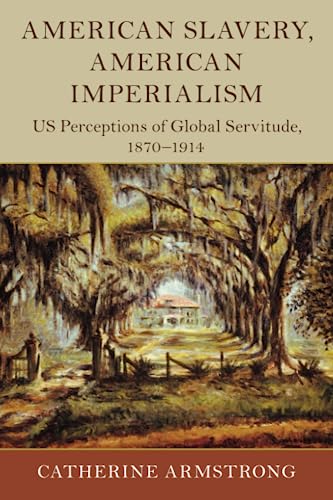
American Slavery, American Imperialism by Catherine Armstrong
Slavery casts a long shadow over American history; despite the cataclysmic changes of the Civil War and emancipation, the United States carried antebellum notions of slavery into its imperial expansion at the turn of the twentieth-century. African American, Chinese and other immigrant labourers were exploited in the name of domestic economic development, and overseas, local populations were made into colonial subjects of America. How did the U.S. deal with the paradox of presenting itself as a global power which abhorred slavery, while at the same time failing to deal with forced labour at home? Catherine Armstrong argues that this was done with rhetorical manoeuvres around the definition of slavery. Drawing primarily on representations of slavery in American print culture, this study charts how definitions and depictions of slavery both changed and stayed the same as the nation became a prominent actor on the world stage. In doing so, Armstrong challenges the idea that slavery is a merely historical problem, and shows its relevance in the contemporary world.
'This important and original interdisciplinary book sheds new light on how the US used slavery to mould its own post-war identity through the rhetorical tool of 'othering'Wide-ranging in its theoretical and methodological scope and geographic context, Armstrong successfully draws upon diverse forms of popular culture to decipher how the nation sought to identify itself as an antislavery imperialist power between the ending of the Civil War and the onset of World War I.' Emily West, Professor of American History, University of Reading
'In this elegant and deeply-researched book, Catherine Armstrong discusses how Americans came to terms with unfree forms of labour in an era when slavery had been abolished. Overlooking the domestic persistence of unfree labour, many Americans linked the continuation of slavery around the world to non-white 'others' that in turn helped to justify the need for white imperialism. This book has powerful resonances for the analysis of modern-day slavery.' Tim Lockley, University of Warwick
'Drawing astutely on recent scholarship, Armstrong illumines how, from Reconstruction to WWI, Americans manipulated their depictions of slavery, including its perpetrators and victims, to reinforce either a conservative or progressive racial, imperial, or gendered agenda … Recommended.' J. D. Smith, Choice
'In this elegant and deeply-researched book, Catherine Armstrong discusses how Americans came to terms with unfree forms of labour in an era when slavery had been abolished. Overlooking the domestic persistence of unfree labour, many Americans linked the continuation of slavery around the world to non-white 'others' that in turn helped to justify the need for white imperialism. This book has powerful resonances for the analysis of modern-day slavery.' Tim Lockley, University of Warwick
'Drawing astutely on recent scholarship, Armstrong illumines how, from Reconstruction to WWI, Americans manipulated their depictions of slavery, including its perpetrators and victims, to reinforce either a conservative or progressive racial, imperial, or gendered agenda … Recommended.' J. D. Smith, Choice
Catherine Armstrong is Senior Lecturer in American History at Loughborough University.
| SKU | Unavailable |
| ISBN 13 | 9781108701914 |
| ISBN 10 | 1108701914 |
| Title | American Slavery, American Imperialism |
| Author | Catherine Armstrong |
| Series | Slaveries Since Emancipation |
| Condition | Unavailable |
| Binding Type | Paperback |
| Publisher | Cambridge University Press |
| Year published | 2023-06-22 |
| Number of pages | 297 |
| Cover note | Book picture is for illustrative purposes only, actual binding, cover or edition may vary. |
| Note | Unavailable |