


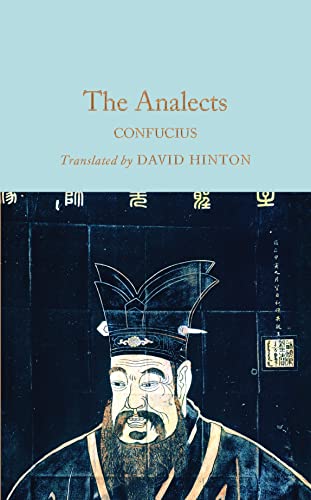
The Analects by Confucius
The Analects, literally Selected Sayings also known as the Analects of Confucius, is an ancient Chinese book composed of collection of sayings and ideas attributed to the Chinese philosopher Confucius and his contemporaries, traditionally believed to have been compiled and written by Confucius's followers. It is believed to have been written during the Warring States period (475-221 BC), and it achieved its final form during the mid-Han dynasty (206 BC-220 AD). By the early Han dynasty the Analects was considered merely a commentary on the Five Classics, but the status of the Analects grew to be one of the central texts of Confucianism by the end of that dynasty. During the late Song dynasty (960-1279) the importance of the Analects as a philosophy work was raised above that of the older Five Classics, and it was recognized as one of the Four Books. The Analects has been one of the most widely-read and studied books in China for the last 2,000 years, and continues to have a substantial influence on Chinese and East Asian thought and values today. Confucius believed that the welfare of a country depended on the moral cultivation of its people, beginning from the nation's leadership. He believed that individuals could begin to cultivate an all-encompassing sense of virtue through ren, and that the most basic step to cultivating ren was devotion to one's parents and older siblings. He taught that one's individual desires do not need to be suppressed, but that people should be educated to reconcile their desires via rituals and forms of propriety, through which people could demonstrate their respect for others and their responsible roles in society. Confucius taught that a ruler's sense of virtue was his primary prerequisite for leadership. His primary goal in educating his students was to produce ethically well-cultivated men who would carry themselves with gravity and speak correctly.Confucius (551–479 BCE) was born into a noble family in the Chinese state of Lu. His father died when he was very young and the family fell into poverty. Confucius resigned from a political career and then travelled for many years, searching for a province willing to adopt his ideas. Unsuccessful, he returned to Lu where he spent the rest of his life teaching. He is considered one of the most influential figures in the world.
David Hinton has translated many volumes of classical Chinese poetry and is the first translator in nearly two centuries to translate all five of the seminal classics in Chinese philosophy. This work has earned him many national awards in the United States, including a lifetime achievement award from the American Academy of Arts and Letters. His book of essays, Hunger Mountain: A Field Guide to Mind and Landscape was on the Guardian’s Best-Books-of-the-Year list.
| SKU | Unavailable |
| ISBN 13 | 9781529080100 |
| ISBN 10 | 152908010X |
| Title | The Analects |
| Author | Confucius |
| Series | Macmillan Collector's Library |
| Condition | Unavailable |
| Binding Type | Hardback |
| Publisher | Pan Macmillan |
| Year published | 2022-07-07 |
| Number of pages | 240 |
| Cover note | Book picture is for illustrative purposes only, actual binding, cover or edition may vary. |
| Note | Unavailable |