
An Asian Direct and Indirect Real Estate Investment Analysis


World of Books
The feel-good place to buy books
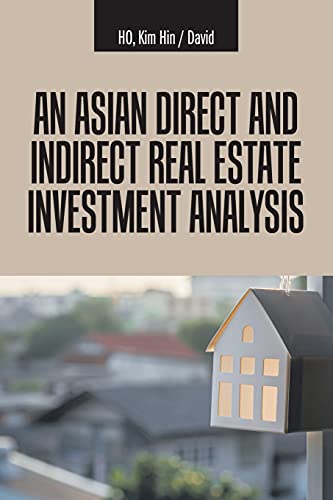
An Asian Direct and Indirect Real Estate Investment Analysis by Kim Hin David Ho
This book is dedicated to real estate scholastic work, in advancing the greater understanding of real estate investment analysis. This is because there has been limited research in bringing out clearly the uncertainty or risk, which is quantifiable uncertainty in real estate market analysis. Even real estate market research, which is carried out as an industry practice among private real estate researches, is no exception. Another reason is that it has been widely accepted that while the financial revolution has substantially changed many sectors of the financial industry, it has made little impact on real estate development and investment practice as Ill as scholastic work. Furthermore, while it is readily acknowledged that despite its huge share in the world Ialth, real estate investment discipline and research is on the whole still a poorly researched subject area. As a result, the industry tends to be dominated by traditional real estate analysts with little understanding of real estate market uncertainty and capital markets. These commentators are widely regarded to spend too much time worrying about local space supply and demand conditions, while totally losing sight of the everchanging real estate market and capital market conditions. The theme of this book is real estate investment analysis of direct and indirect real, which in turn can be appropriately managed under economic theory and the theoretical conceptions of real estate finance, provided the uncertainty is quantifiable. The book deploys case studies involving Singapore and Asia. This Black over White background viii framework enables real estate market analysis to attempt what defines the Asian direct and indirect real estate sectors; what is being measured; how it behaves (in terms of price and non-price factors); how it is structured and how it effectively achieves the objectives of sustainable total returns and manageable real estate market uncertainty. Managing real estate market uncertainty optimally is achieved at the portfolio level through real estate asset allocation. This is important because the real estate portfolio is able to virtually eliminate the unique (i.e. specific) uncertainties among the various Asian real estate sectors; thus retaining within the portfolio only the systemic (i.e. market-wide) uncertainty. Apart from real estate asset allocation, the alternative and modern approach to risk management at the portfolio level, is the value-at-risk (VaR) approach. Another modern and important alternative to coping with uncertainty is real option analysis and pricing that help to better define real estate market uncertainty in extent and time. Real option analysis and pricing also represent uncertainty via a decision tree and the risk-neutral probability conception, in order to comprehend how uncertainty impacts on the value of real estate investment decisions. The pricing of uncertainty is based on the risk-free hedge security conception. These are best examined at the micro level of the investment in a real estate development opportunity on vacant land. Nevertheless, the real estate sectors in Singapore and Asia offer promising prospects since the Asian currency crisis of 1997. It is now timely to take stock and make an assessment of how the sectors would pan out for the future, Ill into at least rest the next century. I are very pleased to present our thinking and research in international real estate with particular emphasis on Asia. The region's vast potential for real estate is itself a large incentive for international real estate research and education that has inspired me to document the significant work I have done over the years. Black over White background ix I wish all readers a pleasurable reading of this book, and I thank you sincerely for your support without which the publication of this book would be made all the more difficult. Dr HO, Kim Hin / David Honorary Professor (University of Hertfordshire, UK) (International Real ...
Dr HO Kim Hin / David is Honorary Professor in Development Economics & Land Economy, awarded by the UK public university, the University of Hertfordshire. He retired end-May 2019 as Professor (Associate) (Tenured) from the National University of Singapore. Professor HO spent the last thirty-one years across several sectors, which include the military, oil refining, aerospace engineering, public housing, resettlement, land acquisition, land reclamation, real estate investment, development and international real estate investing. He spent six years in the real estate career as part of the executive management group of Singapore Technologies at Pidemco Land Limited, and as part of the senior management team of the Government of Singapore Investment Corporation's GIC Real Estate Private Limited. Seventeen years have been spent in the National University of Singapore at the then School of Building and Estate Management, the Department of Real Estate, School of Design and Environment, where his research expertise is in two areas. First is international real estate in the area of risk-return behavior behind international real estate investing in direct and indirect real estate. Secondly, is urban and public policy analysis involving real estate, sea transport, public housing, land and land use. Schooled in development economics and in land economy at the University of Cambridge, England, he has effectively extended these disciplines to examine his two expertise areas. Apart from being well versed in econometrics, his quantitative interests include real estate demand and supply, investment and finance, artificial intelligent modeling in real estate and system dynamics modeling for real estate market analysis and public policy analysis. He is the Member of the Royal Economics Society (U.K.), Academic Member of the National Council of Real Estate Investment Fiduciaries (U.S.), Fellow of the American Real Estate Society (U.S.), member of the American Economic Association (U.S.) and member of the Economic Society of Singapore and the Singapore Institute of Management. He holds the degrees of Master of Philosophy (1st Class Honors with Distinction), Honorary Doctor of Letters and the Doctor of Philosophy from the University of Cambridge, U.K. He has published widely in top international journals and conferences, in chapters of international academic book publishers. Dr Ho has written 7 major books (including this book), undertaken many consultancies and funded research projects. He has written a total of about 275 published works (with 91 in peer reviewed, reputable international journals). He is an editorial board member of the Journal of Economics & Public Finance, Real Estate Economics journal, Journal of Property Research, Journal of Property Investment & Finance, Journal of Real Estate Finance & Economics, the Property Management journal and the International Journal of Strategic Property Management. He has published widely in conferences, Finance, chapters of international academic book publishers, undertaken many consultancies and funded research projects. He is an immediate past Governor of the St Gabriel's Foundation that oversees nine schools in Singapore; and a District Judge equivalent member of the Valuation Review Board, Ministry of Finance, Singapore, and the Singapore Courts.
| SKU | Unavailable |
| ISBN 13 | 9781543764086 |
| ISBN 10 | 1543764088 |
| Title | An Asian Direct and Indirect Real Estate Investment Analysis |
| Author | Kim Hin David Ho |
| Condition | Unavailable |
| Binding Type | Paperback |
| Publisher | Partridge Publishing Singapore |
| Year published | 2021-05-04 |
| Number of pages | 992 |
| Cover note | Book picture is for illustrative purposes only, actual binding, cover or edition may vary. |
| Note | Unavailable |