
Basics of Structural Equation Modeling


Summary
The feel-good place to buy books
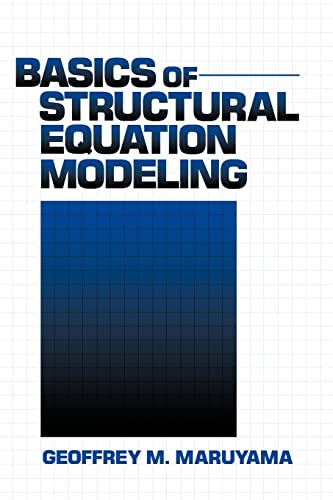
Basics of Structural Equation Modeling by Geoffrey M Maruyama
With the availability of software programs such as LISREL, EQS, and AMOS modeling techniques have become a popular tool for formalized presentation of the hypothesized relationships underlying correlational research and for testing the plausibility of hypothesizing for a particular data set. The popularity of these techniques, however, has often led to misunderstandings of them, particularly by students being exposed to them for the first time. Through the use of careful narrative explanation, Basics of Structural Equation Modeling describes the logic underlying structural equation modeling (SEM) approaches, describes how SEM approaches relate to techniques like regression and factor analysis, analyzes the strengths and shortcomings of SEM as compared to alternative methodologies, and explores the various methodologies for analyzing structural equation data."Overall, the book is a well-written introduction to structural equation modelling for people with a non-mathematical backgroundThe stress is put on the logic of structural equation modelling and therefore it might be appreciated by more mathematical trained statisticians as well."
-- Oliver Thas * The Statistician *"This book is a gentle introduction to the topic of structural equation modelling."
-- Richard A. Chechile
My interest in what happens in diverse urban schools began when I became involved in a study of school desegregation while in graduate school. Those interests have led me to study a range of issues in schools, including school schedules and structures, teaching approaches such as cooperative learning and conflict resolution, social influence processes, and student background characteristics including poverty, type of housing, language, ability, and race/ethnicity. This work has been facilitated by time I spent in the Saint Paul Public Schools as their director of research, evaluation and assessment. Recently, my work has moved beyond schools to look more broadly at how universities engage urban communities to build partnerships addressing key social issues. I have complemented my substantive interests with methodology interests in structural equation methods and program evaluation. Finally, I have held administrative roles that have enriched and informed my research interests, including director of the Center for Applied Research and Educational Improvement (CAREI), assistant/associate vice president for multicultural and academic affairs, and now vice president for system academic administration . I am a past-president of the Society for the Psychological Study of Social Issues (SPSSI), and currently edit one of their journals, Analyses of Social Issues and Public Policy.
| SKU | Unavailable |
| ISBN 13 | 9780803974098 |
| ISBN 10 | 0803974094 |
| Title | Basics of Structural Equation Modeling |
| Author | Geoffrey M Maruyama |
| Condition | Unavailable |
| Binding Type | Paperback |
| Publisher | SAGE Publications Inc |
| Year published | 1997-10-30 |
| Number of pages | 328 |
| Cover note | Book picture is for illustrative purposes only, actual binding, cover or edition may vary. |
| Note | Unavailable |