


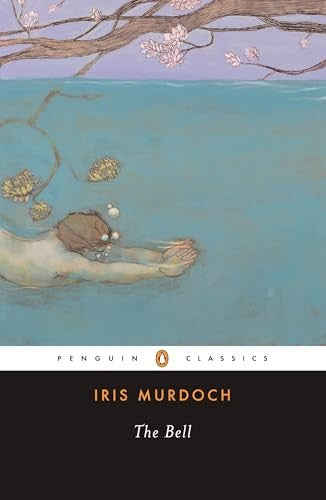
The Bell by Iris Murdoch
A motley assortment of characters seek peace and salvation in this early masterpiece by the Booker Prize-winning author of The Sea, The SeaA lay community of thoroughly mixed-up people is encamped outside Imber Abbey, home of an order of sequestered nuns. A new bell is being installed when suddenly the old bell, a legendary symbol of religion and magic, is rediscovered. And then things begin to change. Meanwhile the wise old Abbess watches and prays and exercises discreet authority. And everyone, or almost everyone, hopes to be saved, whatever that may mean. Originally published in 1958, this funny, sad, and moving novel is about religion, sex, and the fight between good and evil.
For more than seventy years, Penguin has been the leading publisher of classic literature in the English-speaking world. With more than 1,700 titles, Penguin Classics represents a global bookshelf of the best works throughout history and across genres and disciplines. Readers trust the series to provide authoritative texts enhanced by introductions and notes by distinguished scholars and contemporary authors, as well as up-to-date translations by award-winning translators.
She was born in Dublin, Ireland, on July 15, 1919, the only child of Anglo-Irish parents. Her father was a bookish civil servant who had served as a cavalry officer during World War I; her mother had trained as an opera singer before marrying. The love of both literature and music instilled in her by her parents proved to be powerful formative influences, and she reportedly began writing at the age of nine. The family moved to London in Iris's childhood and she grew up in the western suburbs of Hammersmith and Chiswich. The 1940s saw Iris receive a first-class degree in classics from Oxford, briefly become a member of the Communist Party (from which she resigned in disappointment), work in Belgian and Austrian refugee camps for the United Nations Rehabilitation and Relief Program, and befriend Jean-Paul Sartre, on whom she wrote what was to be her first published work, a critical study entitled Sartre: Romantic Rationalist (1953). In 1947 she took up a postgraduate studentship at Cambridge, studying philosophy under none other than Ludwig Wittgenstein. The fruits of these philosophical encounters went on to form an important part of her fertile talent as a novelist.
With three previous novels unpublished, Murdoch made her fiction-writing debut in 1954. Under the Net is a picaresque existentialist adventure set in London and Paris's Left Bank that displays many of the traits for which her later work is so admired: a fast-paced plot, finely wrought settings, imaginatively developed characters, and a strong philosophical concern with moral issues and ethical crises. Surpassing the somewhat derivative existentialist strictures of this nevertheless stunning debut, Murdoch published almost a novel per year throughout the 1950s, '60s, and '70s and continued at a slightly less feverish pace throughout the '80s and early '90s. With each book, she displayed her unique talent for combining a lively, comic touch in characterization and plot with a serious concern for such profound themes as the nature of goodness and human freedom. A novelist and philosopher rolled into one, Iris Murdoch declared in her famous essay Against Dryness (1961) that literature has taken over some of the tasks formerly performed by philosophy. However, she never allowed her novels or her characters to become abstract stand-ins for philosophical viewpoints, asserting in the same essay that the novel should be a fit house for free characters to live in.
Producing romances such as The Sandcastle (1957), religious fables such as The Bell (1958), and fantasies such as The Unicorn (1963), she ranged widely across genres and settings. A Severed Head (1961)--later made into both a play and a film--takes on Jungian archetypes and Freud's theories about masculine sexuality, while in The Red and the Green (1965), Murdoch, in her only foray into historical fiction, delved into the 1916 Easter Rising in Dublin. Her calling cards became the intoxicating combination of love, marriage, adultery, sexuality, and religion, as well as the inventive use of gothic elements. In The Time of Angels (1966), for instance, the protagonist is an atheist Anglican priest in an impoverished inner-city parish who engages in black magic--and through whom Murdoch explored the central question of the role of morality after the death of God.
From the 1970s into the 1990s, international acclaim and recognition coincided with the publication of some of her finest work, including an experimental novel of love gone mad, The Black Prince (1973), her popular and highly esteemed The Sea, The Sea (1978), and a Platonic investigation of morality, Metaphysics as a Guide to Morals (1992), one of her most acclaimed nonfiction writings. Her last novel, Jackson's Dilemma (1995), was published just as Alzheimer's began to take its toll. She died in Oxford on February 8, 1999, survived by her husband, John Bayley.
| SKU | Unavailable |
| ISBN 13 | 9780141186696 |
| ISBN 10 | 0141186690 |
| Title | The Bell |
| Author | Iris Murdoch |
| Condition | Unavailable |
| Binding Type | Paperback |
| Publisher | Penguin Putnam Inc |
| Year published | 2001-12-01 |
| Number of pages | 320 |
| Cover note | Book picture is for illustrative purposes only, actual binding, cover or edition may vary. |
| Note | Unavailable |