


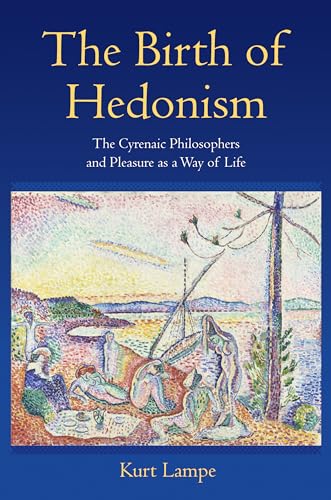
The Birth of Hedonism by Kurt Lampe
According to Xenophon, Socrates tried to persuade his associate Aristippus to moderate his excessive indulgence in wine, women, and food, arguing that only hard work can bring happiness. Aristippus wasn't convinced. Instead, he and his followers espoused the most radical form of hedonism in ancient Western philosophy. Before the rise of the better known but comparatively ascetic Epicureans, the Cyrenaics pursued a way of life in which moments of pleasure, particularly bodily pleasure, held the highest value. In The Birth of Hedonism, Kurt Lampe provides the most comprehensive account in any language of Cyrenaic ideas and behavior, revolutionizing the understanding of this neglected but important school of philosophy. The Birth of Hedonism thoroughly and sympathetically reconstructs the doctrines and practices of the Cyrenaics, who were active between the fourth and third centuries BCE. The book examines not only Aristippus and the mainstream Cyrenaics, but also Hegesias, Anniceris, and Theodorus. Contrary to recent scholarship, the book shows that the Cyrenaics, despite giving primary value to discrete pleasurable experiences, accepted the dominant Greek philosophical belief that life-long happiness and the virtues that sustain it are the principal concerns of ethics. The book also offers the first in-depth effort to understand Theodorus's atheism and Hegesias's pessimism, both of which are extremely unusual in ancient Greek philosophy and which raise the interesting question of hedonism's relationship to pessimism and atheism. Finally, the book explores the "new Cyrenaicism" of the nineteenth-century writer and classicist Walter Pater, who drew out the enduring philosophical interest of Cyrenaic hedonism more than any other modern thinker.
"This fine book is the most comprehensive study of Cyrenaic hedonism in EnglishIt will be the core resource on the Cyrenaics for anyone with a serious interest in ancient ethics. More than that, it ensures that the Cyrenaics (at last) have a place alongside the other great ancient philosophical schools, and it is a model for scholarship to affirm the continuing appeal and relevance of ancient philosophy."--Sean McConnell, Classical Journal
Kurt Lampe is a lecturer in the Department of Classics and Ancient History at the University of Bristol.
| SKU | Unavailable |
| ISBN 13 | 9780691161136 |
| ISBN 10 | 0691161135 |
| Title | The Birth of Hedonism |
| Author | Kurt Lampe |
| Condition | Unavailable |
| Publisher | Princeton University Press |
| Year published | 2014-10-26 |
| Number of pages | 304 |
| Cover note | Book picture is for illustrative purposes only, actual binding, cover or edition may vary. |
| Note | Unavailable |