


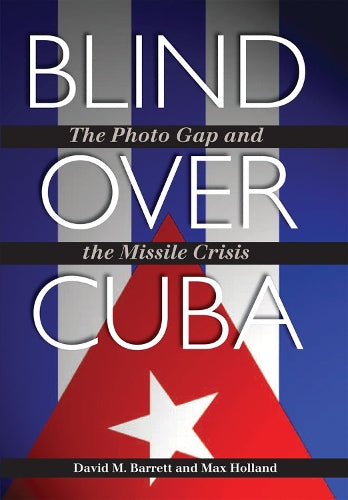
Blind Over Cuba by David M Barrett
In the aftermath of the Cuban Missile Crisis, questions persisted about how the potential cataclysm had been allowed to develop. A subsequent congressional investigation focused on what came to be known as the “photo gap”: five weeks during which intelligence-gathering flights over Cuba had been attenuated. In Blind over Cuba, David M. Barrett and Max Holland challenge the popular perception of the Kennedy administration’s handling of the Soviet Union’s surreptitious deployment of missiles in the Western Hemisphere. Rather than epitomizing it as a masterpiece of crisis management by policy makers and the administration, Barrett and Holland make the case that the affair was, in fact, a close call stemming directly from decisions made in a climate of deep distrust between key administration officials and the intelligence community. Because of White House and State Department fears of “another U-2 incident” (the infamous 1960 Soviet downing of an American U-2 spy plane), the CIA was not permitted to send surveillance aircraft on prolonged flights over Cuban airspace for many weeks, from late August through early October. Events proved that this was precisely the time when the Soviets were secretly deploying missiles in Cuba. When Director of Central Intelligence John McCone forcefully pointed out that this decision had led to a dangerous void in intelligence collection, the president authorized one U-2 flight directly over western Cuba—thereby averting disaster, as the surveillance detected the Soviet missiles shortly before they became operational. The Kennedy administration recognized that their failure to gather intelligence was politically explosive, and their subsequent efforts to influence the perception of events form the focus for this study. Using recently declassified documents, secondary materials, and interviews with several key participants, Barrett and Holland weave a story of intra-agency conflict, suspicion, and discord that undermined intelligence-gathering, adversely affected internal postmortems conducted after the crisis peaked, and resulted in keeping Congress and the public in the dark about what really happened. Fifty years after the crisis that brought the superpowers to the brink, Blind over Cuba: The Photo Gap and the Missile Crisis offers a new chapter in our understanding of that pivotal event, the tensions inside the US government during the cold war, and the obstacles Congress faces when conducting an investigation of the executive branch.
"Anyone interested in the Cold War, the Kennedy Administration, intelligence, or the Congress will want a copy of this fascinating book"--Loch K. Johnson, editor, Intelligence and National Security, and author, National Security Intelligence (Polity, 2012)
|"Anyone interested in the Cold War, the Kennedy Administration, intelligence, or the Congress will want a copy of this fascinating book."--Loch K. Johnson, editor, Intelligence and National Security, and author, National Security Intelligence (Polity, 2012)
|"Anyone interested in the Cold War, the Kennedy Administration, intelligence, or the Congress will want a copy of this fascinating book."--Loch K. Johnson, editor of the journal Intelligence and National Security, and author of National Security Intelligence (Polity, 2012)
|"Anyone interested in the Cold War, the Kennedy Administration, intelligence, or the Congress will want a copy of this fascinating book."--Loch K. Johnson, editor, Intelligence and National Security, and author, National Security Intelligence (Polity, 2012)
|"Anyone interested in the Cold War, the Kennedy Administration, intelligence, or the Congress will want a copy of this fascinating book."--Loch K. Johnson, editor of the journal Intelligence and National Security, and author of National Security Intelligence (Polity, 2012)
DAVID M. BARRETT, a professor of political science at Villanova University, is the editor of Lyndon B. Johnson’s Vietnam Papers: A Documentary Collection (Texas A&M University Press, 1997) and the author of The CIA and Congress: The Untold Story from Truman to Kennedy (University Press of Kansas, 2005).MAX HOLLAND is the editor of Washington Decoded, an independent, online monthly magazine. He also serves on the editorial board of the International Journal of Intelligence and CounterIntelligence and is a contributing editor for Wilson Quarterly and The Nation. He previously served for five years as a research fellow at the University of Virginia’s Miller Center of Public Affairs.
| SKU | Unavailable |
| ISBN 13 | 9781603447683 |
| ISBN 10 | 1603447687 |
| Title | Blind Over Cuba |
| Author | David M Barrett |
| Series | Foreign Relations And The Presidency Ser |
| Condition | Unavailable |
| Binding Type | Hardback |
| Publisher | Texas A & M University Press |
| Year published | 2012-12-30 |
| Number of pages | 240 |
| Cover note | Book picture is for illustrative purposes only, actual binding, cover or edition may vary. |
| Note | Unavailable |