


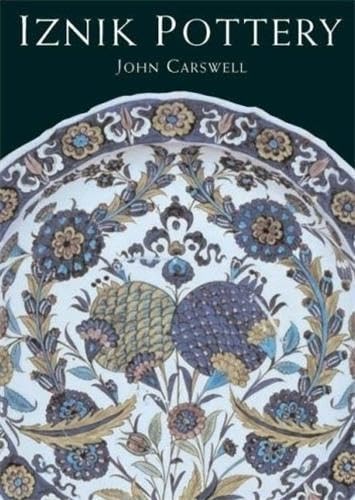

Iznik Pottery by John Carswell
The Turkish pottery at Iznik, ancient Nicaea, supplied the Ottoman court with luxurious vessels and splendid tiles to decorate newly founded palaces, mosques and other buildings. One of the great glories of Ottoman art at its peak period, the designs combine purely Turkish motifs with elements ingeniously transposed from imported Chinese blue-and-white porcelain. Over time, a subtle and complex palette was introduced, of cobalt blue, turquoise, olive green, magenta and grey. During the second half of the sixteenth century, the brilliant combination of blue, viridian, turquoise and a relief red resembling sealing-wax was introduced, not only for pottery by also for tiles such as the great series that line the interior of the mosque of Rustem Pasha, Grand Vizier of Sultan Suleyman the Magnificent, in Istanbul. Iznik pottery was much prized outside the Ottoman empire, and many examples have English and European seventeenth-century silver-gilt mounts. Although the Iznik factories passed their peak in the late seventeenth century, their influence lived on in nineteenth-century European imitations by such potters as William De Morgan and Cantagalli. Most of the examples illustrated are drawn from the British Museum, acknowledged to have the greatest collection of Iznik in the world, including the famous Godman Bequest.| SKU | Unavailable |
| ISBN 13 | |
| ISBN 10 | |
| Title | Iznik Pottery |
| Author | John Carswell |
| Series | |
| Condition | Unavailable |
| Binding Type | |
| Publisher | |
| Year published | |
| Number of pages | |
| Cover note | Book picture is for illustrative purposes only, actual binding, cover or edition may vary. |
| Note | Unavailable |
View All Editions
Filter
Applied Filters (0)
Sort by:
Loading editions...